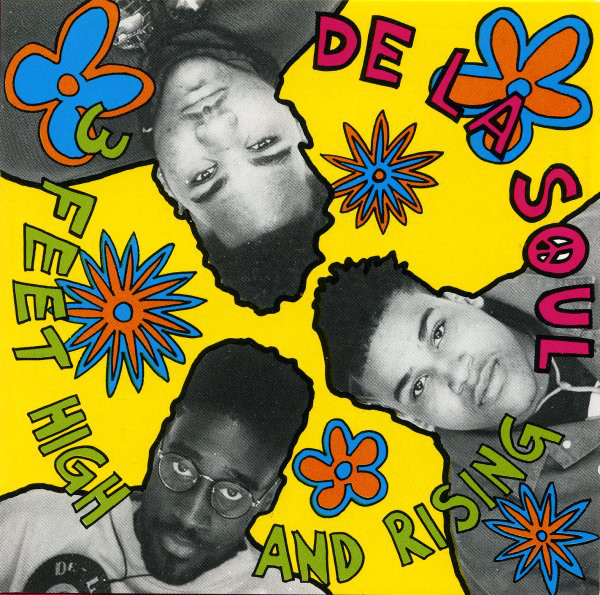
Twenty-four tracks in 67 minutes. Recorded across eighteen months at Calliope Studios in Manhattan with Prince Paul producing. Roughly 70 uncleared samples spanning Steely Dan, the Turtles, Hall & Oates, Liberace, and a 1980s French-language lesson record. The album that proved hip-hop could be a sustained playful art-pop statement at the highest commercial register, and the last great sample-collage record produced before the Grand Upright ruling made its specific approach commercially impossible.
- Released
- March 14, 1989
- Label
- Tommy Boy Records (TBLP-1019, distributed by Warner Bros.)
- Producer(s)
- Prince Paul (primary) · De La Soul (executive)
- Runtime
- 67:25 (24 tracks including skits and interludes)
- Chart peak (US)
- #24 (Billboard 200); #1 (Billboard R&B Albums)
- Chart peak (UK)
- #13 (UK Albums Chart)
- Certifications
- Platinum (RIAA, June 1989); 2× Platinum (BPI, 1989)
- Awards & honours
- Ranked #103 on Rolling Stone's 500 Greatest Albums (2020); Library of Congress National Recording Registry (2010); Source Five Mic rating (1989); Best New Artist Grammy nomination (1990)
Twenty-four tracks in 67 minutes. Recorded across eighteen months at Calliope Studios in Manhattan with Prince Paul producing. Roughly seventy uncleared samples spanning Steely Dan, the Turtles, Hall & Oates, Liberace, French-language teaching records, and Schoolhouse Rock. The album that proved hip-hop could be a sustained playful art-pop statement at the highest commercial register, and the last great sample-collage record made before the 1991 Grand Upright ruling and the resulting Turtles lawsuit forced post-clearance sample economics into existence.
De La Soul in 1988 was three teenagers from Amityville, Long Island: Kelvin Mercer (Posdnuos / Plug 1), David Jolicoeur (Trugoy the Dove / Plug 2), and Vincent Mason (Maseo / Plug 3). They had met at Amityville Memorial High School in 1985 and had been making demos in Maseo's basement on a four-track since the spring of 1986. Their producer, Stetsasonic DJ Paul Huston (Prince Paul), had heard one of those demos through a Long Island contact in autumn 1987 and had brought the demos to Tom Silverman's Tommy Boy Records, an independent label that had been releasing Afrika Bambaataa records since 1981. Silverman signed the group in November 1987 to a £25,000 advance on a one-album deal.
Recording began at Calliope Studios, a modest 16-track facility on West 37th Street in Manhattan, in February 1988 and ran sporadically through August of that year. Prince Paul's working method was specific: he had been collecting samples on cassettes for two years and had brought roughly 200 distinct source recordings into the sessions. He would sit at the SP-1200 sampler chopping breaks while the three rappers wrote verses in the live room. The group's sample selections, Schoolhouse Rock cartoons, Liberace piano, Hall & Oates blue-eyed soul, Steely Dan, the Turtles, a 1970s French-language record bought for £2 at a Brooklyn flea market, were deliberately heterogeneous in a way no previous hip-hop album had attempted. Public Enemy's Bomb Squad had been layering samples in sixteen-track configurations; Prince Paul's approach was different in kind, treating each sample as a distinct quotable cultural reference rather than a sound-texture component.
The album's twenty-four tracks include nine extended skits and interludes that were not, at the time, what mainstream hip-hop albums included. Prince Paul had structured the record as a televised game show, the Intro is a game-show host setting up the album; subsequent skits return to that frame intermittently. The conceit was not an obvious commercial play; Tommy Boy's marketing team had argued against the inclusion of so many non-song tracks. The decision to keep them in was Prince Paul's and the group's; the structure became the album's most-imitated architectural feature. Every subsequent hip-hop album built around skit-as-album-architecture, Snoop Dogg's Doggystyle, Wu-Tang's 36 Chambers, every Kanye West LP, traces directly to the 3 Feet High and Rising template.
The samples were entirely uncleared. The era's sample-clearance norms were informal; most Tommy Boy releases of the period (Bambaataa, Stetsasonic, Queen Latifah) used uncleared samples as a matter of course. The album shipped in March 1989 with roughly seventy distinct uncleared sources. Within eighteen months, the legal landscape had changed twice: Grand Upright Music v. Warner Bros. (December 1991) established that uncleared samples were copyright infringement; the Turtles' subsequent lawsuit against De La Soul over the 'Transmitting Live from Mars' use of 'You Showed Me' (filed March 1991, settled August 1991 for ~£1.7 million) made De La Soul the test case for the new economics.
Singles drove the album's commercial path. 'Me Myself and I' (released January 1989 as the album's lead single) was the breakout, the Funkadelic '(Not Just) Knee Deep' sample, Posdnuos's autobiographical verses about 'just being De La,' and the MTV video that put the group's anti-glamour visual presentation in front of a wider audience than hip-hop singles typically reached in 1989. The song peaked at US #34 pop, US #1 R&B, and UK #22. 'Eye Know' (April 1989) was the album's second-most-played single, the Steely Dan 'Peg' chorus and the Otis Redding whistle were both unfamiliar to hip-hop audiences and instantly recognizable to older listeners; the resulting cross-generational reach was unusual for the period. 'Say No Go' and 'Buddy' followed in autumn and winter 1989, both top-40 R&B singles.
The album peaked at US #24 on the Billboard 200 (and #1 on R&B) and at UK #13. By June 1989, 10 weeks after release, it'd been certified Platinum by the RIAA. By the end of 1989, it'd been named album of the year by The Village Voice's annual Pazz & Jop poll; Robert Christgau ranked it #1, ahead of Neil Young's Freedom and the Cure's Disintegration. The album sold approximately 1.5 million copies in its first eighteen months. The Turtles settlement in August 1991 consumed most of the next-LP advance the group had been working against; the second LP (De La Soul Is Dead, 1991) was both an artistic statement about being trapped by the daisy-age image and a commercial response to the sample-economics catastrophe.
The album's catalogue trajectory was distorted for two decades by sample clearance. By the late 1990s, Tommy Boy had been unable to renew sample licenses for several album tracks; the digital catalogue (iTunes, Spotify) did not carry the album in any complete form from approximately 2000 to 2019. The original 1989 vinyl pressing went out of print in 1996 and did not return to print until a 2014 Tommy Boy reissue that itself had partial sample-clearance issues. The full digital availability of the album (Spotify and Apple Music) was restored in March 2023, thirty-four years after release, following an agreement between De La Soul and Reservoir Media (which had acquired the Tommy Boy catalogue from Tom Silverman in 2021). Trugoy the Dove (David Jolicoeur) died of congestive heart failure in February 2023, 4 weeks before the streaming restoration. The agreement and his death are the album's specific cultural moment of 2023.
3 Feet High and Rising belongs at #53 because it is the album that proved hip-hop could be a sustained playful art-pop statement at the highest commercial register and the founding text of the Native Tongues collective (De La Soul, A Tribe Called Quest, Jungle Brothers, Black Sheep, Queen Latifah) that defined East Coast hip-hop's alternative-to-gangsta-rap path through the early 1990s. The album's sample-density production approach was made commercially impossible within three years of release; 3 Feet High is therefore the most extreme document of an aesthetic the law shortly abolished. The skit-as-album-architecture move it established has been canonical in hip-hop for thirty-five years. The album's specific contribution, that hip-hop could be heterogeneous, playful, art-pop, and platinum at the same time, has been argued out in every subsequent generation.
Pressing guide — the one to own
Original 1989 US first pressing, Tommy Boy, single sleeve with the multicoloured hand-drawn daisy 'D.A.I.S.Y. Age' cover (art by Grey Organisation) and a printed paper inner with cartoon and credits. Note the catalogue number differs by location: spine reads TBLP 1019, labels read TB 1019. It was a Direct Metal Mastering (DMM) cut, confirmed by the '-DMM' in the deadwax alongside Specialty (SP) metalwork codes and an embossed letter on the B-side label; there is no Tom Coyne or Frankford/Wayne credit, so disregard any 'FW' signature. The famous unavailability was the post-1996 streaming/sample-clearance blackout (resolved 2023), not the vinyl. Clean originals trade around £60-£120.