On December 9, 1964, four men walked into a New Jersey studio with a single sheet of paper on which John Coltrane had sketched a four-movement suite. They left 33 minutes later having made one of the few records in any genre that everyone agrees is a prayer.
- Released
- February 1965
- Label
- Impulse! / ABC
- Producer(s)
- Bob Thiele · Engineer: Rudy Van Gelder
- Runtime
- 33:02 (four movements)
- Chart peak (US)
- #83 (Billboard 200) · #1 (Cash Box Jazz, 8 weeks)
- Chart peak (UK)
- Did not chart (album market)
- Certifications
- Gold (RIAA, 2001); estimated 1.4M units worldwide, the best-selling Coltrane album by a wide margin
- Awards & honours
- Grammy Hall of Fame (1989); Library of Congress National Recording Registry (2003); Down Beat Hall of Fame for the album (2000); NEA Jazz Masters posthumous award context; ranked #1 on most all-time-jazz polls since 1980
Coltrane had been off heroin for seven years. He had been off alcohol for one. He had made eight studio LPs as a leader for Impulse! in the previous twenty-six months. And he had begun to feel that he had not yet made the record his career was actually for.
John Coltrane was thirty-eight years old. He had recovered from heroin addiction in 1957, had stopped drinking in 1963, had been married to Naima for nine years and was about to leave her for Alice McLeod (whom he would marry the following year), and had been leading what most listeners agreed was the most adventurous quartet in jazz since 1961. McCoy Tyner, twenty-six, was the pianist. Jimmy Garrison, thirty, was the bassist. Elvin Jones, thirty-seven, was the drummer. The four men had been working together almost daily for nearly four years and had reached a level of telepathy that jazz historians since have struggled to describe without resorting to religious vocabulary.
By the summer of 1964, Coltrane had begun to tell his wife and his bandmates that he wanted to record something that would express what he had survived. He had had a 'spiritual awakening' in 1957, his own term, used repeatedly in interviews, and felt, after seven years, ready to thank, in music, whatever it was he believed had pulled him out of addiction. He had been reading the Bhagavad Gita, Sufi mystical texts, Krishnamurti, and a book his mother had given him called The Self-Realization Fellowship Magazine. He spoke of his recovery as a debt owed. The album he wanted to make was the payment.
The session was on December 9, 1964, at Rudy Van Gelder's studio in Englewood Cliffs, New Jersey, a converted single-story house with a high cathedral ceiling that Van Gelder had been refining as a recording space since 1959. The session lasted 6 hours. The four-movement suite, Acknowledgement, Resolution, Pursuance, Psalm, was completed in a single afternoon. What Coltrane handed each musician was a sheet of paper with a few chord changes, a tempo direction, and the suite's titles. The rest was decided in the room. McCoy Tyner has said the quartet didn't rehearse the album beforehand; Jimmy Garrison has said the band rehearsed it once, the day before. The accounts differ on detail. They agree that the session produced almost everything on the released album in first takes.
Acknowledgement, the opening seventeen-minute statement, is built on a four-note bass figure that Garrison plays almost continuously for the entire movement. Coltrane improvises on top of it for 15 minutes, then chants the words 'A love supreme, a love supreme, a love supreme, a love supreme' in a tenor voice, overdubbed three times, the only overdub on the entire record, into the fadeout. The four-note phrase is the album's signature. Tyner's modal vamp under Coltrane's solo runs longer than the average jazz performance on a single chord change in 1964. Elvin Jones is everywhere, riding the cymbals, dropping bombs, holding the time the way only Elvin held time.
Resolution, the second movement, is Coltrane's most singable melody of the period, a 32-bar piece with a clear AABA structure that the quartet then dismantles. Coltrane plays the head twice, Tyner takes a solo of nearly 5 minutes, Coltrane returns, and the band locks into a series of escalating exchanges that are, by the standards of 1964 jazz, both rigorously structured and improvisationally free. Pursuance, the third movement, opens with Elvin Jones alone, a thirty-second drum solo that is the most-quoted drum break in modern jazz, before the band enters at a sprint and runs for 10 minutes. It is the fastest, most aggressive playing on the album.
Psalm, the closing movement, is the album's most radical structural choice. Coltrane composed a poem during the months leading up to the session, a thirty-two-line prayer of thanks, printed in full on the back cover of the LP, and on Psalm he 'plays' the poem. There are no chord changes. There is no tempo. There is no melody as conventionally defined. What Coltrane does is play each syllable of the poem on his saxophone, the rhythm of his phrasing matching the rhythm of the words as he wrote them. The result is not 'free' jazz in the Ornette Coleman sense; it is structured but the structure is linguistic rather than harmonic. Garrison's bowed bass holds a drone behind him. Tyner plays gentle chords. Elvin Jones plays mallets on cymbals. It is the quietest piece of music on any Coltrane album and the most argued-over.
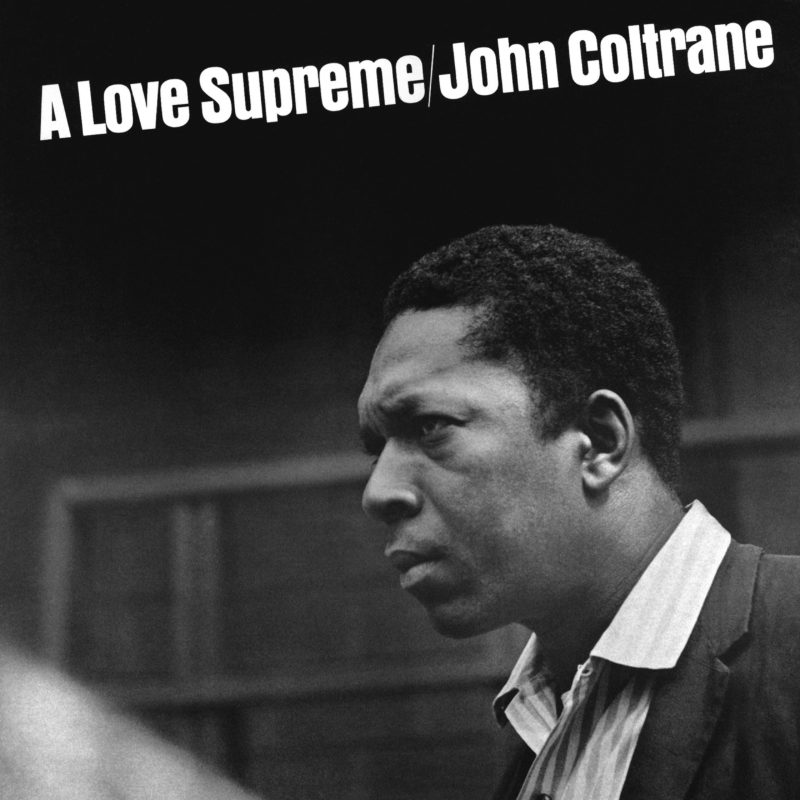
Impulse! released the album with no edit and no fade-in beyond the natural rise of Garrison's bass at the opening. The sleeve had a black-and-white photograph of Coltrane in profile by Bob Thiele, the album's producer. The back cover printed the poem in full and a brief note from Coltrane: 'This album is a humble offering to Him. An attempt to say THANK YOU GOD through our work, even as we are aware of our shortcomings. May He help and strengthen all men in every good endeavor.' It is one of the very few liner notes by a jazz musician in the modern era that reads as a religious statement rather than as marketing copy or a discographer's note.
A Love Supreme belongs at #10 because it is the rare jazz record that operates as a complete utterance, a single thirty-three-minute statement whose parts you don't separate, and because the statement is not jazz history's most-attempted (a romantic ballad, a swing standard, a blues) but rather the form of religious music. There are not many records in any genre that the religious and the secular both claim. This is one of them. The album opened the door to a category that did not formally exist before it, 'spiritual jazz', and that category has run continuously since: Pharoah Sanders's Karma, Alice Coltrane's Journey in Satchidananda, Don Cherry's Brown Rice, Kamasi Washington's The Epic, every artist who has tried to write a record about something larger than themselves and has felt they needed permission to do it. Coltrane gave the permission. The album was the document of having given it.
Pressing guide — the one to own
Original 1965 Impulse! first pressing, AS-77 (stereo) or A-77 (mono), on the orange-and-black gatefold label, with Rudy Van Gelder's 'RVG' hand-etched in the deadwax. The gatefold sleeve and Van Gelder's mastering are the key authenticity markers. Both mono and stereo originals are collectible; the stereo typically carries a modest premium because the spatial separation of the quartet adds to the listening experience. Confirm 'RVG' in the runout and the Impulse! orange-and-black labels to verify an early copy.