
№ 14 of 100
Abbey Road
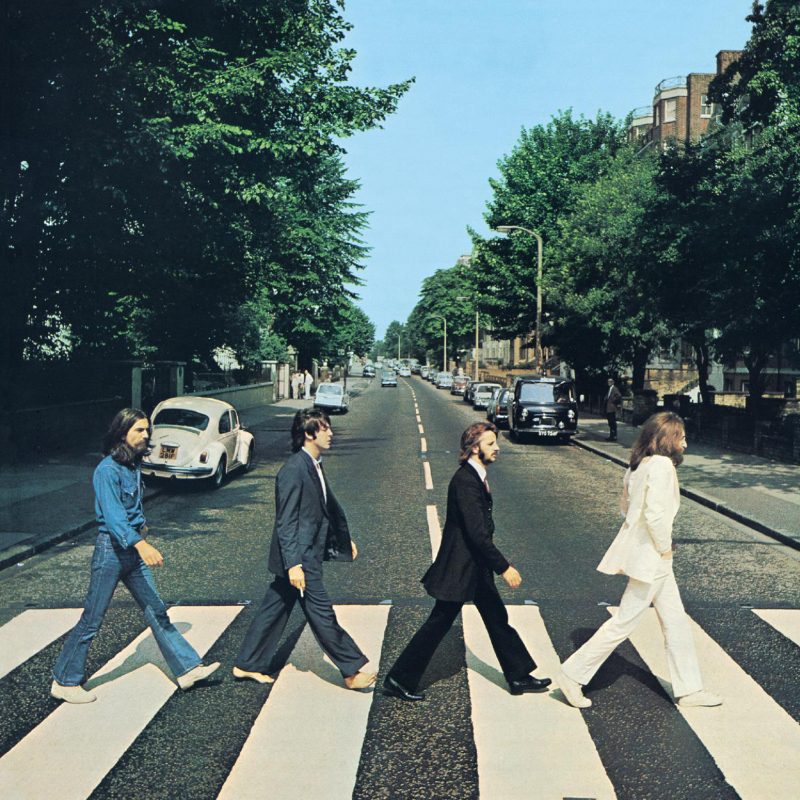
Abbey Road by The Beatles (1969), № 14 in The Lead-In’s 100 greatest albums. The last Beatles album they actually finished as a band. Side two's medley invents the technique every concept-record closer has used since.
Abbey Road by The Beatles (1969), № 14 in The Lead-In’s 100 greatest albums. The last Beatles album they actually finished as a band. Side two's medley invents the technique every concept-record closer has used since.
The last album the Beatles ever recorded. 8 weeks at Abbey Road in summer 1969, with the four of them barely speaking outside the studio, producing a sixteen-minute medley on side two that became the most-imitated farewell in pop, and a cover photograph that became the most-walked zebra crossing in the world.
By the time they walked into Studio Three on July 1, 1969, the Beatles had been openly breaking up for six months. The Get Back / Let It Be sessions earlier in the year had gone so badly the tapes were being held in a vault until a producer could be found to make something of them. Abbey Road was a deliberate, end-of-affair attempt to make one more album where they sounded like a band.
The Beatles in early 1969 weren't the Beatles of 1966. The acrimony of the White Album sessions had culminated in the January 1969 Get Back / Let It Be sessions at Twickenham Film Studios, recorded on cold soundstages under harsh lights for a documentary that was supposed to capture them as a band rehearsing toward a return-to-live-performance climax. The sessions had been a disaster. Harrison walked out twice. McCartney was overbearing. Lennon was distracted and increasingly absent. Ringo had threatened to quit during the White Album the previous year. By March 1969 the Get Back tapes were stalled, the documentary unfinished, and the four weren't speaking to each other except through their managers and lawyers in the increasingly bitter Apple Records litigation.
McCartney was the one who proposed they make one more record. He had been talking to George Martin about it. Martin had told him he would only produce it if the four came in committed to making a proper Beatles album rather than four solo records sharing studio time. McCartney agreed. He went to each of the others, separately, through April and May 1969, and obtained the same agreement. They would come back to Abbey Road. They would make one more album the way they had made Revolver and Sgt. Pepper. They would let George Martin be the producer.
The sessions began on July 1, 1969. Martin had insisted on Studio Three (rather than the larger Studio Two they had used for most of their career) because it was a more intimate room. The Beatles arrived knowing this would be the end. None of them said so out loud. They had each, by July, begun planning the post-Beatles careers they would launch within the year, Lennon's Plastic Ono Band, McCartney's solo McCartney album, Harrison's All Things Must Pass, Ringo's Sentimental Journey. The Abbey Road sessions ran for 8 weeks. They were the most productive 8 weeks the band ever spent. The records they were making outside the building were nothing compared to what they made inside it.
The album they delivered is the last great Beatles album, and the only Beatles album recorded with the band knowing it was the last. Every track on Abbey Road sounds like the band trying, for the last time, to be the band. Side one is a collection: Harrison's 'Something' (the second-most-covered Beatles song after 'Yesterday'); Lennon's 'Come Together' (the album's opener, with one of the most-imitated bass figures in pop); McCartney's 'Maxwell's Silver Hammer' (which Lennon refused to play on and which the band fought about for weeks); Ringo's 'Octopus's Garden' (his second self-composed Beatles song); McCartney's 'Oh! Darling' (which McCartney sang for a week trying to perfect the lead vocal). Side two is the medley, 16 minutes of song fragments stitched into a continuous suite, the most-imitated formal device in pop after the Beatles invented it on this album.
The medley was McCartney's idea, with Martin's enthusiastic support. They had a backlog of song fragments, bits of songs the band had been working on through 1968 and 1969 that had not become full songs, and rather than discard them, McCartney proposed stitching them together. 'You Never Give Me Your Money' segues into 'Sun King,' which segues into 'Mean Mr. Mustard,' which segues into 'Polythene Pam,' which segues into 'She Came in Through the Bathroom Window,' which segues into 'Golden Slumbers,' which segues into 'Carry That Weight,' which segues into 'The End.' Eight song fragments, 16 minutes, no breaks. The medley closes with the lyric McCartney had been holding for the band's farewell, 'And in the end, the love you take is equal to the love you make', followed by a hidden track ('Her Majesty,' 23 seconds, a McCartney throwaway about Queen Elizabeth II that was originally supposed to be cut and was reinserted by accident).
What the album argues is that the Beatles, even in collapse, could make a more coherent record than most bands could make at their peak. The instrumental playing is the band's most refined; Ringo's drum performance on side two (he soloed for the first and only time on a Beatles record, on 'The End') is the most-cited drum performance in pop. Harrison's two contributions, 'Something' and 'Here Comes the Sun', are not just his best Beatles songs; they are arguably the best songs on the album. Lennon's 'Because' is a three-part harmony piece based on a Beethoven 'Moonlight Sonata' chord progression Yoko Ono had played to him backwards; the Lennon-McCartney-Harrison vocal stack on 'Because' is among the most-quoted harmony arrangements in pop. McCartney is everywhere, bass, piano, harmony vocals, the structural architect of side two. The four are still, somehow, listening to each other.
The album was released on September 26, 1969. It debuted at #1 in the UK on October 4 and held the position for 17 weeks; in the US it took longer to climb (it hit #1 on November 1) and held for 11 weeks. Both runs were the longest of any Beatles album. Reviews were initially mixed, some critics found the medley to be a sign of the band's inability to write full songs anymore, others praised it as a brilliant formal innovation. Within a year the consensus had settled: it was a masterpiece. The band announced their breakup, privately to each other in September 1969 (Lennon told the others he was leaving during a meeting at Apple), publicly in April 1970 (when McCartney announced his solo album). The album that had been their farewell became the last full statement of what they'd been.
Abbey Road belongs at #14 on this list because it is the most cohesive and most-played Beatles album of the late period, and because it represents a formal innovation, the long-form medley, that has been imitated for fifty-six years. Of the three Beatles albums on this list, Revolver (at 3) sits above it and Sgt. Pepper (at 18) below it; Revolver and Sgt. Pepper each represent a different invention, while Abbey Road is the band's most refined execution of techniques they had developed elsewhere. The reason it isn't higher is that the thirteen albums above it have a slightly tighter argument about a single thesis; Abbey Road is more diffuse, more concerned with showcasing what each band member can do, less unified than Revolver. But it is the last great album by the band that made the modern recording era possible, and the medley alone is one of the great formal achievements in pop. Every album-as-suite from 1970 forward owes Abbey Road the architecture.
Original 1969 UK pressing, Apple PCS 7088, in a single (non-gatefold) sleeve with the Iain Macmillan zebra-crossing cover and the green 'granny smith' Apple label. 'Her Majesty' is unlisted on the earliest sleeves, added to the printed listing only on later issues. First-state copies carry low-number Apple/EMI runout stampers in the YEX 749 / YEX 750 family rather than a 'PCS 7088' matrix. Look also for the 'Sold in U.K.' rights statement and correct early label typography.
© The Lead-In · an independent, reader-supported music publication.