
№ 45 of 100
Achtung Baby
Achtung Baby by U2 (1991), № 45 in The Lead-In’s 100 greatest albums. U2 break their own sound on purpose. The Edge plugs into Eno's TR-808 and the band re-invents itself as a Berlin disco group with an Irish accent.
Achtung Baby by U2 (1991), № 45 in The Lead-In’s 100 greatest albums. U2 break their own sound on purpose. The Edge plugs into Eno's TR-808 and the band re-invents itself as a Berlin disco group with an Irish accent.
U2's reinvention. Recorded at Hansa Studios Berlin (the same room that produced Bowie's Low) over 1990-1991. Released November 19, 1991.
Twelve months at Hansa Studios in Berlin and at the band's STS Studios in Dublin with Brian Eno and Daniel Lanois co-producing. Twelve tracks across 55 minutes. The album that U2 deliberately used to destroy and remake themselves after the post-Joshua Tree backlash, the album that established the irony-and-persona mode that would define their 1990s work, and the album that produced 'One', widely considered the band's best single song.
The Joshua Tree (March 1987) had been U2's commercial and critical peak. Rattle and Hum (October 1988), a hybrid documentary/album that paired Joshua Tree material with US blues, gospel, and rock-history references, had been substantially less well received. The 1988 album's deliberate American-roots earnestness was widely criticized; reviewers in the UK and Europe particularly accused U2 of pretentiousness and self-importance. By spring 1990 the band was forty years old (in the sense that they'd been together for thirteen years), commercially huge but artistically vulnerable, and aware that the Joshua Tree-Rattle and Hum mode couldn't be sustained without commercial and critical decline. The Edge proposed a deliberate creative reset: record in Berlin, drop the American-roots material, embrace electronic textures, ironic personas, and the deliberately European art-rock vocabulary that the band had been resisting since the early 1980s.
Recording began at Hansa Studios in Berlin in October 1990, 6 weeks after German reunification on October 3. The studio, Bowie's Berlin Trilogy site (Low, Heroes, Lodger), located in former West Berlin's Schöneberg district just a few hundred meters from the Berlin Wall site, had been the band's specific symbolic choice. Brian Eno (who had been instrumental in the Bowie Berlin work) was re-engaged as co-producer with Daniel Lanois. Mark 'Flood' Ellis joined as engineer. The sessions were notoriously difficult: The Edge's marriage to Aislinn O'Sullivan was collapsing during recording; the band experienced multiple severe creative disagreements; Lanois later described the Berlin sessions as the worst of his career; Eno arrived later than originally planned to mediate. The band considered breaking up multiple times during the autumn 1990 Berlin sessions.
'One' was the breakthrough. The song was recorded in autumn 1990 at Hansa during the worst of the sessions' internal tensions. Multiple band members have said in subsequent interviews that 'One' was the song that prevented the band's dissolution; its specific emotional weight, written by Bono partly in response to The Edge's marital collapse, gave the band a reason to continue. The song was tracked relatively quickly compared to the album's other tracks, approximately three days of work in October 1990, but the chord progression and central melody had been demoed by The Edge in summer 1990 and held back for the right moment. The released version uses Bono's vocal (recorded in one take during the third day of work on the song), The Edge's specific arpeggiated guitar pattern, and Adam Clayton's understated bass.
The album's sessions extended through the winter of 1990-91 and into spring 1991. After Berlin, the band relocated to STS Studios in Dublin in February 1991; the recording continued at STS through April. Eno's role expanded during the Dublin sessions; he'd been deliberately itinerant at Hansa but became more present at STS. The deliberate move toward electronic textures (sampling, programmed drums, deliberate processing of guitar and bass) was largely Eno's structural decision. The Edge has said in subsequent interviews that the album's specific sound, the deliberately distorted bass on 'The Fly,' the processed vocals on 'Until the End of the World,' the Mark Ellis (Flood)–style filtered electronic textures, was a deliberate refusal of every Joshua Tree production choice.
The album's twelve tracks operate as deliberate inversions of the Joshua Tree mode. 'Zoo Station' opens with a deliberately industrial-sounding train-and-vocal collage, the title is a reference to the Berlin S-Bahn station near Hansa Studios. 'Even Better Than the Real Thing' is the deliberate ironic-pop track. 'One' is the album's commercial centerpiece. 'Until the End of the World' is the deliberate Wim Wenders-soundtrack track (the song appeared on the soundtrack to Wenders's 1991 film Until the End of the World). 'Who's Gonna Ride Your Wild Horses' is the closest the album gets to a traditional U2 emotional anthem. 'So Cruel' is the album's most explicitly post-marital track. 'The Fly' is the album's first single (reached UK #1 and US #61) and the introduction of Bono's mirrored-sunglasses 'Fly' persona. 'Mysterious Ways' is the dance-pop track. 'Tryin' to Throw Your Arms Around the World' is the lullaby. 'Ultraviolet (Light My Way)' is the slow-build track. 'Acrobat' is the closer's deliberate political-religious meditation. 'Love Is Blindness' is the deliberate album-closing meditation on relationship collapse.
The album was released on November 18, 1991, two months before the dissolution of the Soviet Union on December 26, 1991. Critical response was immediate and substantial; Rolling Stone, the Village Voice, and the NME reviewed the album as a major creative reinvention. Commercial response was strong despite the deliberate sonic shift, Achtung Baby reached US #1 and UK #2, sold 18 million copies worldwide. The Zoo TV Tour (February 1992 through December 1993) was the album's deliberate live extension, multi-screen video walls, satellite-linked phone calls to the White House, Bono in mirrored sunglasses playing 'The Fly' and other personas. Zoo TV is consistently named among the most influential rock tours of the 1990s; Achtung Baby is the album that enabled it.
Achtung Baby belongs at #45 because it is the album that proved U2 could deliberately destroy their own institutional position and remake themselves in public. The Berlin sessions, the marital collapse, the studio fights, the European production aesthetic, all combined to produce a record that explicitly rejected the American-roots earnestness of The Joshua Tree. The band has cited the album as the moment they decided to stay together for the long term; the Edge has said in multiple interviews that without Achtung Baby's risk, U2 would have ended as a 1980s band. The deliberate pivot, done at the height of commercial success and against the audience's expressed preference, became the template for late-career artistic reinvention every major rock band has had to attempt since. The 1991 commercial success ratified the risk; the band has subsequently positioned the album as their best record across multiple interviews. The Zoo TV Tour established the 1990s rock-tour template that subsequent decades wouldn't exceed.
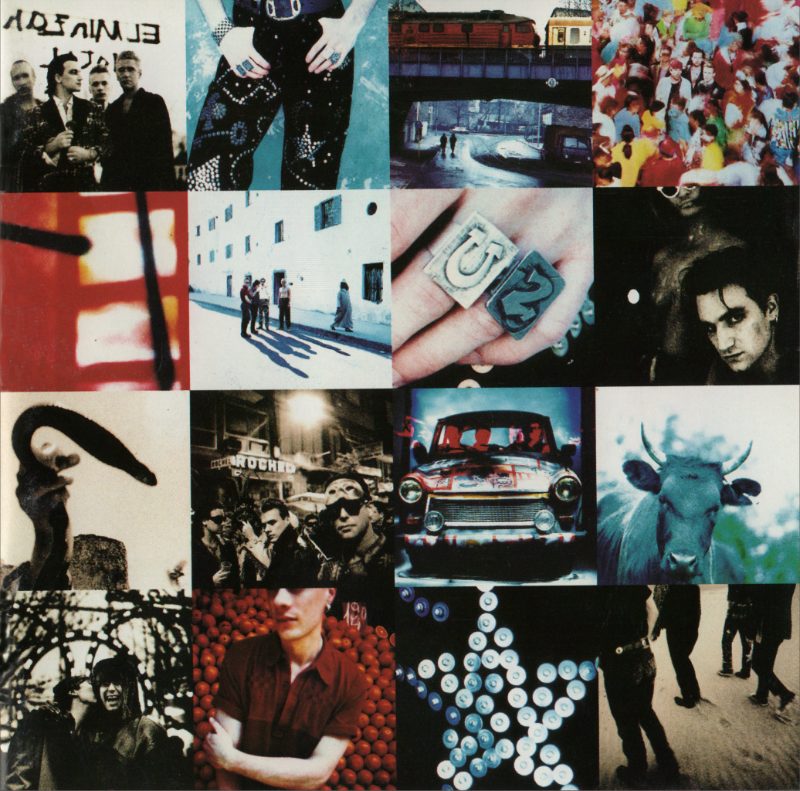
1991 UK first pressing, Island U2 8 with the original Anton Corbijn 16-photograph grid cover (16 different photographs of the four band members arranged in a 4x4 grid on the outer sleeve, each photograph deliberately stylized and partially obscured). Look for the matrix etchings U2 8-A1 / B1, hand-etched at the Townhouse Studios mastering facility by John Dent. The original UK pressings include the gatefold inner with the additional Corbijn photography and the credits printed in deliberately stylized typography that echoes the album's specific design aesthetic.
© The Lead-In · an independent, reader-supported music publication.