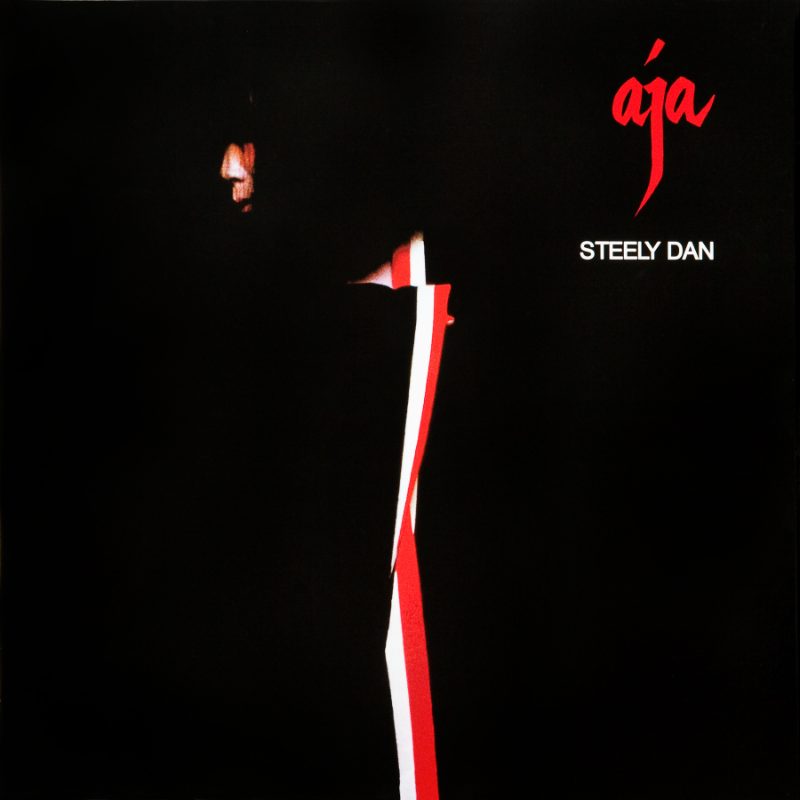
Seven tracks in 40 minutes. Recorded across eight months at six Los Angeles studios with Gary Katz producing and roughly forty session musicians cycling through. Walter Becker and Donald Fagen had stopped touring two years earlier and were treating the recording studio as a laboratory; Aja was the laboratory's masterwork. The album where jazz-rock fusion arrived at major-label commercial pop with no compromise in either direction.
- Released
- September 23, 1977
- Label
- ABC Records (US, AB-1006) · Probe / ABC (UK, AB 1006)
- Producer(s)
- Gary Katz
- Runtime
- 39:54 (7 tracks)
- Chart peak (US)
- #3 (Billboard 200)
- Chart peak (UK)
- #5 (UK Albums Chart)
- Certifications
- 5× Platinum (RIAA, 1993 cumulative); estimated 7M+ units worldwide
- Awards & honours
- Grammy for Best Engineered Recording, Non-Classical (1978, Roger Nichols, Bill Schnee, Elliot Scheiner, Al Schmitt); ranked #145 on Rolling Stone's 500 Greatest Albums (2020); Library of Congress National Recording Registry (2010)
Seven tracks. 40 minutes. Six Los Angeles studios. Forty session musicians. Eight months of recording. Walter Becker and Donald Fagen had stopped touring two years earlier and were treating the recording studio as a laboratory. Aja was the laboratory's masterwork, the album where jazz-rock fusion arrived at major-label commercial pop with no compromise in either direction, and the record that established the studio-as-instrument production approach that twenty years of subsequent pop would imitate.
Steely Dan in 1977 was no longer a band. It was a recording project. Walter Becker and Donald Fagen had retired their touring band after the November 1974 tour for Pretzel Logic; from Katy Lied (1975) onward, Steely Dan was Becker, Fagen, producer Gary Katz, and whichever session musicians their increasingly elaborate compositions required. By the spring of 1977, when sessions for Aja began at ABC Recording Studios in Los Angeles, the working method had crystallized: Becker and Fagen would write a song over weeks or months at Fagen's Encino home, demo it onto cassette with a basic drum pattern and rough vocals, then bring it to Katz, who would book Los Angeles's first-call session musicians for that song's specific personnel. Most tracks went through multiple lineups before settling. Most musicians were paid for sessions where their parts were ultimately replaced.
The sessions ran from January through August 1977 across six studios, ABC Recording Studios was primary, but tracks were also cut at Producer's Workshop, the Village Recorder, Sound Labs, Hollywood Sound Recorders, and Cherokee Studios, depending on which engineering setup the song required. Engineer Roger Nichols ran the desk for most band tracking; Bill Schnee, Elliot Scheiner, and Al Schmitt handled overdubs and mixing. The four would share the Best Engineered Recording Grammy in March 1978. The studio time was extraordinary even for a 1977 major-label rock album: Becker and Fagen would routinely book eight-hour sessions for a single song, then book another 8 hours the following week to track the same song with a different rhythm section if they were not satisfied. The 'Peg' guitar solo alone, Steve Khan's final take, after seven other guitarists had tried, accumulated approximately 40 hours of studio time before the part was set.
The session musician list reads like a Los Angeles studio union directory. Drummers: Steve Gadd ('Aja'), Bernard 'Pretty' Purdie ('Home at Last,' 'Deacon Blues'), Rick Marotta ('Peg'), Jim Keltner ('Josie'), Paul Humphrey ('Black Cow'). Bass: Chuck Rainey on all tracks except 'I Got the News' (Walter Becker himself). Guitar: Larry Carlton, Lee Ritenour, Steve Khan, Denny Dias, Jay Graydon, Walter Becker. Keyboards: Don Grolnick, Joe Sample, Michael Omartian, Victor Feldman, Donald Fagen. Horns: Wayne Shorter, Tom Scott, Pete Christlieb, Plas Johnson, Jim Horn, Lou McCreary. Backing vocals: Michael McDonald, Timothy B. Schmit, Venetta Fields, Sherlie Matthews, Clydie King.
What Becker and Fagen were chasing, and what the album finally delivers, is a sonic register that no rock or jazz record had previously occupied. The chord changes are sophisticated harmonically (eleven of the album's twenty-two distinct chord types are jazz extensions or alterations not heard on conventional pop records of the period) but they are deployed inside pop song structures, with verse-chorus-bridge architecture and three-to-eight-minute runtimes. The lyric voice is sardonic, literate, and steeped in Becker-Fagen's running joke about the Los Angeles they were living in (the cocaine economy, the studio session ecology, the fake spirituality of late-1970s California). The performances are virtuosic but never frenetic. The mix prioritizes clarity over loudness; the dynamic range across the album is approximately 14 dB, almost double what a 1977 mainstream rock album would have delivered.
The album's seven tracks split into two registers. 'Black Cow,' 'Peg,' and 'Josie' are the pop-length cuts (5 minutes and under), built on hooks Becker and Fagen had deliberately designed for FM radio rotation. 'Aja' (seven and a half minutes), 'Deacon Blues' (seven and a half), and 'Home at Last' (five and a half) are the long-form jazz-rock pieces, with extended instrumental sections and solo space. 'I Got the News' sits between the two registers, an up-tempo pop song with an extended bass solo. The sequencing is deliberate: pop-rock opener ('Black Cow'), long-form centerpiece ('Aja'), back into long-form ('Deacon Blues'), pop hit ('Peg'), long-form again ('Home at Last'), up-tempo bridge ('I Got the News'), pop closer ('Josie'). The structure mirrors the structure of a Wayne Shorter or Joe Henderson late-1960s Blue Note record, the album is, in a real sense, a Blue Note record made on ABC Records' budget by white pop musicians using session jazz musicians as their primary collaborators.
ABC released Aja on September 23, 1977 with a substantial promotional push. The album debuted on the Billboard 200 at #38, climbed to #3 within 5 weeks, and remained on the chart for 40 weeks. 'Peg' and 'Deacon Blues' were both top-twenty singles; the title track received heavy album-rock-FM rotation despite its seven-and-a-half-minute length. By March 1978, when the Best Engineered Recording Grammy was announced, the album had sold over a million copies; it would eventually become Steely Dan's commercial peak and the most-played jazz-rock album of the FM era. The cover photograph of Japanese model Sayoko Yamaguchi (taken by Hideki Fujii in Tokyo earlier that year) became one of the most-imitated album sleeves of the late 1970s.
Aja belongs at #52 because it is the album where jazz-rock fusion arrived at major-label commercial pop with no compromise in either direction. Every subsequent album that has tried to combine pop song architecture with jazz harmonic vocabulary, Joni Mitchell's Mingus, Donald Fagen's solo Nightfly, Sting's Dream of the Blue Turtles, Sade's Diamond Life, D'Angelo's Voodoo, Robert Glasper's Black Radio, Vulfpeck, every track on every Cory Wong record, exists in Aja's shadow. The studio-as-instrument production approach (multiple drummers per album, parts swapped between session musicians until the desired register is reached, mixing prioritized over performance) is the template every major pop production studio adopted within five years. The album's sustained audiophile-press circulation has kept it in print continuously since 1977; the 2010 Cisco Music 180g pressing remains, in many high-end record-club listening sessions, the demo record played first.
Pressing guide — the one to own
Original 1977 US first pressing, ABC Records AB-1006, gatefold sleeve with the Hideki Fujii cover photograph of model Sayoko Yamaguchi and a printed inner sleeve. It was mastered by Bernie Grundman at A&M Studios, Hollywood, though his initials are not etched in the deadwax. The genuine first-press marker is the catalogue number: the earliest copies read AB-1006 (about 2 weeks later a price rise made them AA-1006), and the runout carries revision codes such as 'AB 1006 (RE-3)-A' with a plant letter (P=Pitman, T=Terre Haute, S=Santa Maria). A multi-platinum title, so clean originals are common, roughly £50-£120.