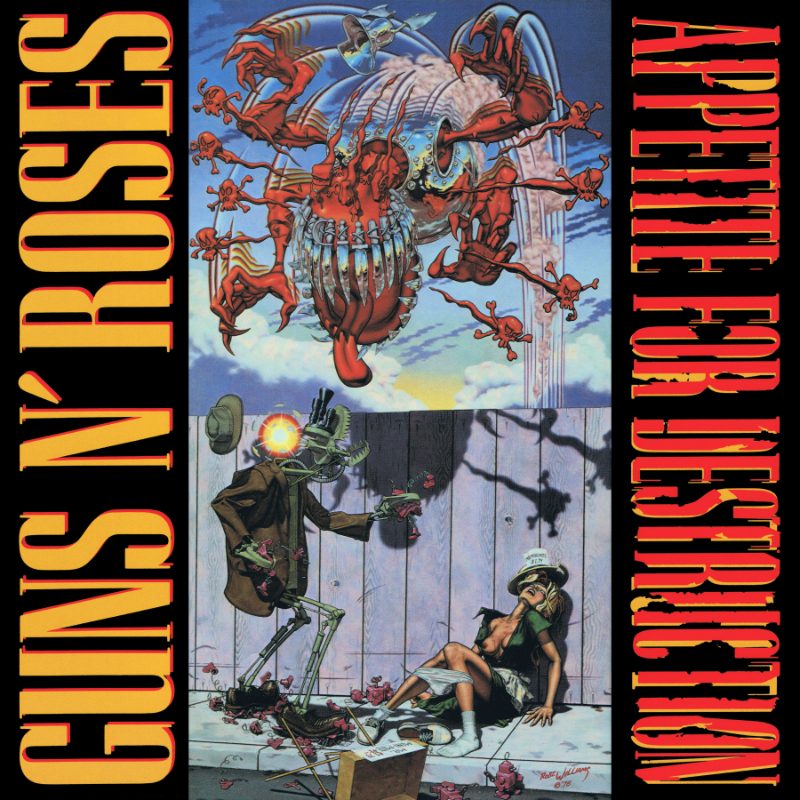
Twelve tracks in 53 minutes. Recorded across roughly three months at Rumbo Recorders in Canoga Park and Take One Studios in Burbank in early 1987 with Mike Clink producing. Guns N' Roses' debut LP, Axl Rose, Slash, Izzy Stradlin, Duff McKagan, Steven Adler, released by Geffen in July 1987 to modest reception before a year-long slow-burn climb to US #1 in August 1988. The album that converted late-1980s LA hard-rock from glam-metal into a dangerous, melodic-pop-hook commercial form.
- Released
- July 21, 1987
- Label
- Geffen Records (US, GHS 24148)
- Producer(s)
- Mike Clink
- Runtime
- 53:31 (12 tracks)
- Chart peak (US)
- #1 (Billboard 200, August 1988)
- Chart peak (UK)
- #5 (UK Albums Chart)
- Certifications
- 18× Platinum (RIAA, 2018); the bestselling debut album in US history
- Awards & honours
- Ranked #62 on Rolling Stone's 500 Greatest Albums (2020); Library of Congress National Recording Registry (2024); MTV Video Music Award Best New Artist (1988)
Twelve tracks in 53 minutes. Recorded across approximately three months at Rumbo Recorders in Canoga Park and Take One Studios in Burbank in early 1987 with Mike Clink producing. Guns N' Roses' debut LP, Axl Rose, Slash, Izzy Stradlin, Duff McKagan, Steven Adler, released by Geffen Records in July 1987 to modest initial commercial reception before a year-long slow-burn climb to US #1 in August 1988. The album that converted late-1980s LA hard-rock from glam-metal commercial form into deliberately dangerous commercial-pop vocabulary and inaugurated the gritty-hard-rock-with-melodic-pop-hooks template every subsequent commercial hard-rock LP has worked within.
Guns N' Roses in mid-1986 was a five-piece Los Angeles band, Axl Rose (vocals), Slash (lead guitar), Izzy Stradlin (rhythm guitar), Duff McKagan (bass), Steven Adler (drums), coalescing through the Sunset Strip club circuit since 1985. Geffen Records signed the band in March 1986 on the strength of the Sunset Strip residency and a substantial bidding war. The label's commercial expectations were modest: Geffen's A&R Tom Zutaut had projected approximately 200,000 first-year sales for the debut LP.
Mike Clink was contracted as producer in late 1986. Clink was a Los Angeles-based producer-engineer with substantial UFO and Heart credits but no commercial-pop breakthrough to that point. His production methodology was deliberately stripped-down, live tracking with the band in the live room, deliberate preservation of the band's raw-edge sound, minimal overdubbing.
Sessions began at Rumbo Recorders in Canoga Park in January 1987 and continued at Take One Studios in Burbank through March 1987. Substantial production tension across the recording period: Rose's vocal sessions were difficult to schedule due to band-internal conflicts; Slash's guitar overdubs extended beyond the initial schedule; Adler's drum performances required substantial editing. The completed album was mixed by Steve Thompson and Michael Barbiero at Mediasound Studios in New York in April 1987.
Geffen released the album on July 21, 1987 with minimal commercial promotion. The initial 'Welcome to the Jungle' single (released August 1987) received minimal MTV rotation; sales through autumn 1987 were modest. The breakthrough came with the September 1987 release of 'Sweet Child o' Mine' as second single, the song's melodic-pop accessibility broke the band on Top 40 radio and produced sustained MTV rotation. The album reached US #1 the week of August 6, 1988, 55 weeks after release. The chart trajectory is among the longest sustained climbs to #1 in Billboard 200 history.
Critical reception in 1987 was substantially mixed; the album's reputation grew across 1988-89 as commercial reception consolidated. By 1990 the album had reached RIAA 7× Platinum; by 1999 RIAA Diamond (10× Platinum); subsequent certifications have pushed the figure to 18× Platinum US (2018). Worldwide lifetime sales exceed 30 million units.
The original 'Robert Williams' cover artwork, a stylized illustration of a robot with a fanged demon victim, was banned by retailers including Walmart shortly after release. Geffen replaced the cover with the 'cross-and-skulls' illustration that has been the canonical sleeve since. The original Williams cover was preserved as the inner-sleeve image; first-state pressings with the Williams-cover front are the collector's primary target.
Appetite for Destruction belongs at #70 because it is the album that converted late-1980s LA hard-rock from glam-metal commercial form into deliberately dangerous commercial-pop vocabulary and inaugurated the gritty-hard-rock-with-melodic-pop-hooks template every subsequent commercial hard-rock LP has worked within. Every subsequent Skid Row, Mötley Crüe (after Dr. Feelgood), Bon Jovi (after New Jersey), and 1990s hard-rock LP that takes commercial-pop hooks plus dangerous-aesthetic seriously runs on the proof Appetite delivered. The album's eighteen-times-Platinum US certification (2018) and Rolling Stone 2020 #62 ranking confirm the canonical-text status.
Pressing guide — the one to own
Original 1987 US pressing on Geffen, GHS 24148, mastered by George Marino at Sterling Sound. The holy grail is the first-state copy with Robert Williams' 'Appetite for Destruction' robot painting as the FRONT cover: after retailer refusals it was recalled, the Williams art moved to the inner sleeve, and the front was replaced with Billy White Jr.'s cross-and-skulls design. So the cross-of-skulls front is the LATER, censored state, not the first. The earliest uncensored copies can carry 'XXXG 24148' on the inner sleeve; Allied-pressed copies show B-27798 / B-27799-style plant codes in the deadwax.