An unknown American guitarist moved to London in September 1966. Seven months later he had a band, a Marshall stack he played louder than anyone had dared, and a first album that changed what people thought a guitar was for. He would be dead in three years.
- Released
- May 12, 1967 (UK) · August 23, 1967 (US, with altered track list and different sleeve)
- Label
- Track Records (UK) · Reprise (US)
- Producer(s)
- Chas Chandler · Engineer: Eddie Kramer
- Runtime
- 39:55 (UK, 11 tracks) · 41:14 (US, 11 tracks, different sequence)
- Chart peak (US)
- #5 (Billboard 200)
- Chart peak (UK)
- #2 (Record Retailer)
- Certifications
- 5× Platinum (RIAA); estimated 7M+ units globally
- Awards & honours
- Library of Congress National Recording Registry (2005); Grammy Hall of Fame for 'Purple Haze' (1999); ranked #15 on Rolling Stone's 500 Greatest Albums (2020); routinely #1 on guitar-magazine all-time-debut polls
Five months, 3 London studios, an 8-track tape machine and about £1,500, with a band that had been together under a year. The album that handed the electric guitar a vocabulary it didn't have before.
Jimi Hendrix landed at Heathrow on September 24, 1966 with a Fender Stratocaster, a small bag of clothes and a contract with Chas Chandler, the former Animals bassist who'd watched him play a Greenwich Village club two months earlier and talked him into coming to London. Hendrix was 23. He'd spent four years backing Little Richard, the Isley Brothers, Curtis Knight and half a dozen other R&B acts on the chitlin circuit, and he'd been fired by most of them for upstaging the headliner. Chandler's insight was simple: the thing that got Hendrix sacked in Harlem was the thing that would make him a star in London. Inside a week he had a rhythm section for what he was already calling the Jimi Hendrix Experience — Noel Redding, a guitarist he talked into playing bass, and Mitch Mitchell, a jazz-trained drummer poached from Georgie Fame. The three of them first played together on October 12, 1966.
The band's first single, 'Hey Joe,' was recorded at De Lane Lea Studios in central London on October 23, eleven days after the band's first rehearsal. It reached #6 on the UK singles chart by December. The second single, 'Purple Haze,' was recorded in January 1967 and reached #3. By February, when the band began recording the full-length debut, they had become the most-talked-about live act in London. They played the Marquee Club, the Saville Theatre, and the Bag O'Nails on weekends; the audiences at those shows included Paul McCartney, John Lennon, Mick Jagger, Keith Richards, Eric Clapton, Pete Townshend, Brian Jones, and Roger Daltrey. Lennon and McCartney both attended the album-launch listening sessions. Clapton later said he 'cried in his bath' the first time he heard 'Purple Haze.'
In five months at De Lane Lea, Olympic and CBS, Hendrix turned four things that were accidents into techniques. Feedback became a melody line rather than a mistake. The wah-wah pedal became a voice. He bent strings further than the instrument was built to take. And he ran a Marshall Plexi 100-watt stack at a volume the room was never designed for, then recorded the room as much as the amp. Eddie Kramer engineered it. He was 24, with about a year behind a desk, and he has said the album's sound came from pushing Hendrix's amplifier signal through Olympic's outboard gear — Fairchild compressors, Pultec EQs, sometimes a tape-delay rig — in combinations that were in no manual. This is the first major studio record that treats an electric guitar as a fully voiced solo instrument.
The songs on the UK album are a survey of what Hendrix could do inside three and a half minutes. 'Foxy Lady' opens with a single dissonant guitar chord, Hendrix's signature E7#9 voicing, held for nearly 15 seconds before the band enters. 'Manic Depression' is in 6/8 with Mitchell playing a jazz-style hi-hat pattern that no rock drummer had previously attempted on a debut. 'Red House' is a slow Texas-style blues that Hendrix tracks live with the rhythm section. 'Can You See Me' is straight R&B; 'Love or Confusion' is a fuzz-tone freakout; 'I Don't Live Today' is a Hendrix-as-poet meditation; 'May This Be Love' is the album's quietest moment; 'Fire' is the album's funkiest; 'Third Stone from the Sun' is a 6:44 instrumental science-fiction reverie. The album closes with the title track, 'Are You Experienced', a backwards-tape piece that runs 4:14 on reverse drums and reverse guitar.
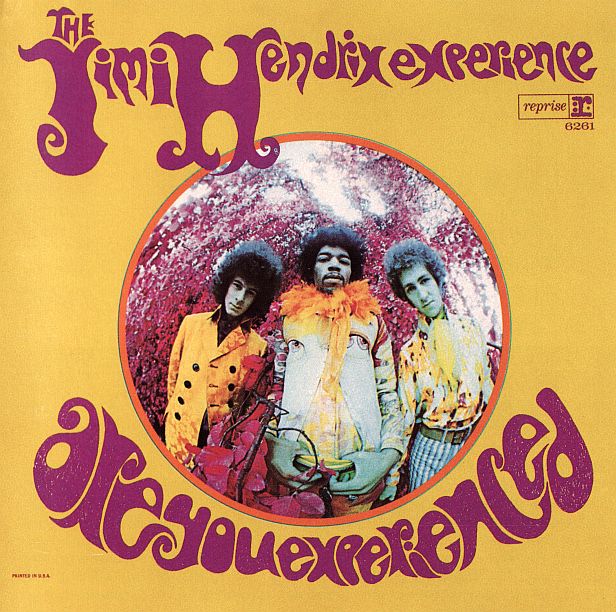
Released May 12, 1967 in the UK, the album peaked at #2, kept off the top only by Sgt. Pepper's Lonely Hearts Club Band, which was finishing its run. The US release, on Reprise Records four months later, used a different sleeve (a Karl Ferris fisheye photograph instead of the UK's white-background portrait), a different track sequence, and three new tracks (the band's UK singles 'Hey Joe,' 'Purple Haze,' and 'The Wind Cries Mary' were added; 'Red House,' 'Can You See Me,' and 'Remember' were dropped). The US version reached #5 on the Billboard 200; it has since outsold the UK version by a factor of three.
Are You Experienced belongs at #21 because it is the debut on which one musician, backed by two Englishmen and an engineer roughly his own age, built a vocabulary for the electric guitar that didn't previously exist. Two things follow from it directly. Heavy rock inherited his fuzz and feedback — every solo on Led Zeppelin's first three albums is in conversation with this record, and metal's basic guitar sound starts here. And he established that one guitar could carry a whole arrangement rather than a part in one: Kevin Shields has said this album taught him a guitar could be 'an entire orchestra', which is the ambition prog and stadium rock spent the next decade scaling up. Hendrix died on September 18, 1970, aged 27, with three finished studio albums to his name. The first is still the most consequential.
Pressing guide — the one to own
Original 1967 UK pressing, Track Record 612 001, mono only (the stereo 613 001 came later and is not a 1967 first press). The first-press disc carries the matt black-and-silver Track label and was pressed through Polydor; the sleeve is a single (non-gatefold) jacket, laminated front and matte back, with Bruce Fleming's group portrait of Hendrix and the band under his cape. Note this is a different record from the US Reprise issue (R 6261 mono / RS 6261 stereo), which has Karl Ferris's fisheye cover and a revised tracklist adding the early singles. Top-grade copies fetch into four figures, though clean playing copies sit closer to £150.