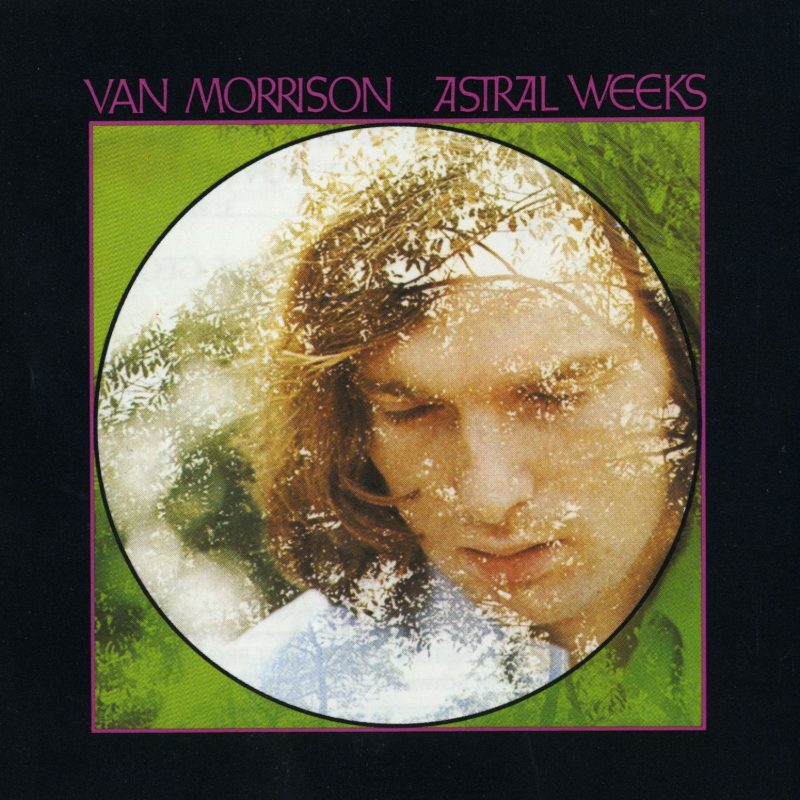
Van Morrison at twenty-three, 3 weeks free of a Bang Records contract that had nearly destroyed him, walked into a Manhattan studio with eight songs nobody had heard and four jazz musicians who had not been told what kind of record they were making. They cut it in two afternoons. Nobody bought it. It changed music anyway.
- Released
- November 1968
- Label
- Warner Bros. Records
- Producer(s)
- Lewis Merenstein · Engineer: Brooks Arthur
- Runtime
- 47:08 (8 tracks)
- Chart peak (US)
- Did not chart (eventually #166 on the 1969 catalog re-entry)
- Chart peak (UK)
- Did not chart
- Certifications
- Gold (RIAA, 2001); estimated 1.8M units globally, small for an album of its critical stature
- Awards & honours
- Library of Congress National Recording Registry (2017); ranked #19 on Rolling Stone's 500 Greatest Albums (2020); Grammy Hall of Fame (2009); routinely #1 on Van Morrison-specific polls
An album of stream-of-consciousness Belfast memories sung against improvised jazz accompaniment by a 23-year-old Northern Irishman who had spent the previous year suing his former record label. The session musicians had never met the singer before the first day of recording. They weren't told what kind of music they were going to play.
By the summer of 1968, Van Morrison had been free for about three months. His previous band, Them, had broken up in 1966. His first solo contract, with Bert Berns's Bang Records, had been a disaster. Berns had cut the swooning 'Brown Eyed Girl' into a hit single and then released a contractually-required full-length LP, Blowin' Your Mind!, that Morrison didn't authorize and considered an embarrassment. Berns died of a heart attack on December 30, 1967. Morrison spent the first half of 1968 in legal arbitration with Berns's widow, who controlled the Bang catalog and refused to release him from his contract without compensation. In June 1968, Warner Bros. Records paid the Berns estate £20,000 in cash to release Morrison from Bang. The condition was that Morrison would deliver three new studio LPs to Bang Records, songs that the Berns estate could release if it chose. Morrison delivered the contractually required material in a single afternoon at a New York warehouse: thirty-one short songs, mostly nonsense lyrics sung to single-chord vamps, including a song called 'Ring Worm' and one called 'You Say France and I Whistle.' The recordings were released in 1994 under the title The Genuine Philosopher's Stone. The thirty-one-minute session is, in its strange way, the prologue to Astral Weeks.
Free of Bang, Morrison flew to New York at the invitation of Warner Bros. producer Lewis Merenstein, who had been recording him in demo sessions throughout the summer. Merenstein had assembled, on his own initiative, a band composed entirely of jazz musicians: Richard Davis on bass (one of the most-recorded bassists in jazz, who had played on dozens of Blue Note and Verve sessions and had recently completed work on Eric Dolphy's Out to Lunch), Connie Kay on drums (the longtime drummer of the Modern Jazz Quartet), Jay Berliner on guitar (a first-call session player whose previous credits included a recent Charles Mingus LP), and Warren Smith on percussion. Larry Fallon was hired to write string and brass arrangements. The session was booked for two afternoons at Century Sound Studios on Broadway in Manhattan. Brooks Arthur engineered.
On September 25, 1968, Van Morrison walked into Century Sound for the first day of recording. He had never met any of the musicians. He had not given them charts. He had not played them the songs. He sat down with an acoustic guitar, opened his mouth, and started singing. The band, all of whom were paid by the session and had no idea what was being made, played what they heard. Connie Kay later said in interviews that he assumed the music was 'modern folk' and treated it as such, light brushwork on the snare, ride cymbal accents, minimal kick. Richard Davis played walking bass figures that he had used in jazz contexts; with no chart, he improvised entirely on the modal direction Morrison's vocals suggested. Jay Berliner picked up the song's tempos by ear and stayed out of the way. Eight songs were recorded across the two sessions (September 25 and October 15, 1968), plus a single instrumental track (Larry Fallon's string overdubs) on a third date. Morrison was sometimes singing in a single take; on at least three songs the take used on the released LP is take one.
What the band understood, dimly, was that the songs weren't really songs in the verse-chorus-verse sense. 'Astral Weeks' opens the album with a stream-of-consciousness lyric ('If I ventured in the slipstream / Between the viaducts of your dreams') sung over a flute-and-acoustic-guitar bed that drifts modally for over 7 minutes. There is no chorus. There is barely a repeated lyric. The melody is closer to declamation than to song. 'Sweet Thing' has a chorus of sorts but its emotional center is a long bridge in which Morrison repeats 'Sugar baby' for 30 seconds while the band stretches a single chord. 'Madame George' is a nine-minute character study of a Belfast drag queen that ends with a five-minute string-and-vocal passage in which Morrison repeats 'Get on the train' a hundred times. The album is closer in form to a Bill Evans piano session or a Joao Gilberto bossa nova LP than to anything in 1968 rock.
It is also one of the very few records of the period in which a singer-songwriter improvises so much of the material in real time. Morrison has said in interviews, repeatedly, over fifty years, that he barely remembered making the album. He has acknowledged he didn't write down most of the lyrics. The vocal performances weren't rehearsed; the band wasn't paid to rehearse; the session musicians weren't even introduced to Morrison until they arrived at Century Sound. The result is the closest thing rock music has to a live jazz LP, a record in which the form is being invented as it is being recorded.
Warner Bros. released Astral Weeks in November 1968 with no single, no advertising, and no expectation. The album didn't chart. It sold under twenty thousand copies in its first year. Critics noticed it slowly. Lester Bangs's now-canonical 1979 essay 'Astral Weeks', one of the foundational documents of personal rock criticism, declared the album 'a record I have never recovered from.' Bangs argued that the album was about death and grief in a way no other rock LP had been. The essay gradually pulled the album into the canon. By the mid-1980s every serious rock-critic poll placed Astral Weeks in the top fifty of all time. By the 2003 Rolling Stone 500 Greatest, it had moved to #19, where it has stayed.
What Astral Weeks did, more than any other 1968 album, was open the possibility that a rock LP could be sung. Morrison's vocal performance on the album, sustained, declamatory, melismatic, ranging from whisper to wail across single lines, is closer to a Sufi qawwali or a gospel preacher than to any 1960s rock singer. It taught a generation of subsequent vocalists (Bruce Springsteen, who has cited the album in print as the foundational text for his own vocal style; Patti Smith, who has named 'Cyprus Avenue' as the song that taught her to sing; Bono, who has called Morrison 'the only one of us'; Jeff Buckley, who recorded 'Madame George' multiple times) that a rock vocal could be a sustained extemporaneous improvisation. Without Astral Weeks there is no Born to Run, no Patti Smith Horses, no Joshua Tree, no Grace, no Hurry Up, We're Dreaming. The road from rock-as-song to rock-as-improvised-vocal-statement runs almost entirely through this album.
Astral Weeks belongs at #16 because it is the rare rock LP that operates on principles closer to those of jazz or sacred music than to those of pop song form. The album has no hits. It produced no singles. It charted nowhere. Its commercial profile in 1968 was effectively zero. What it has, instead, is the longest-running and most-cited critical reputation of any commercially-overlooked album in rock history, sixty years of writers returning to it, of musicians naming it as foundational, of the album's quiet half-life finally outweighing the careers of its commercially-successful contemporaries. It is the album of the post-1960s singer-songwriter movement: the proof that a popular song doesn't have to be a song in any conventional sense to do what it does.
Pressing guide — the one to own
Original 1968 US first pressing, Warner Bros.-Seven Arts WS 1768, on the green 'W7' boxed-logo label (Warner Bros.-Seven Arts, not the later 'big WB' green-and-gold), in a single flip-back sleeve rather than a gatefold. Pressings came from the Columbia plants, with a small stamped 'P' (Pitman) or Santa Maria markings in the deadwax; the labels read 'Part 1' and 'Part 2'. There is no verified Sterling etching on this first issue. Original 'W7'-label flip-back copies in clean shape are the genuine first-press target and trade at a strong premium.