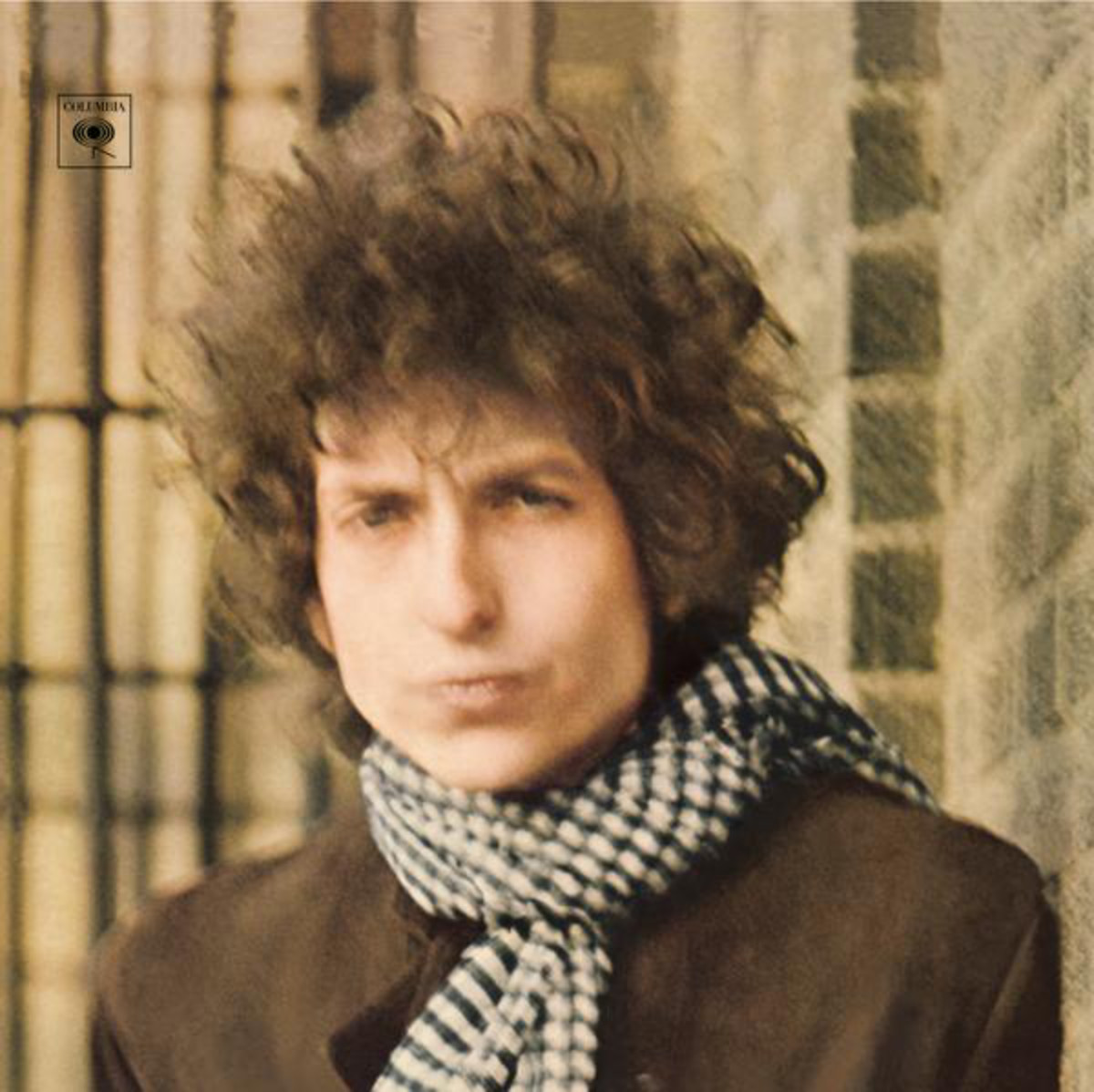
The first great double album in pop. Recorded in Nashville session houses by New York session players Bob Dylan had flown south at his own expense, in a six-week burst that produced an album about being a stranger in your own life that nobody else has been able to write since.
- Released
- May 16, 1966 (US Columbia C2L 41) · later release dates in some markets
- Label
- Columbia
- Producer(s)
- Bob Johnston
- Runtime
- 73:24 (double LP)
- Chart peak (US)
- #9 (Billboard 200)
- Chart peak (UK)
- #3 (Record Retailer)
- Certifications
- 2× Platinum (RIAA); estimated 6M+ units globally
- Awards & honours
- Grammy Hall of Fame (1999); Library of Congress National Recording Registry (2002); often described as the best-sounding album Dylan ever made, partly thanks to Nashville's room and partly thanks to Bob Johnston's hands-off engineering
Dylan finished his folk-rock trilogy by walking into a studio in Nashville with most of the same New York musicians who'd cut Highway 61 Revisited, plus a small group of Nashville session players Johnston had assembled, and recording, over 6 weeks of late-night sessions, mostly between 10 PM and 4 AM, the longest, strangest, most lyrically baroque album of his early career.
Bob Dylan arrived at Columbia Studio A in Nashville on February 14, 1966, with a half-finished album and a touring schedule that would kill anyone with a less robust constitution. He had spent October, November, December, and most of January in New York at Columbia's 30th Street studio attempting to finish the record there. He had cut 'Visions of Johanna' (twice), 'Just Like a Woman' (twice), 'I'll Keep It with Mine' (which wouldn't make the album), 'She's Your Lover Now' (which also wouldn't), and a handful of other songs. The sessions had not produced an album. Producer Bob Johnston had been advocating since Highway 61 Revisited that they should try Nashville: the players were better, the rooms were quieter, the sessions ran on their own clock, and Albert Grossman, Dylan's manager, had repeatedly refused. By February 1966 Dylan overruled them both and flew south.
He brought Robbie Robertson (lead guitar) and Al Kooper (organ) from the New York sessions. Bob Johnston assembled the rest from Nashville's A-list studio musicians: Charlie McCoy on bass and trumpet, Kenny Buttrey on drums, Joe South on guitar and bass, Wayne Moss on guitar, Hargus 'Pig' Robbins on piano, Henry Strzelecki on bass. They were country session players. They had never met Dylan. The arrangements Dylan brought down with him were sketches at best; some songs (most famously 'Sad-Eyed Lady of the Lowlands') were written in his hotel room at the Ramada Inn while the musicians waited in the studio, sometimes for 8 hours, sometimes overnight. McCoy would later describe the experience as the best-paid waiting of his career: the players were on union scale by the hour whether the session was producing music or not.
The Nashville sessions began at midnight on February 14 and ended on the morning of March 10. In total, the band cut six of the album's fourteen tracks during that first stint. They returned March 7–10, then again in late March, then once more for overdubs in late April. Eleven of the fourteen tracks on Blonde on Blonde were cut in Nashville. The remaining three were New York sessions that survived. The album was sequenced and mastered in early May, with Dylan personally rejecting a stereo mix on the grounds that the mono was what he had heard in the room. The album was released on May 16, 1966, eight days after Pet Sounds. 3 weeks later he would fall off a motorcycle in upstate New York and stop touring for eight years.
What is happening on Blonde on Blonde is that the songwriter is no longer trying to be understood. He is trying to be true to a state of mind he cannot quite hold steady, and inviting the listener to spend an hour and 12 minutes inside it with him. The songs are not about anything in particular. They are not protest songs. They are not love songs in any conventional shape. They are songs in the voice of a narrator who has been awake for 30 hours, has been told something he half-believed and half-rejected, and is now trying to describe the texture of the morning to a stranger on a hotel phone. The lyrics are dense with proper nouns whose referents are private; they namecheck Mona, Louise, Sweet Marie, Mister Jones, the deputy who wears a six-shooter, the hollow places and railroad gates that recur across multiple songs as if they were stations on a map only the speaker can read. The effect is hallucinatory but also, somehow, intimate. You are not eavesdropping. You are being addressed. The narrator just isn't sure who he's talking to.
Side three of the original double LP is 'Sad-Eyed Lady of the Lowlands' alone, 11 minutes 23 seconds of one song, taking up an entire side of vinyl. No major-label pop release had done this before. The song is a love song to Dylan's then-new wife Sara, and the band, by Kenny Buttrey's later account, had no idea how long it was going to be. Dylan started playing; they joined when they could; he kept going. After about 7 minutes they assumed the song was about to end. He went into another chorus. Around 11 minutes he signaled the close. They all looked at each other. The take is the one on the album. Buttrey said in 1985 that he started the song lightly because he assumed it was a three-minute ballad and built up; if he had known it was 11, he'd have played differently. The unrepeatable quality of it, the fact that everyone in the room was making real-time guesses about what would happen next, is what gives 'Sad-Eyed Lady' its specific gravity.
Half the canon of Dylan thinkpieces has been about whether the songs on Blonde on Blonde are about specific women, Sara, Edie Sedgwick, Joan Baez, a Memphis blues girl Dylan had known. The answer is: yes and no, and the no is more interesting. The songs use the address-to-a-woman as the structural device by which a narrator works out what he thinks about his own consciousness, and the woman in the song is sometimes Sara, sometimes Edie, sometimes Joan, sometimes the speaker's own mother, sometimes the speaker himself, and on at least three songs (including 'Stuck Inside of Mobile' and 'Memphis Blues Again') it is no specific person at all but a posture, the act of addressing, that the song is built around. Pop songs had been about specific women for fifty years before Blonde on Blonde. Dylan was the first songwriter to use 'a woman' as a generic destination for a state-of-consciousness report. Everyone in indie rock from 1990 to last week is downstream.
It is the album that ends Dylan's electric trilogy (Bringing It All Back Home, Highway 61 Revisited, Blonde on Blonde) by abandoning the trilogy's own coherence. Bringing It All Back Home is a folk-rock LP with one side of each. Highway 61 Revisited is a rock-poetry LP. Blonde on Blonde is, to use the unhelpful word the album itself never settles, 'thin, wild mercury music,' which is what Dylan called the sound in a 1978 interview. He has never said exactly what he meant. The sound has been understood since to mean: spacious, watery, mid-register, a band that is playing with conviction but at half-volume, a piano that's slightly too prominent, an organ that's slightly behind the beat, a vocalist who's audibly tired. The reverb on Dylan's vocal across the album is the longest on any record he made before 1989. The harmonica solos are slower than they'd been on Highway 61. The whole record sounds like it is happening underwater, late, in a room with the windows closed. Bob Johnston has said the sound was an accident of the Nashville studio's natural reverb and Charlie McCoy's choice to mic the room ambient rather than close-miked. Charlie McCoy has said the sound was an accident of the band being too tired to play hard. They are both right.
Blonde on Blonde ranks at #11, just below its companion Highway 61 Revisited, because where Highway 61 is the breakthrough, the moment rock decided it could be serious writing, Blonde on Blonde is the perfection of that mode rather than its invention. It is a double album and earns the runtime, but the sprawl that makes it luxuriant also makes it less compressed than the records above it. It is also the moment a singer-songwriter stopped writing songs and started writing extended documents of consciousness, and pop hasn't gotten over that decision. Every album that ever asks you to spend more than 40 minutes inside one person's head, Joni Mitchell's Blue, Carole King's Tapestry, Stevie Wonder's Songs in the Key of Life, Lauryn Hill's Miseducation, Frank Ocean's Channel Orange and Blonde, Big Thief's Dragon New Warm Mountain, owes Blonde on Blonde the form. It is the album the singer-songwriter as a category begins with.
Pressing guide — the one to own
Original 1966 US mono pressing, Columbia C2L 41, double LP in a gatefold sleeve carrying Jerry Schatzberg's out-of-focus cover portrait of Dylan in a brown suede scarf. Look for the red Columbia 'two-eye / 360 Sound' label (Columbia, not 'CBS') with 'MONO' at the foot. The true first state has the full set of inside gatefold photos including the famous Claudia Cardinale shot, which Columbia removed from later 1968 jackets, and lists the Side 2 second track as 'Memphis Blues Again'. Dylan favoured the mono mix. Clean original-state mono copies are highly prized, with white-label promos far rarer still.