
№ 37 of 100
Blue
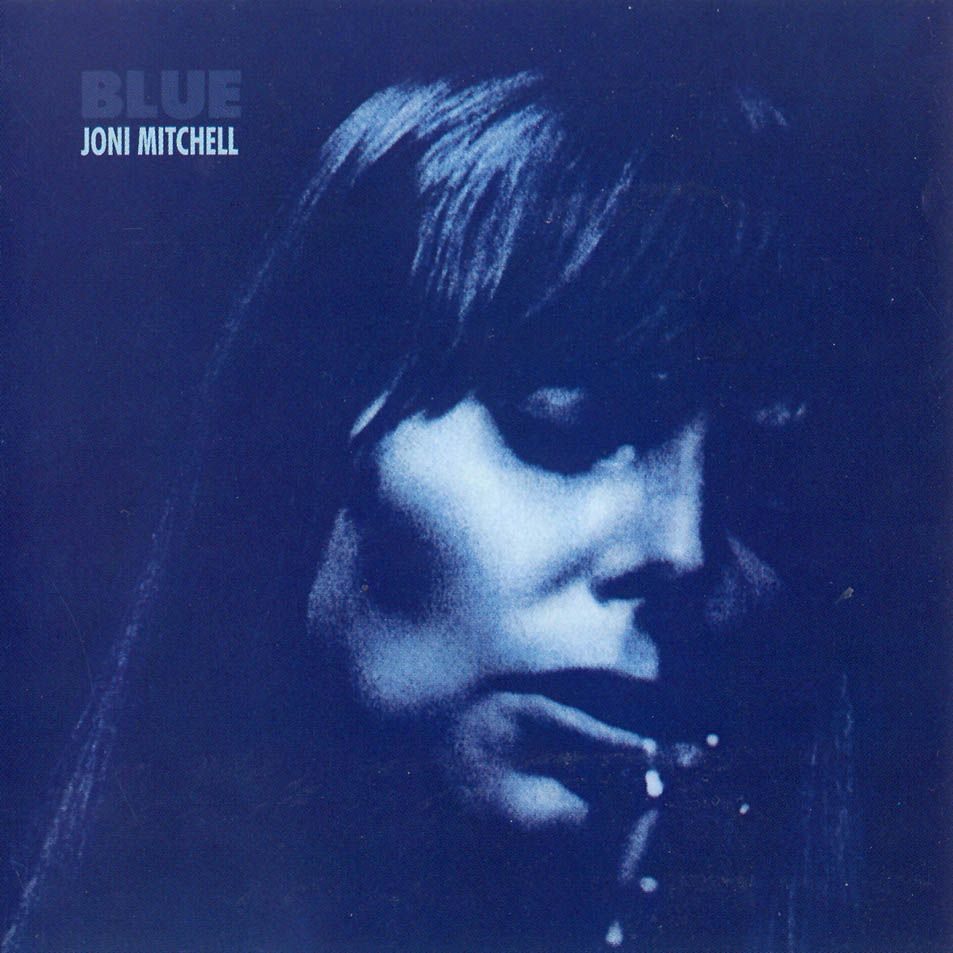
Blue by Joni Mitchell (1971), № 37 in The Lead-In’s 100 greatest albums. Joni Mitchell figured out that a confession could be architecture. Every singer-songwriter who has tried since has been working in her blueprint.
Blue by Joni Mitchell (1971), № 37 in The Lead-In’s 100 greatest albums. Joni Mitchell figured out that a confession could be architecture. Every singer-songwriter who has tried since has been working in her blueprint.
Joni Mitchell at twenty-seven, after a year of personal upheaval, recorded ten songs with three musicians at A&M Studios. The most-direct singer-songwriter album of its era. Released June 22, 1971.
3 weeks at A&M Studios in Hollywood with Henry Lewy engineering. Ten tracks across 36 minutes. The album that turned Joni Mitchell, twenty-seven, four albums into a serious singer-songwriter career, recently emerged from relationships with Graham Nash and James Taylor, into the foundational figure of the confessional-songwriter form, and the album that has continued to define what an emotionally serious singer-songwriter record could mean for fifty-three subsequent years.
Joni Mitchell had been recording since 1968, Song to a Seagull (1968), Clouds (1969), Ladies of the Canyon (1970). Ladies of the Canyon had produced her commercial breakthrough with 'Big Yellow Taxi' and 'Woodstock'; the album sold over a million copies and established Mitchell as a major commercial figure as well as a critically respected one. By spring 1970 Mitchell was 26 and exhausted. She had ended a long relationship with Graham Nash that February; the breakup wasn't amicable. She had also been involved with David Crosby (who had produced her debut) and with James Taylor (whom she would meet during the Ladies of the Canyon period). She gave a single concert at the Isle of Wight Festival in August 1970 and then withdrew from touring for over a year. She spent the autumn of 1970 traveling alone through Europe, Crete, Spain, France, writing the songs that would become Blue.
Mitchell had given up her first child, Kelly Dale Anderson, for adoption in 1965, when Mitchell was 21 and her then-boyfriend (later husband, briefly) Brad MacMath had abandoned her. The adoption wasn't publicly disclosed until 1993, when Mitchell located her daughter via a letter to a magazine. The years between 1965 and 1993, including the entire Blue period, were lived with the daughter's existence as a private fact. The album's specific emotional vocabulary, the alternation between assertion and exhaustion, the way 'Little Green' addresses a child without naming the child, the way Mitchell sings about freedom and lostness as inseparable conditions, is partly the document of carrying this private fact. The lyric to 'Little Green' is one of the most-decoded in modern songwriting; Mitchell has confirmed in subsequent interviews that the song is addressed to her daughter.
Recording took place at A&M Studios in Hollywood across January and February 1971, with engineer Henry Lewy, who had worked with Mitchell since her debut, running the sessions. The deliberate decision was to record with minimal session-musician intervention. Mitchell played all the principal instruments herself: acoustic guitar (in standard and various open tunings), piano, dulcimer. Stephen Stills contributed bass and acoustic guitar on 'Carey' (one track); James Taylor contributed acoustic guitar on three tracks ('All I Want,' 'A Case of You,' 'California'); Russ Kunkel played drums on two tracks. There are no other session credits. The session musicians on Blue, three players across six contributions, are by an order of magnitude fewer than on any contemporaneous LA singer-songwriter album. Mitchell's specific intent was to make the album sound like a single voice from a single person, with the smallest possible apparatus between the song and the listener.
Five tracks were recorded as Mitchell's voice plus a single instrument: 'My Old Man' (piano), 'Little Green' (acoustic guitar), 'Blue' (piano), 'River' (piano), and 'The Last Time I Saw Richard' (piano). The deliberate sparseness is part of the album's argument, that the songs don't need ornamentation, that the emotional content is fully present in voice-and-one-instrument. The remaining tracks add minimal accompaniment: dulcimer ('California,' 'A Case of You'), bass ('Carey'), drums ('Carey,' 'California'), additional acoustic guitar (James Taylor's contributions). Henry Lewy's engineering approach, close-miked vocal, minimal compression, modest reverb, vocal placed prominently in the mix, became the template for the entire LA confessional-songwriter aesthetic of the 1970s.
The album was released on June 22, 1971. The critical response was immediately serious; Rolling Stone and the New York Times reviewed it as a major artistic statement on first release. Commercial response was modest by Mitchell's standards, Blue peaked at US #15 (lower than Ladies of the Canyon) and UK #3. Tapestry, released four months before Blue, was at US #1 throughout Blue's chart life; the singer-songwriter market in summer 1971 was dominated by King's record. The two albums have been routinely compared since, Tapestry as the commercial victory, Blue as the artistic victory, and the comparison is approximately right, though it understates both records. Blue's sales were respectable for a deliberately introspective album; its long-term cultural impact has been substantially larger than its first-year chart position would suggest.
Blue's reputation has compounded continuously since 1971. The album is now consistently named among the greatest records of all time across most critical surveys (Rolling Stone's 500 Greatest Albums of All Time placed Blue at #3 in the 2020 update, ahead of every other Mitchell record and ahead of Tapestry). The Library of Congress added Blue to the National Recording Registry in 2017. Mitchell herself has been ambivalent about the album's canonical status, she has expressed in subsequent interviews that the deliberate emotional exposure was costly and that she wouldn't want her younger work to overshadow her later, more musically ambitious records (Court and Spark, Hejira, Mingus, Hissing of Summer Lawns). But the canonical position is now stable. Blue is the album that every subsequent generation of female singer-songwriters from Tori Amos through Phoebe Bridgers has had to position themselves in relation to.
Blue belongs at #37 because it is the album that established the foundational possibilities of the confessional singer-songwriter form and has continued to set the upper bound of what the form can accomplish for fifty-three years. Mitchell's specific contribution, the willingness to write directly autobiographical material at the highest production register, with deliberate engineering simplicity that exposes rather than ornaments the voice, was new in 1971 and remains the standard. The album's three-week recording window, the absence of significant session-musician apparatus, the album's specific list of named subjects (Graham Nash on 'My Old Man,' Cary Raditz on 'Carey,' James Taylor and Kris Kristofferson on several others) made it a document of a specific person at a specific moment, refusing the universal-anthem mode that contemporaneous singer-songwriter records often used as a shield. Mitchell was 27 when the album appeared; she has continued to record for the next fifty-three years and has made greater records musically but not greater records as confessional statements. Blue remains her foundational document and one of the foundational documents of the form.
1971 US first pressing, Reprise MS 2038 with the deep-blue tinted self-portrait cover photograph (by Tim Considine) and the original printed inner sleeve with the full lyric sheet. Look for the matrix etchings MS 2038-A1 / B1, hand-etched at A&M's mastering facility by Bernie Grundman. The earliest pressings have a specific deep-blue cover tint that lightened on subsequent print runs; the deep-tint sleeves are the first-state collector's mark.
© The Lead-In · an independent, reader-supported music publication.