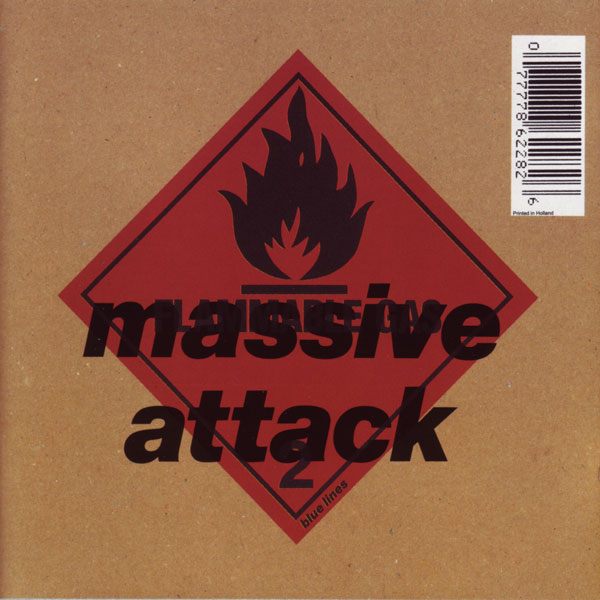
Nine tracks in 45 minutes. Recorded at Coach House Studios in Bristol with Cameron McVey and Jonny Dollar producing. The Bristol trio's debut LP and the founding text of trip-hop.
- Released
- April 8, 1991
- Label
- Wild Bunch / Virgin (UK, BLNLP 1)
- Producer(s)
- Massive Attack · Cameron McVey · Jonny Dollar
- Runtime
- 45:18 (9 tracks)
- Chart peak (US)
- Did not chart
- Chart peak (UK)
- #13 (UK Albums Chart)
- Certifications
- Platinum (BPI, 2002)
- Awards & honours
- Ranked #350 on Rolling Stone's 500 Greatest Albums (2020); Mercury Prize shortlist (1991)
Nine tracks in 45 minutes. Recorded across approximately eight months at Coach House Studios in Bristol and Eel Pie Studios in London with Massive Attack, Jonny Dollar, and Cameron McVey producing. The debut LP by the Bristol collective that emerged from the Wild Bunch sound system, 3D, Daddy G, and Mushroom, with vocalists Shara Nelson, Horace Andy, and Tricky. The founding text of trip-hop, the album that fused hip-hop production, dub reggae, and soul vocal into a sustained slow-tempo commercial form that every subsequent Bristol-sound and downtempo-electronic LP has worked within.
Massive Attack in 1990 emerged from the Wild Bunch, a Bristol sound-system collective that had been one of the most-influential UK sound systems of the mid-1980s. The Wild Bunch, Robert Del Naja (3D), Grant Marshall (Daddy G), Andrew Vowles (Mushroom), Nellee Hooper, and others, had played warehouse parties and clubs across Bristol fusing hip-hop, soul, reggae, and punk in extended DJ sets. Nellee Hooper had left to join Soul II Soul (whose 1989 commercial breakthrough established a London-based soul-and-breakbeat vocabulary); the remaining core formed Massive Attack as a recording project.
The Bristol context was central. Bristol in the 1980s had a distinctive multicultural music culture, a substantial Jamaican-British community, a sound-system tradition, and a geographic distance from London's commercial-music infrastructure that allowed a slower, more idiosyncratic vocabulary to develop. The 'Bristol sound' that Blue Lines inaugurated is inseparable from the city's specific cultural geography.
Recording extended across approximately eight months in 1990-91 at Coach House Studios in Bristol and Eel Pie Studios in London. Cameron McVey (Neneh Cherry's partner and producer) and Jonny Dollar provided production guidance; the three core members built the production beds. The vocalists were drawn from the collective's network: Shara Nelson (a soul vocalist who delivered the album's most-celebrated performances), Horace Andy (the veteran Jamaican reggae vocalist who became Massive Attack's recurring collaborator across the subsequent three decades), and Tricky (Adrian Thaws, then a young Bristol rapper who would launch his own solo career on Maxinquaye in 1995).
The album's central artistic decision was the deliberate slowing of hip-hop's tempo into a meditative, atmospheric register. Where contemporary American hip-hop ran at 90-100 BPM, Blue Lines tracks run substantially slower, the breakbeats stretched, the bass dub-influenced, the vocals soul-and-reggae rather than rapped throughout. The fusion had no clear precedent; the album invented the slow-tempo, multi-vocalist, genre-omnivorous form that the music press would name 'trip-hop' (a term Massive Attack themselves disliked). Blue Lines is the founding text of the genre.
'Unfinished Sympathy', the album's centerpiece single, became one of the most-celebrated singles of the 1990s. Shara Nelson's soul vocal over a string-and-breakbeat arrangement, the one-take Los Angeles street-walk video, the song's emotional sweep: the single has been cited in numerous greatest-singles-ever polls. During the 1991 Gulf War the band temporarily shortened its name to 'Massive' to avoid radio-and-press association with military attacks, the single was released as by 'Massive' in some markets.
Wild Bunch / Circa / Virgin released the album on April 8, 1991. The album reached UK #13; US release was modest. BPI Platinum certification followed; the album's commercial trajectory was sustained rather than launch-week. Blue Lines has remained continuously in print since 1991.
Critical reception was extraordinary and unanimous; subsequent critical-poll positioning placed Blue Lines among the canonical British LPs of the 1990s and among the founding texts of electronic music. The 2020 Rolling Stone ranking confirms the institutional standing.
Blue Lines belongs at #77 because it is the founding text of trip-hop, the album that fused hip-hop production, dub reggae, and soul vocal into a sustained slow-tempo commercial form. Every subsequent Dummy (Portishead, 1994), Maxinquaye (Tricky, 1995), Mezzanine (Massive Attack's own 1998 commercial peak), and the entire Bristol-sound and downtempo-electronic tradition runs on the proof Blue Lines delivered. The album's influence extends through Burial, the xx, James Blake, and the broader twenty-first-century atmospheric-electronic tradition.
Pressing guide — the one to own
Original 1991 UK pressing on Wild Bunch Records (also carrying Circa), manufactured and distributed by Virgin, catalog WBRLP 1, a single LP. The true earliest-press marker is the artist credit: at first release during the Gulf War the band was billed simply as 'Massive' (not 'Massive Attack'), and that 'Massive' label/sleeve variant is the deeper collector's target. Confirm the WBRLP 1 catalog number to distinguish an original from reissues.