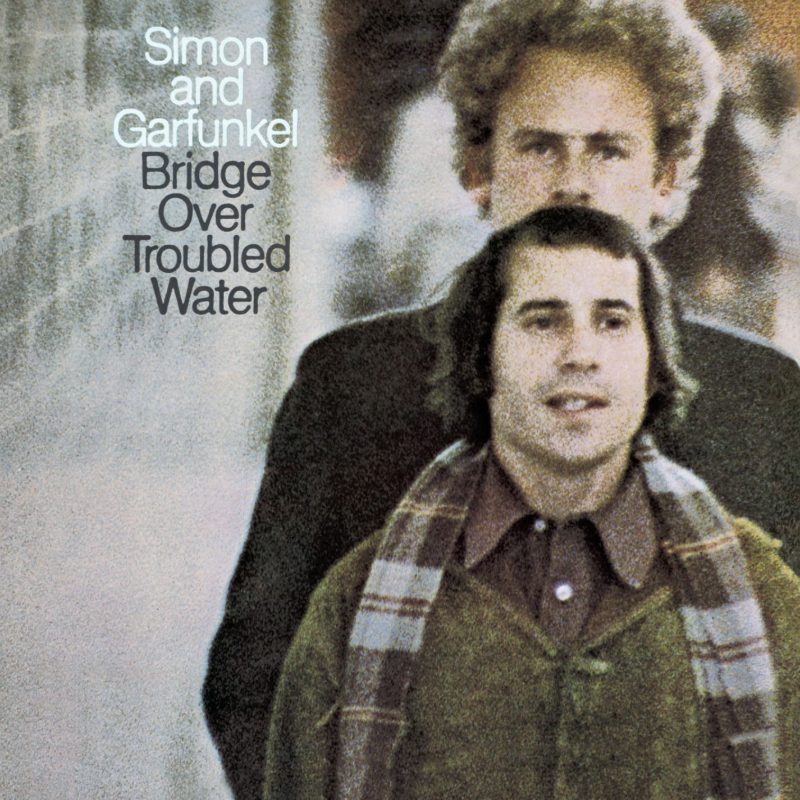
Simon & Garfunkel's fifth and final album. Released January 26, 1970. Won six Grammys. The album that broke up the duo.
- Released
- January 26, 1970
- Label
- Columbia Records
- Producer(s)
- Roy Halee · Simon & Garfunkel
- Runtime
- 36:27 (11 tracks)
- Chart peak (US)
- #1 (Billboard 200, 10 weeks)
- Chart peak (UK)
- #1 (Record Retailer, 33 weeks)
- Certifications
- 8× Platinum (RIAA); 25M units globally
- Awards & honours
- Grammy Album of the Year (1971); Grammy Record of the Year (title track); Library of Congress National Recording Registry (2003); ranked #51 on Rolling Stone's 500 Greatest Albums (2020)
Approximately one year of intermittent recording at Columbia Studios in Nashville and Los Angeles with Roy Halee producing. Eleven tracks across 36 minutes. The album that closed the Simon & Garfunkel partnership at the institutional and commercial peak both members had ever reached, the album whose title track became the consolation song of the post-Kent State American moment, and the album that spent 10 weeks at US #1 and won six Grammy Awards in 1971 including Album of the Year.
Simon & Garfunkel had been recording as a duo since 1964. Their previous four albums, Wednesday Morning, 3 A.M. (1964), Sounds of Silence (1966), Parsley, Sage, Rosemary and Thyme (1966), and Bookends (1968), plus the Mike Nichols-produced soundtrack to The Graduate (1968) had established them as the most commercially significant folk-rock duo in American music. By 1969 the partnership was straining. Paul Simon had been increasingly interested in solo writing and recording; Art Garfunkel had accepted a starring role in Mike Nichols's Catch-22 (1970) and was spending much of 1969 on location in Mexico filming. Bridge Over Troubled Water was recorded across the gaps in both schedules, Simon recording in New York and Los Angeles, Garfunkel flying in for vocal sessions during breaks from filming. The deliberate fragmentation of the recording process is one reason the album took approximately a year to complete.
The title track was the album's organizing event. Paul Simon had written 'Bridge Over Troubled Water' in November 1969 at his apartment on Central Park West in New York. The song was originally conceived as a two-verse, two-chorus piece with a piano arrangement Simon had been developing on his Yamaha grand. Larry Knechtel, a Wrecking Crew session pianist Simon and Roy Halee had brought to Los Angeles in November 1969 specifically for this song, spent approximately a day at Columbia Studios in Los Angeles developing the final piano arrangement with Simon. The piano figure that opens the song, the gospel-derived chord progression, and the dramatic build into the third verse are all Knechtel's contributions to a song that Simon's original demo had not contained. The third verse itself was written by Simon as a deliberate addition after Garfunkel and Halee insisted on a longer arc; the famous 'sail on, silvergirl / sail on by' lyric is Simon's compromise to give the song the emotional weight that the two-verse original couldn't deliver.
Simon has spoken in subsequent interviews about half-regretting that he gave the title track to Garfunkel as a solo vocal. Simon had been the duo's primary lead vocalist on most material since 1965; Garfunkel's solo vocals had been reserved for specific songs (the harmonics of 'The Sound of Silence,' the lead of 'Scarborough Fair/Canticle'). 'Bridge Over Troubled Water' was Simon's most ambitious composition to date and the song he had been working toward for two years. Simon's decision to give Garfunkel the lead, based on the recognition that Garfunkel's tenor could carry the song's gospel-derived emotional weight in ways Simon's baritone could not, became one of the most-discussed decisions in late-1960s pop. The song's commercial scale was, by any measure, wildly disproportionate to its production budget, Knechtel's piano, Garfunkel's vocal, Joe Osborn's bass, Hal Blaine's drums, plus the multi-track mix that Halee assembled across 2 weeks.
The album's other ten tracks were recorded across the year-long fragmentation. 'El Cóndor Pasa (If I Could)' uses the melody of a 1913 Peruvian zarzuela arrangement; the Andean instrumentation (Los Incas, Daniel Robles' band that had recorded the source melody) is direct. 'Cecilia' is the percussion-and-vocal track recorded in Los Angeles with Simon and Garfunkel pounding on furniture and chairs at the studio in the days before the song's final mix. 'Keep the Customer Satisfied' is the deliberate post-Vietnam protest. 'So Long, Frank Lloyd Wright' is the architecture-as-metaphor meditation. 'The Boxer' (released as the album's first single in March 1969, eleven months before the album appeared) is the New York-portrait that became one of the duo's most-imitated tracks. 'Baby Driver' is the lighter-rock track. 'The Only Living Boy in New York' is the address Simon wrote to Garfunkel during the Catch-22 filming. 'Why Don't You Write Me' is the closing rock-leaning track. 'Bye Bye Love' is the Everly Brothers cover recorded live at the November 1969 Carnegie Hall show. 'Song for the Asking' closes the album.
Recording extended from spring 1969 through October 1969 (the principal sessions for 'The Boxer' and 'Cecilia' in New York and Los Angeles); continued through November 1969 (the 'Bridge' sessions with Larry Knechtel in Los Angeles); and concluded in early 1970 with vocal overdubs and final mixing. Roy Halee, the duo's principal engineer since their 1965 sessions, was the album's producer of record. His specific approach, deliberate stereo separation, multi-track-built vocal harmonies, willingness to use unusual recording locations (a stairwell at Columbia's Los Angeles studio for the 'Cecilia' percussion; the Carnegie Hall stage for 'Bye Bye Love'), was the album's primary engineering innovation.
The album was released on January 26, 1970. The Vietnam War's Cambodia incursion would happen four months later; the Kent State shootings would happen three months after release. The album reached US #1 on March 8, 1970 and stayed at #1 for ten consecutive weeks, at the time, the longest run by any album at US #1 since 1960. The title track was released as a single on January 26, 1970 (same day as the album) and reached US #1 in February 1970, where it stayed for 6 weeks. 'Cecilia' (released in April 1970) reached US #4; 'El Cóndor Pasa (If I Could)' (released in July 1970) reached US #18. Total first-year US sales: approximately 8 million. The album won six Grammy Awards at the March 1971 ceremony, Album of the Year, Record of the Year, Song of the Year, Best Contemporary Song, Best Engineered Recording (Halee), and Best Arrangement (Halee, Simon, Knechtel). The six-Grammy sweep made Simon & Garfunkel the second artist to win Album, Record, and Song of the Year at the same ceremony.
The duo announced their split in March 1970, two months after the album's release. The breakup had been forecast for over a year by industry observers; the formal announcement came as the album was at US #1. Each member would pursue solo careers, Simon's 1972 self-titled debut and 1973's There Goes Rhymin' Simon, Garfunkel's 1973 Angel Clare. The album therefore stands as the conclusion of the duo's recording career, made at the moment both knew it would be the last. Bridge Over Troubled Water belongs at #46 because it is the album that closed the Simon-Garfunkel partnership at the institutional and commercial peak both members had ever reached. The title track became, through the spring of 1970 and the years that followed, the consolation song the post-Kent State country had not asked for and couldn't unhear. The deliberate apoliticism of the album, Simon's resistance to direct Vietnam material, gave the song its specific availability for grief work, since it referred to no particular crisis. The album's continued half-century life is partly a function of this universality. The duo's reunion shows over the decades have always closed with this song; it is the song that survived their partnership. The Library of Congress added Bridge Over Troubled Water to the National Recording Registry in 2002.
Pressing guide — the one to own
1970 US first pressing, Columbia KCS 9914 with the famous Bob Cato cover photograph (Simon and Garfunkel in profile, half-lit, in front of a deliberately abstract painted background). Look for the matrix etchings KCS 9914-A1 / B1, hand-etched at Columbia Pitman by Vlado Meller. The original US gatefold includes the printed inner sleeve with the full lyric sheet on textured paper.