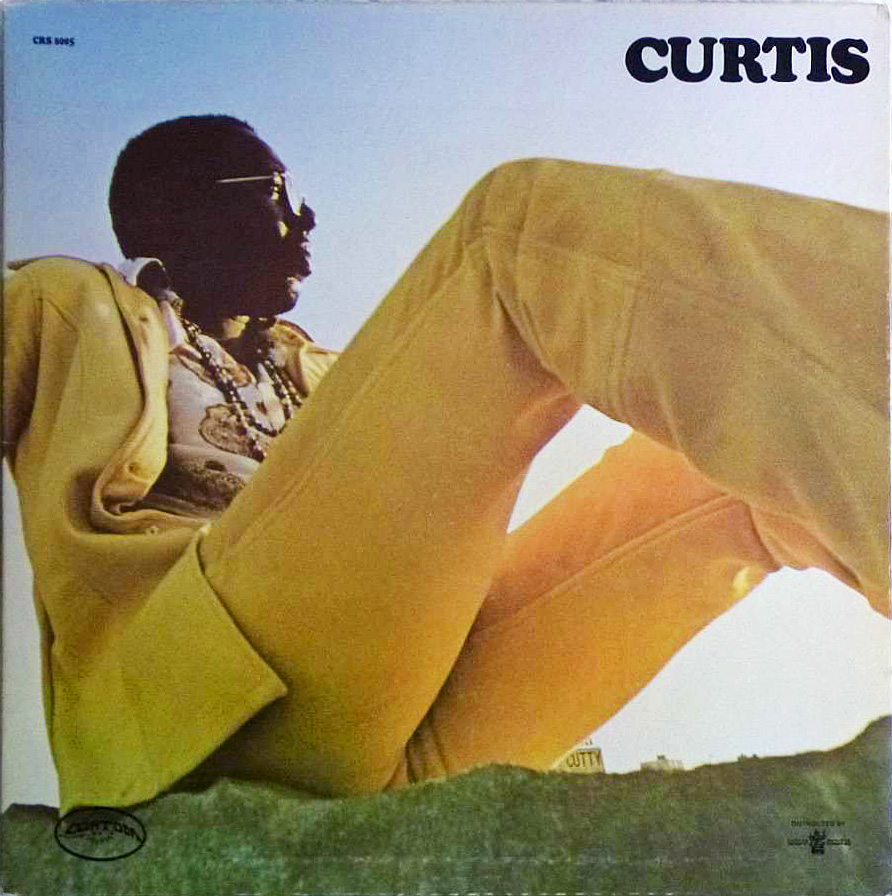
Eight tracks in 45 minutes. Recorded at RCA Studios Chicago, summer 1970. Curtis Mayfield's solo debut after twelve years with the Impressions. The album that consolidated socially-conscious soul as a sustained album-statement form.
- Released
- September 1970
- Label
- Curtom Records (CRS 8005)
- Producer(s)
- Curtis Mayfield
- Runtime
- 45:00 (8 tracks)
- Chart peak (US)
- #19 (Billboard 200); #1 (R&B)
- Chart peak (UK)
- Did not chart
- Certifications
- Gold (RIAA, 1972)
- Awards & honours
- Library of Congress National Recording Registry (2022); ranked #275 on Rolling Stone's 500 Greatest Albums
Eight tracks in 45 minutes. Recorded across summer 1970 at RCA Studios in Chicago with Curtis Mayfield self-producing and Riley Hampton and Gary Slabo arranging. Mayfield's solo debut after twelve years and roughly two dozen hit singles with the Impressions, the album that converted the gospel-civil-rights vocabulary of the Impressions into a freestanding social-conscience soul-funk statement and inaugurated the political-soul-LP form Marvin Gaye, Stevie Wonder, and Gil Scott-Heron would extend.
Curtis Mayfield in spring 1970 was twenty-eight years old, having spent twelve years as the songwriter, guitarist, and increasingly the lead voice of the Impressions, the Chicago vocal group whose 'People Get Ready' (1965), 'Keep On Pushing' (1964), and 'We're a Winner' (1968) had been among the defining gospel-civil-rights soul recordings of the 1960s. Mayfield had founded his own label, Curtom Records, in 1968 and had increasingly chafed against the vocal-group format. He left the Impressions in 1970 to pursue a solo career on Curtom; Curtis was the result.
The departure was a deliberate creative-and-commercial decision. The Impressions' three-part-harmony format had constrained Mayfield's songwriting; the solo format allowed him to extend tracks to seven, eight, 9 minutes; to write spoken-word confrontational material the vocal-group format couldn't have accommodated; and to integrate the full social-conscience register the late-1960s political moment had produced. The album is the document of an artist stepping out from a group constraint into freestanding ambition.
Sessions ran across summer 1970 at RCA Studios in Chicago. Mayfield self-produced; Riley Hampton and Gary Slabo provided the string-and-horn arrangements; the rhythm section was drawn from Mayfield's Chicago session-musician network including Master Henry Gibson on congas and percussion (whose Latin-percussion contributions define the album's specific rhythmic signature). Mayfield played his signature open-tuned electric guitar throughout.
The album's central artistic decision was the integration of confrontational social-conscience subject matter with extended funk-soul arrangement. 'If There's a Hell Below' opens the album with a spoken scream addressing every racial-and-ethnic group in America; 'We the People Who Are Darker Than Blue' addresses Black self-determination and intra-community division across a two-movement nine-minute structure; 'The Other Side of Town' narrates ghetto poverty in the first person. The combination, Marvin Gaye would arrive at a comparable synthesis with What's Going On a year later, established the political-soul-LP as a freestanding commercial form.
'Move On Up', the album's eight-minute-forty-nine-second centerpiece, became the album's commercial-cultural signature. The horn-driven uptempo arrangement and the 'move on up' refrain produced one of the most-sampled soul recordings of the subsequent five decades; the track was edited to 2:48 for single release and reached UK #12 on a 1971 reissue. Kanye West sampled it for 'Touch the Sky' (2005); the track has appeared in dozens of subsequent commercial-pop and hip-hop recordings.
Curtom released the album (distributed by Buddah Records) on September 1970. The album reached US #19 and US R&B #1; RIAA Gold certification followed. The album's commercial reception established Mayfield's solo viability and set up the subsequent Super Fly soundtrack (1972) that would become his commercial peak.
Critical reception was extraordinary and unanimous; the album has been treated by subsequent critical-poll positioning as one of the canonical political-soul LPs of the era. The 2020 Rolling Stone ranking at #275 confirms the institutional standing.
Curtis belongs at #75 because it is the album that converted the gospel-civil-rights vocabulary of the Impressions into a freestanding social-conscience soul-funk statement and inaugurated the political-soul-LP form. Every subsequent What's Going On (Marvin Gaye, 1971), There's a Riot Goin' On (Sly Stone, 1971), Innervisions (Stevie Wonder, 1973), and the entire 1970s political-soul tradition runs on the proof Curtis delivered. The album's influence on hip-hop sampling, 'Move On Up' in particular, extends the canonical-text status into the subsequent five decades.
Pressing guide — the one to own
Original 1970 US pressing on Curtom Records, catalog CRS-8005, a stereo LP in a gatefold sleeve, exclusively distributed by Buddah Records (1650 Broadway, NYC) as printed on the jacket. Two recognized first-press plant variants circulate, distinguished by their runout stamps. The gatefold and the Buddah-distribution credit are reliable markers of an original over later issues.