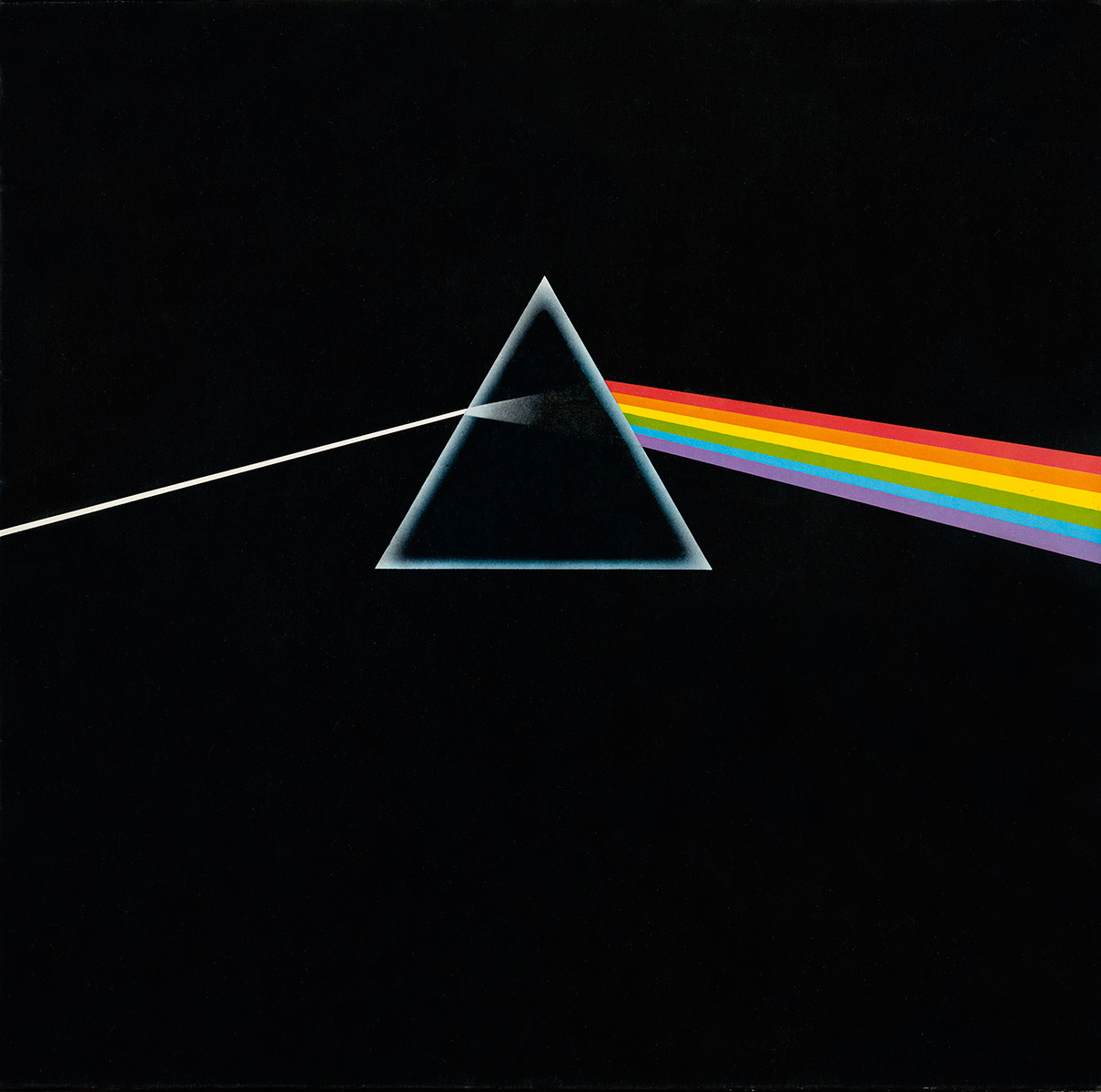
The most-played album in the history of recorded music. A nine-month conceptual experiment about anxiety, money, time, and madness that ran continuously on the Billboard 200 for fourteen years, and that the band performed live, in full, before they ever finished recording it.
- Released
- March 1, 1973 (US Capitol SMAS-11163) · March 24, 1973 (UK Harvest SHVL 804)
- Label
- Harvest (UK) · Capitol (US)
- Producer(s)
- Pink Floyd
- Runtime
- 42:50
- Chart peak (US)
- #1 (Billboard 200, 1 week), but on the Billboard 200 for 962 consecutive weeks (18 years), longer than any other album in history
- Chart peak (UK)
- #2 (held off #1 by Carpenters' 'The Singles 1969–1973')
- Certifications
- 14× Platinum (RIAA); estimated 50M+ units worldwide; among the top five bestselling albums of all time
- Awards & honours
- Grammy Hall of Fame (1998); Library of Congress National Recording Registry (2013); the longest-running album ever on the Billboard 200
Pink Floyd entered Abbey Road in May 1972 with a tour already booked, sleeves printed, and the album's structure presented to live audiences before a single note was on tape. The recording would run nine months. The album became the most-played piece of long-form music in human history.
Pink Floyd in late 1971 were five years out from Syd Barrett's departure, three albums into the post-Barrett band (Meddle, Atom Heart Mother, Obscured by Clouds), and aware that the goodwill they had on the prog circuit would not last forever without a major statement. Roger Waters had been writing more of the lyrics on each successive album; David Gilmour was the band's growing voice and instrumental anchor; Nick Mason was the rhythmic backbone; Richard Wright was the harmonic and atmospheric architect. The four had been a band for seven years. They had not yet made the album everyone in the band would later say they were trying to make.
The conceptual breakthrough happened in Waters's kitchen at the Floyd's Islington rehearsal space in early 1972. He arrived one morning with a written list, pressures of contemporary life that he wanted the album to address: time, money, work, travel, fear, mortality, anger, mental illness. The list was the album's structure. It wouldn't be a story (Waters resisted narrative for as long as he could, until The Wall finally broke him). It would be a sequence of meditations on each pressure, sequenced as a continuous suite. There would be sound effects, clocks, cash registers, heartbeats, screams, conversations, that would carry the listener from track to track. There would be no gaps between songs on side one. There would be no gaps between songs on side two.
They booked Abbey Road Studio 2 (the same room the Beatles had used for Sgt. Pepper) for May 31, 1972. Alan Parsons, the 23-year-old assistant engineer who had worked on Let It Be and Abbey Road, was promoted to chief engineer. The band had spent 8 weeks rehearsing the suite at their own Islington warehouse; they had performed early versions live at Brighton Dome (January 1972) and at fourteen subsequent dates across the UK and Europe before the first session. The album was being road-tested in front of audiences before they had any tape on it, the inverse of how most studio albums get made. By the time they began recording, every song already had a tested structure. They knew which moments worked, which transitions needed tightening, which sounds needed engineering. The sessions ran in three blocks (May–June 1972, October 1972, January–February 1973) interleaved with the tour. The final mix was finished on February 9, 1973. The album was released 3 weeks later.
The sounds on Dark Side of the Moon are mostly the sounds of being alive. The opening minute of 'Speak to Me' is a heartbeat (Nick Mason's bass drum, slowed and looped). The clocks of 'Time' are seven antique clocks Parsons had recorded over an afternoon at an antique shop in north London for a separate Quad library project; the band loved the sound and used it. The cash registers on 'Money' are a tape loop Waters had built at home from his own cash register (he had to find a 1/4-inch tape with a 7/4 meter cycle to match the song's unusual time signature, a struggle that took several days). The voices that punctuate the album, 'I've been mad for fucking years,' 'There is no dark side of the moon really,' 'I'm not frightened of dying', are answers Parsons recorded by sitting Floyd's road crew, their families, and Abbey Road staff in a chair with a microphone and asking them written prompts. (Paul and Linda McCartney, who were recording 'Live and Let Die' upstairs, were also interviewed; their answers were ruled too theatrical and cut. Henry McCullough, McCartney's Wings guitarist, supplied the 'I don't know, I was really drunk at the time' that survives.)
Clare Torry's vocal on 'The Great Gig in the Sky' was recorded in two takes. Torry was a 25-year-old jingle singer Parsons had used on commercial work; she arrived at Abbey Road on a Sunday afternoon, was played the instrumental, told there was no lyric, and asked to sing whatever came to her. She tried imitating an instrument. The band suggested she relax. She did the take. Then she did another, with more screaming. They composited the two. She was paid £30 and given a credit in the small type on the back of the LP. In 2004 she sued for songwriting credit on the grounds that the vocal was a substantive creative contribution; the case was settled out of court, and subsequent reissues credit her as co-composer.
What the album actually argues, through the lyrics on 'Time' ('And then one day you find ten years have got behind you'), through 'Us and Them' (the most overtly anti-war song on a Pink Floyd record), through 'Brain Damage' and 'Eclipse' (which lock the album shut around Syd Barrett's breakdown without naming him), is that the pressures Waters had listed in his kitchen are universal, recurring, and slowly fatal. The album is not depressing exactly; it is unsparing. It tells you what's coming. It puts a heartbeat behind the warning. The closing line, 'There is no dark side of the moon really. Matter of fact, it's all dark', is spoken by Gerry O'Driscoll, Abbey Road's Irish doorman. It was the answer he gave when Parsons asked him about death.
The album was almost universally praised on release. It hit #1 in the US on April 28, 1973 (in its eighth week on the chart), spent a week at the top, and then did something no album had ever done before: it stayed in the chart for week after week, year after year. By 1976 it was still in the top 100. By 1985 it'd been on the chart for over a decade. It wouldn't finally drop off the Billboard 200 until July 1988, fifteen years after release, 741 weeks continuous, the longest unbroken chart run in pop history. It has re-entered the chart repeatedly since. In 2014, Billboard restructured how catalog albums interact with the main chart specifically because Dark Side kept appearing on it. The album sits, in 2026, at over 50 million certified units worldwide, almost certainly more if you count the streaming-era projections.
Dark Side of the Moon belongs at five on this list for a reason that has nothing to do with its sales and everything to do with its method. Five other albums on this list (Pet Sounds, Revolver, Sgt. Pepper, OK Computer, Tomorrow Never Knows) have made the studio into an instrument. Dark Side is the first one that made the studio into an argument, a coherent forty-minute meditation on a single thesis, sequenced as a continuous listen, designed to be heard in one sitting on a quality stereo, with effects that reward repeated listening. Brian Wilson built a song cycle. The Beatles built a kaleidoscope. Pink Floyd built a logic. Every concept album since 1973, from Marvin Gaye's I Want You (1976) to Radiohead's OK Computer (1997) to Kendrick Lamar's To Pimp a Butterfly (2015), is operating under permission Dark Side wrote. The reason it isn't higher is that the four albums above it have a slightly tighter relationship between their formal ambition and their songwriting: Dark Side's songs occasionally serve the concept rather than the other way around. But the album as an album is one of the unimprovable objects of the recording era. You cannot make this argument better than it has been made.
Pressing guide — the one to own
Original 1973 UK Harvest pressing, SHVL 804, with the 'solid blue triangle' (blue-prism) label, gatefold sleeve, two posters and two pyramid stickers. The canonical first cut is matrix A-2 / B-2 in the deadwax. Later 1973 and subsequent UK issues moved to a blue-prism-on-black label variant—there was never a 'rainbow triangle' Harvest label. A complete copy needs all four paper inserts present, since they are almost always missing.