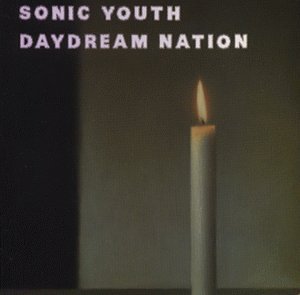
Twelve tracks in 70 minutes. Recorded across approximately three months at Greene Street Studios in NYC in summer 1988 with Nick Sansano engineering. Sonic Youth's fifth LP, the band's commercial breakthrough.
- Released
- October 18, 1988
- Label
- Enigma Records / Blast First (US, BFFP 34)
- Producer(s)
- Sonic Youth · Nick Sansano
- Runtime
- 70:47 (12 tracks)
- Chart peak (US)
- Did not chart
- Chart peak (UK)
- #99 (UK Albums Chart)
- Certifications
- Gold (RIAA, 1992)
- Awards & honours
- Library of Congress National Recording Registry (2005); ranked #38 on Rolling Stone's 500 Greatest Albums (2020)
Twelve tracks in 70 minutes (a double LP). Recorded across summer 1988 at Greene Street Recording in New York with Nick Sansano engineering and Sonic Youth self-producing. The band's fifth LP, Thurston Moore, Kim Gordon, Lee Ranaldo, Steve Shelley, and the culmination of their downtown-New-York no-wave-into-art-rock trajectory. The album that consolidated the altered-tuning, noise-and-structure guitar vocabulary as a sustained commercial-pop form and inaugurated the art-rock template every subsequent alternative-rock band negotiating noise and melody has worked within.
Sonic Youth in spring 1988 was four New York musicians at the culmination of an eight-year trajectory through the downtown no-wave and noise-rock undergrounds. Thurston Moore and Lee Ranaldo (guitars), Kim Gordon (bass and vocals), and Steve Shelley (drums, who had joined in 1985) had developed across four LPs, Confusion Is Sex (1983), Bad Moon Rising (1985), EVOL (1986), Sister (1987), a distinctive guitar vocabulary built on altered tunings, prepared guitars (objects wedged under the strings), and the structural integration of noise and melody. Daydream Nation was the culmination.
The band's altered-tuning methodology is central. Moore and Ranaldo played guitars tuned to non-standard tunings they had developed themselves, often different tunings for each song, sometimes requiring a dozen or more guitars on stage to accommodate the tuning changes. The tunings produced harmonic voicings impossible in standard tuning; combined with the prepared-guitar technique (drumsticks, screwdrivers, and other objects wedged under the strings), they produced the band's distinctive shimmer-and-clangor texture.
The album's central artistic decision was the deliberate expansion to double-LP scale and the integration of pop-melodic songwriting with extended noise-and-structure ambition. Where the band's previous LPs had been noise-forward and structurally fragmentary, Daydream Nation balances genuine pop melodies ('Teen Age Riot,' 'Hey Joni,' 'Candle') with extended seven-and-fourteen-minute structures that build from melody into noise and back. The album refuses to choose between pop accessibility and avant-garde ambition; the refusal is its specific argument and its lasting influence.
Sessions ran across summer 1988 at Greene Street Recording in SoHo, New York, with Nick Sansano engineering. The band self-produced. The double-LP scale, 70 minutes across four sides, was unusual for an underground-rock band of the period and reflected the band's deliberate ambition to make a statement-album rather than a collection of songs. The closing 'Trilogy' suite, 14 minutes across three movements, is the album's most expansive structural gesture.
Enigma / Blast First released the album in October 1988. The album was an underground-and-critical success rather than a commercial event; it didn't chart on the Billboard 200 on release. But its critical reception was extraordinary, and its influence on the gathering alternative-rock movement was immediate. The album led directly to Sonic Youth's 1990 major-label signing with Geffen / DGC, the same label that would sign Nirvana the following year, partly on Sonic Youth's recommendation.
The Gerhard Richter painting on the cover ('Kerze' / 'Candle,' 1983), a single lit candle against a dark background, became one of the most-recognized alternative-rock sleeve images. The use of a contemporary fine-art painting as cover signaled the album's art-rock ambition; Richter's work was reproduced with permission.
Critical reception was extraordinary and unanimous; subsequent critical-poll positioning placed Daydream Nation among the canonical alternative-rock LPs. The 2005 Library of Congress National Recording Registry induction, one of the earliest alternative-rock LPs inducted, and the 2020 Rolling Stone ranking confirm the institutional standing.
Daydream Nation belongs at #80 because it is the album that consolidated the altered-tuning, noise-and-structure guitar vocabulary as a sustained commercial-pop form. Every subsequent alternative-rock band negotiating noise and melody, Nirvana (whose Geffen signing Sonic Youth facilitated), My Bloody Valentine, Pavement, Yo La Tengo, Wilco's experimental moments, the entire 1990s art-rock-into-alternative tradition, runs on the proof Daydream Nation delivered. The Library of Congress induction confirms the canonical-text status.
Pressing guide — the one to own
There is no single "US/UK" original; Sonic Youth's double LP appeared as two distinct October 1988 first pressings. The UK Blast First issue (catalog BFFP 34, in association with Mute) came a day earlier; the US issue was Enigma in association with Blast First, catalog 7 75403-1, pressed by Allied. Both are 2xLP gatefolds, mastered at Masterdisk via Direct Metal Mastering (the runouts are etched with "MASTERDISK DMM" and Thurston Moore's joke side-titles), and shipped with a folded Michael Lavine band poster. The front cover reproduces Gerhard Richter's 1983 candle painting "Kerze." Clean originals with the poster intact typically trade in the low hundreds.