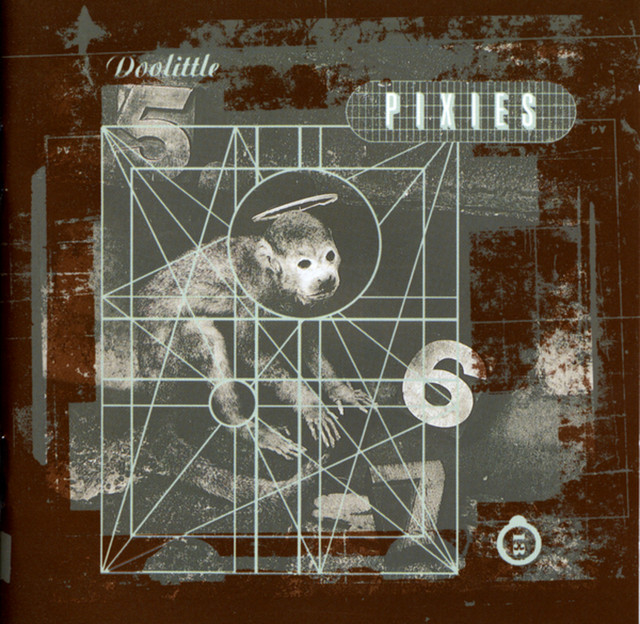
Fifteen tracks in 39 minutes. Recorded across 6 weeks at Downtown Recorders in Boston in October and November 1988 with Gil Norton producing, after the band had fired Steve Albini, the producer of their 1988 debut Surfer Rosa. The album that took Black Francis's surrealist-Spanish-screaming vocabulary, smoothed it just enough to chart, and built the quiet-loud-quiet dynamic template every guitar-rock band of the 1990s would either obey or revolt against.
- Released
- April 17, 1989 (UK); April 18, 1989 (US)
- Label
- 4AD (UK, CAD 905); Elektra (US, 60856)
- Producer(s)
- Gil Norton
- Runtime
- 38:38 (15 tracks)
- Chart peak (US)
- #98 (Billboard 200)
- Chart peak (UK)
- #8
- Certifications
- Gold (BPI, 1989); Gold (RIAA, 1995); Platinum (BPI, 2008)
- Awards & honours
- Ranked #142 on Rolling Stone's 500 Greatest Albums (2020); routinely cited as the most-influential alternative-rock LP of the 1980s
Fifteen tracks in 39 minutes. Recorded across 6 weeks at Downtown Recorders in Boston in October and November 1988 with Gil Norton producing, replacing Steve Albini, the producer of the band's 1988 debut Surfer Rosa whom they had fired during pre-production negotiations for Doolittle. The album that took Black Francis's surrealist-Spanish-screaming vocabulary, gave it a pop frame just sharp enough to chart, and built the quiet-loud-quiet dynamic template that Nirvana, Radiohead, PJ Harvey, and roughly every other major guitar-rock band of the 1990s would either obey or revolt against.
The Pixies in summer 1988 were four Boston musicians, Charles Thompson IV (performing as Black Francis), Joey Santiago, Kim Deal, and David Lovering, coming off a fifteen-month run that had taken them from a Massachusetts-college-house demo (the eight-song 'Purple Tape,' 1987) to a 4AD signing, a debut LP recorded by Steve Albini at Q Division in Boston (Surfer Rosa, March 1988), and a UK tour that had positioned them as the most-watched American import 4AD had ever signed. Surfer Rosa had charted at UK #2 on the independent chart and had been savaged by Albini in print interviews, Albini had publicly disparaged the band before the album was released, calling them 'patently lame.' 4AD's Ivo Watts-Russell pushed for a new producer for the second LP.
Gil Norton was thirty-one years old in summer 1988, a Liverpool-born producer who had spent the previous five years working on UK 4AD-adjacent catalogue, Echo & the Bunnymen's Porcupine and Ocean Rain, the Triffids' Calenture, the Sundays' early demos. Watts-Russell sent Norton the Surfer Rosa LP and a four-song demo Francis had cut in Boston. Norton flew to Boston in August 1988 to meet the band; pre-production sessions began at the Pixies' rehearsal space (a converted garage in Allston, Massachusetts) in late August and ran through September.
Norton's pre-production work was the album's structural decision. He had Francis play him each of the forty-odd songs Francis had ready as solo guitar-and-voice arrangements, then worked with the band to develop arrangements track-by-track over 6 weeks. The result is a band record but with substantially more compositional architecture than Surfer Rosa, the string quartet on 'Monkey Gone to Heaven,' the slow-build of 'No. 13 Baby,' the deliberate quiet-loud-quiet dynamic structure repeated across most of the album. Francis has said in interviews that Norton's pre-production made him 'a songwriter' rather than just a screamer.
Recording began at Downtown Recorders, a Boston studio on Boylston Street, on October 31, 1988. The six-week tracking schedule was substantially longer than Surfer Rosa's twelve-day Albini sprint. The band tracked live in the studio's Studio A, with overdubs done across Studio B over the second half of the schedule. Norton's engineering vocabulary, the Yamaha NS-10 reference monitors, the live-room mic placement, the deliberate use of room ambience on the drums, produced an album that sounds substantially more polished than Surfer Rosa without losing the band's guitar-and-screaming foundation. The compromise between art-rock production and garage-rock energy is the album's specific commercial achievement.
The album's fifteen tracks across 39 minutes are sequenced with deliberate dynamic alternation: the opening 'Debaser' / 'Tame' / 'Wave of Mutilation' triplet sets up the quiet-loud-quiet template; 'Here Comes Your Man' as track five is the deliberately conventional pop song the rest of the album defines itself against; the second half (tracks 8-15) cycles through brief-aggressive ('Crackity Jones'), mock-doo-wop ('La La Love You'), slow-build ('No. 13 Baby'), and the closing biblical-narrative pair ('Gouge Away' as Samson-and-Delilah). The biblical, surrealist, and Spanish-language lyrical motifs unify what would otherwise be a stylistically heterogeneous record.
4AD released the album on April 17, 1989 in the UK and one day later in the US through Elektra (which had picked up US distribution for 4AD's American releases beginning that year). UK reviews were ecstatic, Melody Maker's Steve Sutherland gave a cover feature; the NME ran a long Edwin Pouncey review treating the album as the defining American underground LP of the year. US reviews were more divided, Rolling Stone's David Fricke was sceptical, the Village Voice's Christgau gave it an A-minus. UK sales were immediate: the album entered the UK chart at #8 in May 1989, the band's first UK top-10 placement. US sales were slower but sustained, the album peaked at US #98 (the band's commercial ceiling in the US during their original run) and stayed on the Billboard 200 for 12 weeks.
'Here Comes Your Man' as lead single reached US Modern Rock #3 (a chart that had only existed since 1988) and UK #54, an unusual commercial performance for the band, whose other singles had been promo-only. 'Monkey Gone to Heaven' followed at Modern Rock #5 and UK #60. The album's commercial trajectory was modest by Top-40 measure but extraordinary for an underground-rock LP of 1989: by 1995, RIAA Gold; by 2008, BPI Platinum. The slow-burn catalogue presence, the album has remained continuously in print since 1989, is the album's specific commercial story.
Doolittle belongs at #83 because it is the album that took the underground-rock vocabulary of 1986-88 (Sonic Youth, Hüsker Dü, the Replacements, the Minutemen, the Meat Puppets, the Pixies' own Surfer Rosa) and produced the first commercially-positioned compromise document, pop-melodic enough to chart, weird enough to remain underground. Kurt Cobain has repeatedly cited the album, and 'Tame' in particular, as the structural template for 'Smells Like Teen Spirit.' Thom Yorke has named it as foundational for Radiohead's approach. PJ Harvey, Smashing Pumpkins, Nine Inch Nails, the Breeders (the band Kim Deal co-founded in 1989), Weezer, the Strokes, Yeah Yeah Yeahs, every commercially-positioned alternative-rock band of the subsequent two decades takes the album as either a model or a refusal. The album's commercial trajectory (US #98, UK #8, RIAA Gold by 1995, BPI Platinum by 2008) and critical canonization (Rolling Stone #142, routine appearance on greatest-album lists, the 2014 Pitchfork people's-poll #1) ratify the position.
Pressing guide — the one to own
Original 1989 UK pressing, 4AD CAD 905, with Vaughan Oliver's v23 design over Simon Larbalestier's monkey-with-halo photograph. It is a single LP in a standard (non-gatefold) sleeve with a printed inner; the true first edition added a 16-page lyric booklet. The runout is not a Porky's Prime Cut: the original UK copies were pressed by MPO and cut by Jack Adams, deadwax reading "MPO CAD 905 A1 JA" / "MPO CAD 905 B1." Clean complete copies with the booklet typically trade around £70–130.