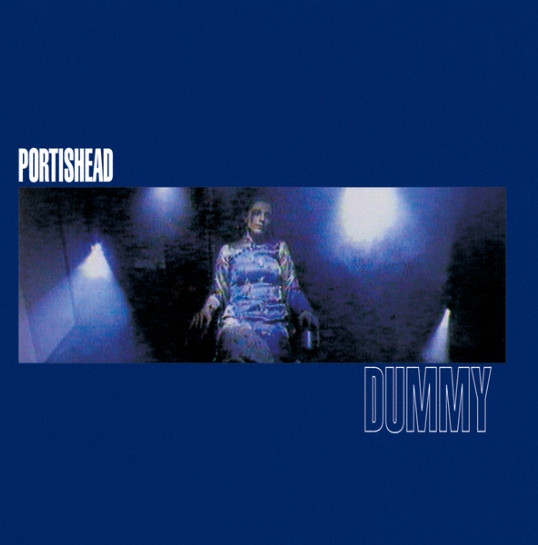
Eleven tracks in 49 minutes. Recorded across approximately ten months at Portishead's Coach House Studios in Bristol with Geoff Barrow and Adrian Utley producing. The Bristol trio's debut LP, Beth Gibbons's deliberately-restrained vocal over Barrow and Utley's deliberately-cinematic trip-hop production. The album that consolidated trip-hop as a commercial genre.
- Released
- August 22, 1994
- Label
- Go! Beat / Polydor (UK, 828 522-1)
- Producer(s)
- Geoff Barrow · Adrian Utley
- Runtime
- 48:48 (11 tracks)
- Chart peak (US)
- #79 (Billboard 200)
- Chart peak (UK)
- #2 (UK Albums Chart)
- Certifications
- Platinum (BPI, 1995); Gold (RIAA, 1996)
- Awards & honours
- Mercury Prize (1995); ranked #338 on Rolling Stone's 500 Greatest Albums (2020); inducted into the BBC's Top 50 albums of all time
Eleven tracks in 49 minutes. Recorded across approximately ten months at Coach House Studios and McRoberts Studio in Bristol with Geoff Barrow and Adrian Utley producing. Portishead's debut LP, Beth Gibbons's restrained, torch-song vocal over Barrow's noir-film sample collage and Utley's jazz guitar. The album that converted the Bristol sound from underground gossip into a Mercury Prize-winning commercial form and consolidated trip-hop as a sustained commercial genre.
Portishead in spring 1994 was three Bristol musicians whose collaboration had crystallized over the previous two years: Geoff Barrow, a twenty-two-year-old former tape-operator who had worked at Coach House Studios during the Massive Attack Blue Lines sessions (1990-91); Beth Gibbons, an older singer Barrow had met through an Enterprise Allowance Scheme jobseekers' course in 1991; and Adrian Utley, a jazz guitarist who had played in Big John Patton's organ trio and brought substantial harmonic sophistication to the project. The band took its name from the small coastal town near Bristol where Barrow had partly grown up.
Barrow had spent 1991-93 developing a production methodology that fused his hip-hop sample-and-scratch vocabulary with film-soundtrack atmosphere. He had been steeped in the Bristol sound-system culture that had produced the Wild Bunch collective (the Massive Attack precursor) and in the John Barry / Lalo Schifrin / Ennio Morricone film-music catalogue. The fusion, hip-hop production methodology applied to noir-film source material, is the band's central creative decision.
Recording extended approximately ten months across 1993-94, primarily at Coach House Studios in Bristol. Barrow's working method was deliberate and slow: he would build sample-based production beds, often recording his own session musicians playing parts that he would then sample back onto vinyl, scratch, and re-record, a circular methodology that allowed him to apply hip-hop production technique to original material. Gibbons would then write and record vocal melodies over the completed beds. Utley's guitar and Barrow's keyboard-and-turntable work were layered throughout.
The album's central artistic decision was the fusion of three apparently incompatible vocabularies: Gibbons's torch-song vocal (descended from Billie Holiday and Nina Simone), Barrow's hip-hop sample-and-scratch production, and the noir-spy-film atmosphere of the John Barry / Lalo Schifrin source library. The fusion had no clear 1994 commercial precedent; Massive Attack's Blue Lines (1991) had established the Bristol sound but had not produced the cinematic-torch-song register Portishead arrived at. Dummy is what happens when a hip-hop producer who loves film soundtracks builds a record around a torch singer.
The band promoted the album with an unusual gesture: a ten-minute short film, To Kill a Dead Man (1994), directed by Alexander Hemming, that Portishead scored and starred in, a deliberate noir-spy pastiche that established the album's visual vocabulary before its release. The film's spy-thriller atmosphere is the visual equivalent of the album's sonic argument.
Go! Beat released the album on August 22, 1994. The album entered the UK chart modestly but built across autumn 1994 to UK #2 by 1995, driven by the 'Glory Box' and 'Sour Times' singles. US entry at #79 was substantial for a debut trip-hop LP. The album won the 1995 Mercury Prize, beating Oasis's Definitely Maybe and Tricky's Maxinquaye, a Bristol-vs-Britpop competition that the music press treated as a referendum on the year's two dominant UK vocabularies.
Critical reception was extraordinary and unanimous. Melody Maker and NME both treated the album as the year's defining alternative-to-Britpop statement; subsequent critical-poll positioning placed it among the canonical trip-hop LPs. RIAA Gold US certification came in 1996; BPI Platinum UK in 1995. The album's commercial trajectory was sustained rather than launch-week, Dummy has remained continuously in print since 1994.
Dummy belongs at #74 because it is the album that converted the Bristol sound into a Mercury Prize-winning commercial form and consolidated trip-hop as a sustained commercial genre. Every subsequent torch-song-over-electronic-production LP, from Lamb to Morcheeba to Goldfrapp's Felt Mountain (2000) to Lana Del Rey's catalogue to FKA twigs to Billie Eilish's quieter material, runs on the proof Dummy delivered. The Mercury Prize win and the album's continuing catalogue presence (~4.6M monthly Spotify) confirm the canonical-text status.
Pressing guide — the one to own
Original 1994 UK pressing on Go! Beat (distributed by Go! Discs), catalog 828 522-1, a single LP in a standard (non-gatefold) sleeve. The cleanest way to identify the UK original is the tracklist: it has ten tracks and does NOT include 'It's A Fire', which was inserted on later US, Australian and European pressings (catalog 828 553). Spine reads 'PORTISHEAD DUMMY 828 522-1 GO! BEAT'. The CD was the primary launch format, but the UK first-press LP is the collector's target.