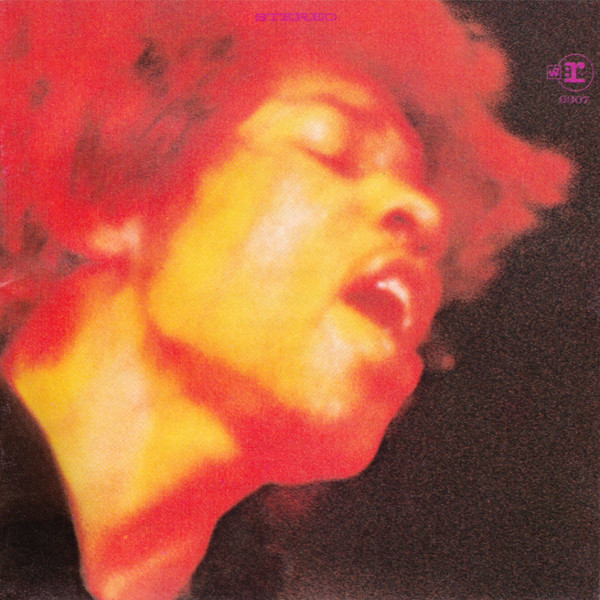
Jimi Hendrix's third and final studio album, a double LP recorded across nine months at New York's Record Plant with the Experience plus guest collaborators. The album that pushed Hendrix's vocabulary to its maximum.
- Released
- October 16, 1968 (US) · October 25, 1968 (UK)
- Label
- Reprise (US) · Track Records (UK)
- Producer(s)
- Jimi Hendrix
- Runtime
- 75:08 (16 tracks)
- Chart peak (US)
- #1 (Billboard 200, 2 weeks)
- Chart peak (UK)
- #6 (Record Retailer)
- Certifications
- 2× Platinum (RIAA); 8M units globally
- Awards & honours
- Library of Congress National Recording Registry (1999); ranked #54 on Rolling Stone's 500 Greatest Albums (2020)
Six months at the Record Plant in New York with Hendrix self-producing after Chas Chandler walked out. Sixteen tracks across 75 minutes of double LP. The album that confirmed Jimi Hendrix as the most influential rock guitarist of the postwar period, the album on which his Dylan cover became the song's canonical version, and the third and final studio LP he would release before his death in September 1970.
By spring 1968 Jimi Hendrix had been recording with the Experience for eighteen months. Are You Experienced (May 1967 UK / August 1967 US) had established him as the most influential new guitarist in rock; Axis: Bold as Love (December 1967 UK / January 1968 US) had confirmed and deepened the position. Both albums had been recorded relatively quickly, Are You Experienced across approximately 5 weeks of London sessions, Axis across approximately 2 weeks. Hendrix was 25, had relocated permanently to New York from London in March 1968, and had begun the next album's sessions at the Record Plant on West 44th Street in April 1968. The Record Plant, newly opened, with Eddie Kramer (who had engineered both prior LPs) as principal engineer, would become the album's principal location and would house Hendrix for the next six months.
The album's recording took place between April and August 1968 across multiple studios. Initial sessions were at Olympic Studios in London (March 1968, before Hendrix relocated to New York); the bulk of recording was at the Record Plant New York between April and August; final overdubs occurred at the Record Plant Hollywood in late summer. Chas Chandler, Hendrix's manager, former bassist of the Animals, and producer of both prior Experience albums, was the credited producer through approximately May 1968. Chandler walked out of the sessions in mid-May, frustrated by Hendrix's perfectionism (some tracks went through fifty takes), the constant presence of an entourage of musicians, friends, and hangers-on at the studio, and the visible escalation of Hendrix's drug use. Hendrix took over production himself with engineer Eddie Kramer for the remaining four months. The album's deliberate density, overdubs, tape effects, extended instrumentals, is partly the document of Hendrix unsupervised.
The sixteen tracks are deliberately varied in approach and quality. 'And the Gods Made Love' opens the album with a tape-effects collage, backwards guitar, varispeed, deliberately disorienting. 'Have You Ever Been (To Electric Ladyland)' establishes the album's psychedelic-soul aesthetic. 'Crosstown Traffic', released as the album's first single, peaked US #52, is a deliberately pop construction. 'Voodoo Chile' is the album's fifteen-minute blues epic with Steve Winwood on Hammond organ, Jack Casady (of Jefferson Airplane) on bass, and Mitch Mitchell on drums; the track was recorded essentially live in a single afternoon at the Record Plant with a small audience including members of the Airplane. '1983... (A Merman I Should Turn to Be)' is the album's thirteen-minute psychedelic-narrative centerpiece. 'All Along the Watchtower', Hendrix's Bob Dylan cover, recorded across twenty-five takes between January and August 1968, would become the album's defining track and one of the most influential covers in rock history.
The 'Watchtower' recording is the album's most-documented session and one of the most-studied in modern rock. Hendrix had heard Dylan's John Wesley Harding version on its December 1967 release and immediately wanted to record it. Initial sessions at Olympic Studios in London in January 1968, with Dave Mason of Traffic on 12-string acoustic, Hendrix on lead electric, Mitch Mitchell on drums, produced an early version that Hendrix felt was incomplete. The track was re-recorded and overdubbed multiple times across the spring at the Record Plant. The final version (released in September 1968 as a single, then on the album in October 1968) uses Mason on 12-string acoustic, Hendrix on four overdubbed electric guitar parts (rhythm, lead, slide, and the climactic ascending figure at 1:52), and Mitch Mitchell on drums. The song became Hendrix's highest-charting single, reaching US #20 in November 1968. Dylan has said in interviews that the cover is so completely successful that he plays the song in Hendrix's arrangement at every live show after 1974. A rare case of the cover replacing the original.
Noel Redding, the Experience's bassist since the band's formation, was barely present for the recording. Redding had been increasingly alienated from Hendrix's musical direction since the Axis sessions; the constant entourage and drug culture at the Record Plant made his presence increasingly uncomfortable. Bass on most Electric Ladyland tracks is played by Hendrix himself, by Jack Casady, or by other session musicians; Redding contributes bass to only a handful of tracks. He announced his departure from the band during the supporting tour after the album's release. The Experience as a working unit was already fracturing during the sessions; Electric Ladyland is therefore both the band's high commercial point and the document of its dissolution.
The album was released on October 16, 1968 (US) and October 25 (UK) as a 16-track double LP. Released into the violent late-1968 cultural moment, the Tet Offensive earlier that year, MLK's assassination in April, RFK's assassination in June, the Chicago Democratic Convention police riots in late August, the album sat in the post-everything mood of autumn 1968 with a particular weight. Hendrix's 'House Burning Down' is explicitly about urban racial violence; 'All Along the Watchtower' read in October 1968 as an apocalyptic comment on the year that had just happened. The album peaked at US #1 (Hendrix's only chart-topping LP) and UK #6. First-year sales were approximately 2 million. The album's reputation has compounded continuously since.
Electric Ladyland belongs at #38 because it is the album in which Jimi Hendrix used the studio as his primary instrument and produced the rock album the post-1968 moment was waiting for. The Chas Chandler exit, the Noel Redding absence, the rotating cast of guests, these are not signs of dysfunction but of an artist who had outgrown the band format and was figuring out what to do next. Hendrix would never make another studio album; the planned Electric Lady Studios sessions in 1970 would be cut short by his September death at age 27. Electric Ladyland therefore stands as his complete late-period studio statement. The Watchtower cover proved he could displace even Dylan when he wanted to; the rest of the album proves he had outgrown the rock-song format he had inherited. Every subsequent generation of rock guitarist has had to position themselves in relation to this record.
Pressing guide — the one to own
1968 UK first pressing, Track Records 613008/9 (two-LP gatefold) with the original Karl Ferris naked-women cover photograph (subsequent reissues replaced this with an alternate Linda Eastman portrait of Hendrix and the Experience). Look for the matrix etchings 613008-A1 / B1 / 613009-A1 / B1, hand-etched at Polydor's Hamburg facility. The very earliest UK pressings have the deliberately controversial naked-women cover that was banned by some UK record retailers and was replaced by the US Reprise alternate cover on subsequent pressings.