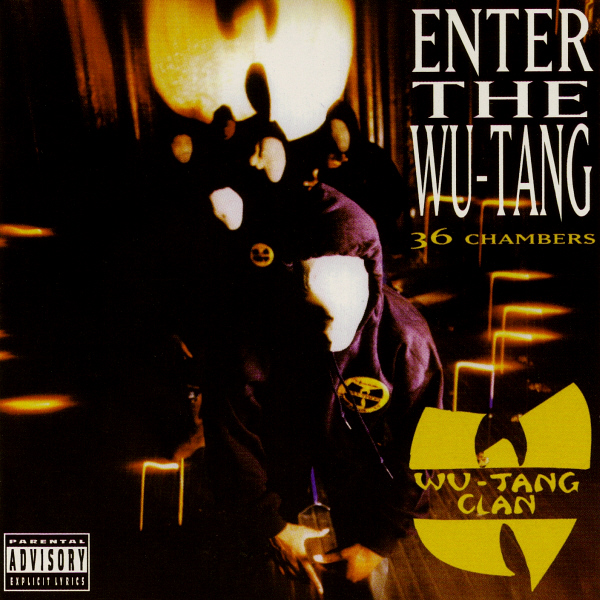
Twelve tracks in 61 minutes. Recorded across approximately eighteen months at RZA's basement studio in Staten Island and at Firehouse Studios in Manhattan with RZA producing the entire album. Nine MCs from the projects of Staten Island and Brooklyn, working under a kung-fu-mythos brand RZA had built around the Shaolin-monastery imagery. Released to commercial indifference and gradually consolidated as the founding text of East Coast hardcore hip-hop.
- Released
- November 9, 1993
- Label
- Loud Records / RCA Records (US, 66336-2)
- Producer(s)
- RZA (sole producer)
- Runtime
- 61:30 (12 tracks)
- Chart peak (US)
- #41 (Billboard 200); #8 (Top R&B/Hip-Hop)
- Chart peak (UK)
- Did not chart on initial release; #11 (1995 reissue)
- Certifications
- Platinum (RIAA, 1995); 3× Platinum (RIAA, 2018)
- Awards & honours
- Source Five Mic rating (1993); ranked #27 on Rolling Stone's 500 Greatest Albums (2020); Library of Congress National Recording Registry (2013)
Twelve tracks in 61 minutes. Recorded across approximately eighteen months at RZA's basement studio in Staten Island and at Firehouse Studios in Manhattan with RZA producing the entire album. Nine MCs from the projects of Staten Island and Brooklyn, working under a kung-fu-mythos brand RZA had built around Shaolin-monastery imagery. Released to commercial indifference and gradually consolidated as the founding text of East Coast hardcore hip-hop, the album that introduced the multi-MC collective model that would define hip-hop's commercial-and-aesthetic vocabulary through the 1990s.
The Wu-Tang Clan in summer 1992 was nine MCs from the housing projects of Staten Island and Brooklyn: Robert Diggs (RZA), Gary Grice (GZA), Russell Jones (Ol' Dirty Bastard), Clifford Smith (Method Man), Dennis Coles (Ghostface Killah), Corey Woods (Raekwon), Jason Hunter (Inspectah Deck), Lamont Hawkins (U-God), and Elgin Turner (Masta Killa). They had been collaborating since 1991 under various names; in summer 1992, RZA brought them together under the Wu-Tang Clan umbrella with a specific working method: each MC would sign individually to the Wu-Tang collective, with RZA retaining production control over the group's first album, after which each MC could sign individually to any major label for solo work. The arrangement was unprecedented in commercial hip-hop and produced the multi-label solo-album rollout (Method Man to Def Jam, Raekwon to Loud, ODB to Elektra) that would define the Clan's mid-1990s commercial dominance.
Recording began at RZA's basement studio in Staten Island in autumn 1992. The studio was a deliberately-lo-fi facility, a single Akai S950 sampler, a Roland TR-808 drum machine, and RZA's growing sample library of kung-fu movie audio, jazz, soul, and obscure 1970s funk records. The first major recording was 'Protect Ya Neck,' the independent-pressing 12-inch single released in summer 1992 that established the Wu-Tang Clan as a hip-hop force. The single sold approximately 10,000 copies through independent distribution; the resulting underground buzz brought Steve Rifkind's Loud Records to sign the group in spring 1993. Loud was a newly-formed RCA subsidiary; the deal allowed Wu-Tang to retain creative control while RCA distributed.
The album sessions ran from spring 1993 through autumn at RZA's basement studio and at Firehouse Studios in Manhattan. RZA's working method was specific: he would build a beat at his basement studio overnight, then bring it to the studio the following day for the MCs to write verses over. The deliberately-collaborative working method produced the album's specific multi-MC architecture; most tracks have between three and eight Clan members trading verses. The kung-fu mythology RZA had built around the group, the Shaolin-monastery imagery, the deliberately-mystical lyric references, the 'Wu-Tang' name itself (derived from a 1980s Hong Kong action film), became the album's specific brand identity.
The album's twelve tracks include nine Clan members (with Masta Killa appearing on only the closer 'Wu-Tang: 7th Chamber - Part II'), with most tracks featuring three to eight MCs trading verses. The deliberately-grimy RZA production approach, the lo-fi Akai S950 sampling, the deliberately-dirty 808 drums, the deliberately-unmastered final mixes, was the album's specific sonic signature. The production discipline was so deliberately-rough that some reviewers questioned whether the album had been professionally mastered at all; RZA has said in subsequent interviews that the deliberately-lo-fi approach was 'a creative choice, not a budget choice.' The album's eventual canonization in the 1996-1998 hip-hop critical conversation rehabilitated the deliberately-rough aesthetic as the founding text of East Coast hardcore hip-hop.
Loud RCA released the album on November 9, 1993 with substantial promotional support for an independent-distributed hip-hop release. The album debuted at US #99 on the Billboard 200 and gradually climbed through the holiday season; it peaked at US #41 by spring 1994 (driven by the 'C.R.E.A.M.' and 'Method Man' singles' commercial success). The 1995 album rollout of individual Clan members' solo LPs, Method Man's 'Tical' (November 1994, US #4), Ol' Dirty Bastard's 'Return to the 36 Chambers' (March 1995, US #7), Raekwon's 'Only Built 4 Cuban Linx...' (August 1995, US #4), GZA's 'Liquid Swords' (November 1995, US #9), transformed the Wu-Tang collective into the dominant force in East Coast hip-hop. Loud's deliberately-coordinated release strategy across the four solo LPs (each on a different major label) made the Wu-Tang model the most-imitated commercial-hip-hop business model of the mid-1990s.
The album's cultural impact has been continuous since the mid-1990s. The Wu-Tang's specific working method (the multi-MC collective with individual solo deals) was widely imitated through the late 1990s and early 2000s (Junior M.A.F.I.A., the Dipset collective, Slaughterhouse, Black Hippy). The RZA production vocabulary (lo-fi sampling, kung-fu mythology, deliberately-grimy sound) became the foundational template for East Coast hardcore hip-hop's continued development. The album's commercial trajectory has been the steady canonization-via-Clan-member-solo-success template; cumulative US sales reached 3M units by 2018, with the album charting continuously on the Billboard 200 catalogue chart since 1994.
Enter the Wu-Tang (36 Chambers) belongs at #62 because it is the album that established the multi-MC collective model that would define East Coast hip-hop's commercial-and-aesthetic vocabulary through the 1990s and provided the kung-fu-mythology brand template every subsequent multi-MC hip-hop collective has worked within. The Wu-Tang business model (collective ownership, individual solo deals, coordinated multi-label rollout) was the most-imitated mid-1990s commercial-hip-hop architecture. RZA's deliberately-grimy production discipline became the foundational East Coast hardcore aesthetic. The album's specific contribution to hip-hop's late-1990s development, the Clan-member-solo-album rollout, the deliberately-cinematic narrative aesthetic, the persistent sample-based production approach, set the template that has continued through the present. The Library of Congress National Recording Registry induction in 2013 confirms a position the music itself had secured by the end of the Wu-Tang solo-album rollout in 1995.
Pressing guide — the one to own
Original 1993 US pressing on Loud Records / RCA, mastered by Chris Gehringer at The Hit Factory, NYC. Both the CD (07863-66336-2) and the SRC-pressed vinyl LP (07863-66336-1) date from 1993, not 1994. The original LP is identified by its red labels and a yellow Wu-Tang logo on the spine, with a full stamper ring that encircles the Wu-Tang Records logo without touching it; later repressings have a whiter spine and a smaller stamper ring. The genuine collector premium is this 1993 first pressing rather than any of the recent anniversary reissues.