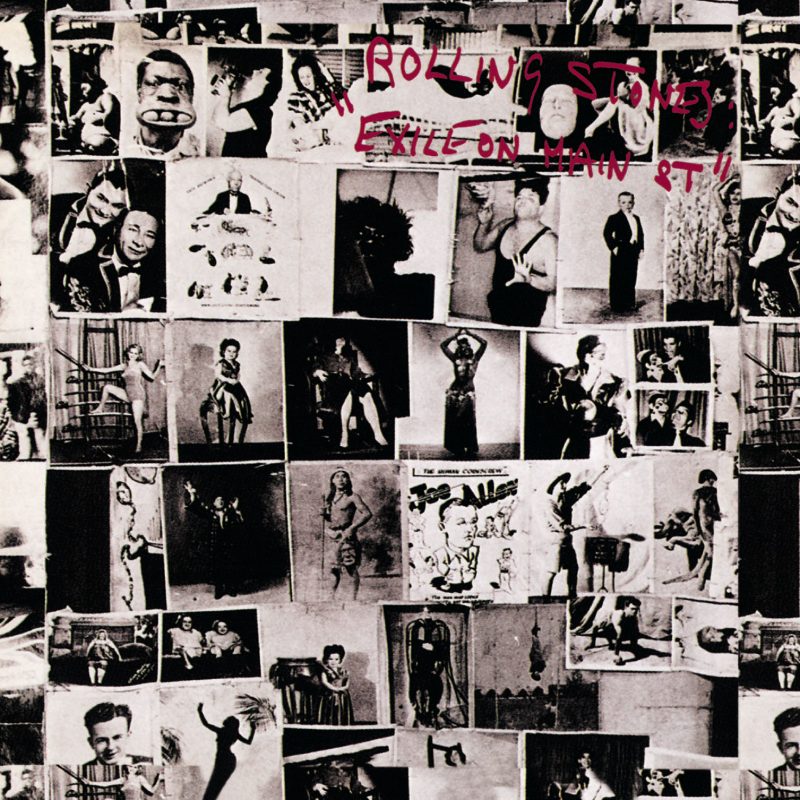
The Rolling Stones, fleeing UK tax authorities, rented a crumbling mansion on the French Riviera, ran a mobile recording truck into the basement, and made the most disordered great rock album ever released. Eighteen songs. Four sides. 90 percent of the work was done in a humid cellar in Villefranche-sur-Mer.
- Released
- May 12, 1972
- Label
- Rolling Stones Records / Atlantic (US) · Rolling Stones Records / EMI (UK)
- Producer(s)
- Jimmy Miller · Engineer: Andy Johns
- Runtime
- 67:07 (double LP, 18 tracks)
- Chart peak (US)
- #1 (Billboard 200, 4 weeks)
- Chart peak (UK)
- #1 (Record Retailer, 1 week)
- Certifications
- Platinum (RIAA, 1988); 2× Platinum (BPI, 2013); estimated 8M+ units globally
- Awards & honours
- Rolling Stone 500 Greatest Albums (rose from outside the top 50 in 1987 to #14 in 2020); Library of Congress National Recording Registry pending; ranked #1 on multiple all-Stones polls since 2000
Mick Jagger had just married Bianca. Keith Richards was deep into heroin. Charlie Watts was running on cigarettes and tea. Mick Taylor was the new guitarist nobody understood. Bill Wyman left the basement to call his wife. The album they made together is the closest rock music has come to a documentary record of itself.
By the spring of 1971, the Rolling Stones owed the British government £6 million in back taxes. The Inland Revenue had been pursuing the case since 1968. The band's accountants, after exhausting every legal option, recommended what was then a radical step: leave the country. Mick Jagger married Bianca Pérez-Mora Macías on May 12, 1971, in Saint-Tropez. Eight days later, the band, their families, their road crew, and several million pounds of recording equipment crossed the English Channel by ferry and settled along the Côte d'Azur. Keith Richards rented Villa Nellcôte, a sixteen-room neoclassical mansion in Villefranche-sur-Mer that had been used as a Gestapo headquarters during World War II, for £1,000 a week. The Stones spent the summer there. They emerged 10 weeks later with sixteen of the eighteen songs that would become Exile on Main St.
The Villa Nellcôte basement wasn't, by any conventional measure, a recording studio. The ceilings were low. The humidity was high. The air conditioning didn't work. The electrical wiring was so unreliable that they had to run a generator from the truck parked outside on the gravel drive. The truck was the Rolling Stones Mobile Studio, a converted Bedford lorry equipped with a 16-track Helios console, Studer A800 tape machines, and miles of cabling that ran out of the truck, under a door, and down a narrow corridor into the basement. Andy Johns engineered. Jimmy Miller produced. Cables had to be re-patched several times a day as humidity affected the connectors. The band recorded at night, ate dinner at midnight, and slept until late afternoon. The schedule was, in practice, that of a Manhattan jazz club rather than a London recording studio.
Keith Richards was the de facto bandleader at Nellcôte. Mick Jagger was in Paris attending to Bianca, who was pregnant with Jade, and arrived in Villefranche on a schedule that the rest of the band described as erratic. The album that Exile became, sprawling, blues-soaked, vocally indistinct, anti-glamorous, is the album Richards wanted to make and the album that Jagger has spent fifty years saying he never fully understood. The Stones had been at the peak of their international fame since Beggars Banquet in 1968; they had produced Let It Bleed, Sticky Fingers, and a half-dozen iconic singles in three years. Exile is the album in which they refused to make another tightly-arranged pop record. They wanted to make a rough double LP that sounded like a series of late-night basement jams. They made one.
What the album does, sonically, is something almost no other Stones record does: it buries the lead vocals. Jagger sings on most tracks, but his voice sits inside the band rather than on top of it. The mix favors guitars, layered acoustic and electric, often three or four of them at once. Charlie Watts's drums are recorded close, dry, and almost percussionless on cymbals, the snare and kick carry the time. Bobby Keys plays saxophone everywhere; Nicky Hopkins plays piano on more than half the album; Jim Price plays trumpet and trombone. The arrangements feel improvised even when they aren't. Songs lurch into each other; 'Loving Cup' begins with a piano figure that Hopkins is still working out; 'Soul Survivor' has Keith and Mick Taylor playing slightly different versions of the same lead line.
It is also the most stylistically promiscuous Stones LP. Side one is rock and R&B; side two is country, gospel, and acoustic blues; side three is funk-rock and ballads; side four is gospel, the Robert Johnson tradition, and the album's only true 'single' ('Happy,' Keith Richards's first-ever lead vocal). 'Sweet Virginia' is a country drinking song with mandolin and pedal steel; 'Sweet Black Angel' is a calypso-style protest song about Angela Davis; 'Just Wanna See His Face' is a Pentecostal gospel improvisation that the band recorded in a single take at the Sunset Sound overdub sessions; 'Shine a Light' is a soul ballad with Billy Preston playing organ in the New Orleans style. There is no single Exile sound. The album is a survey of American music as filtered through five British musicians and one Texan piano player living in a basement in the south of France.
When Exile was released in May 1972 it was widely considered a disappointment. Lester Bangs reviewed it in Creem as 'depressing'; Robert Christgau gave it a B-plus. The mix was described as muddy and the vocal performances as buried. The album reached number one on both sides of the Atlantic but the singles did not break out the way Sticky Fingers's 'Brown Sugar' and 'Wild Horses' had. The Stones themselves did not include any Exile songs in their touring repertoire for the rest of the 1970s. By the end of the decade the album was understood as a transitional record between the band's peak run and their slow decline into Some Girls, Tattoo You, and the long professional middle age.
The critical re-evaluation began in the mid-1980s. Rolling Stone's 1987 anniversary issue ranked it outside the top 50 of all time; by 2003 it had moved to #7. The 2010 reissue, which added an unreleased disc of period-appropriate material assembled by Don Was, drove a new wave of attention. 'Plundered My Soul' became a top-30 single. The documentary 'Stones in Exile' aired on the BBC the same year. By the 2020 Rolling Stone re-ranking, Exile was at #14, ahead of every other Stones album except some lists where Sticky Fingers competes. The critical position is now settled: it is the most-discussed Stones album, the one most often handed to people who don't own a Stones record, and the one whose flaws (the muddy mix, the indistinct vocals, the sprawling length) have come to feel like its argument.
Exile on Main St. belongs at #12 because it is the album on which a rock band at the height of its commercial powers chose to refuse polish, to refuse hits, to refuse the studio-as-camera, and to embed itself instead inside an aesthetic that sounded like the band itself was being captured by accident. Every American underground rock band of the late 1980s and early 1990s, the Replacements, Big Star at the end, Pavement, Guided by Voices, Wilco, Drive-By Truckers, is a child of this album. So is most of the alt-country that emerged in the 1990s. So is the entire mid-fi school of recording. The Stones gave permission for rock to be roomy, ragged, and audibly assembled from parts. It has been roomy and ragged ever since.
Pressing guide — the one to own
Original 1972 UK first pressing, Rolling Stones Records COC 69100, a double LP in a gatefold sleeve issued with the set of twelve postcards. The postcard insert is the collector's marker; original copies almost always lose them, so complete examples carry a clear premium. Documented UK first-press runouts read in the COC 69100 A1 / B1 / C1 / D1 family. The Robert Frank 'tattoo parlour' cover photography is shared across editions, but the UK pressing is the one collectors chase for the postcards and pressing quality.