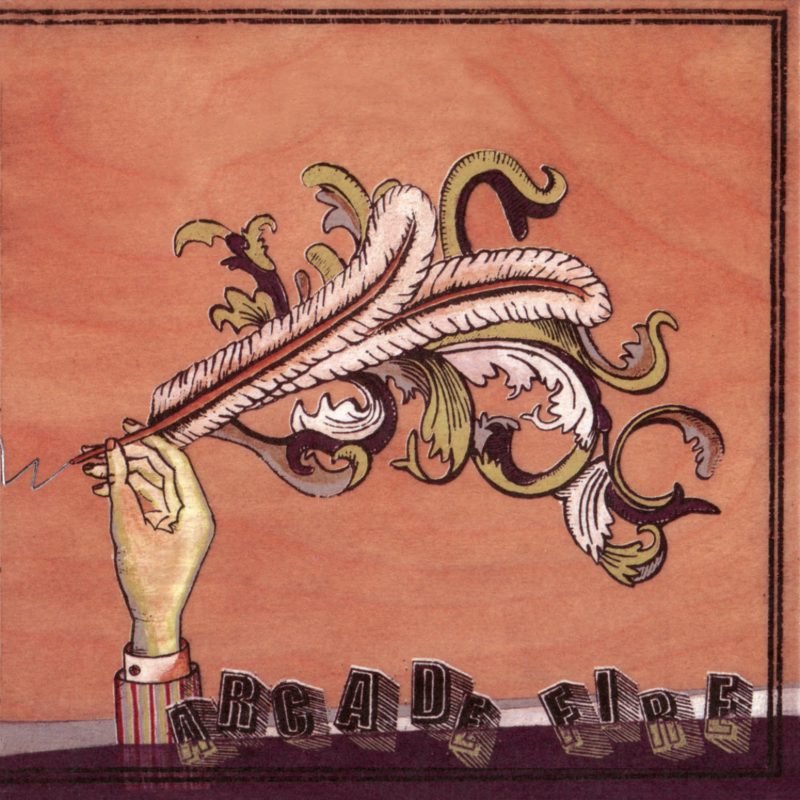
Ten tracks in 48 minutes. Recorded at the Hotel2Tango in Montreal between August 2003 and August 2004 with Howard Bilerman engineering and Arcade Fire self-producing, sessions punctuated by the deaths of multiple band-member family members across the recording period. The Montreal collective's debut LP, released by Merge Records in September 2004. The album that converted Canadian-indie underground into international commercial-pop form and inaugurated the maximalist-orchestral-indie-rock template that has defined a generation of festival-headlining bands.
- Released
- September 14, 2004
- Label
- Merge Records (US, MRG255); Rough Trade (UK, RTRADCD200)
- Producer(s)
- Arcade Fire · Howard Bilerman
- Runtime
- 47:43 (10 tracks)
- Chart peak (US)
- #131 (initial peak); #2 (post-Grammy 2011 catalogue surge)
- Chart peak (UK)
- #33
- Certifications
- Gold (RIAA, 2009); Platinum (BPI, 2008)
- Awards & honours
- Mercury Prize nomination (2005); Polaris Music Prize shortlist (founding ceremony equivalent); ranked #151 on Rolling Stone's 500 Greatest Albums (2020); the canonical indie-rock LP of the 2000s
Ten tracks in 48 minutes. Recorded at the Hotel2Tango in Montreal between August 2003 and August 2004 with Howard Bilerman engineering and Arcade Fire self-producing, sessions punctuated by the deaths of multiple band-member family members across the recording period. The Montreal collective's debut LP, released by Merge Records in September 2004. The album that converted Canadian-indie underground into international commercial-pop form and inaugurated the maximalist-orchestral-indie-rock template that has defined a generation of festival-headlining bands.
Arcade Fire in spring 2003 was a Montreal collective coalescing around Win Butler (a Texas-born art-school student at McGill), Régine Chassagne (a Montreal native and McGill jazz student of Haitian heritage), and a rotating cast of contributors. Win and Régine had married in August 2003; the band's lineup had stabilized by autumn 2003 around Richard Reed Parry, Tim Kingsbury, William Butler (Win's younger brother), and drummer Howard Bilerman (who also engineered). Sarah Neufeld joined as violinist in 2004.
Sessions began at Howard Bilerman's Hotel2Tango studio in Montreal's Mile End neighborhood in August 2003. Hotel2Tango was a small DIY studio operated by Bilerman with substantial reverb-friendly acoustics. The recording was self-financed for the first several months; Merge Records (the North Carolina-based indie label founded by Mac McCaughan of Superchunk) signed the band in spring 2004 based on the partial recordings.
Across the August 2003 through August 2004 recording period, the band experienced multiple family deaths: Régine Chassagne's grandmother died; Win and William Butler's grandfather (Alvino Rey, jazz musician) died; Richard Reed Parry's aunt died. The album's title 'Funeral' refers explicitly to these losses; the 'In the Backseat' closer addresses Régine's grandmother directly. The biographical context of accumulated mortality shapes the album's lyrical content throughout.
The 'Neighborhood' suite, four tracks across the album's first half, is the album's central conceptual frame. The four tracks ('Tunnels,' 'Laïka,' 'Power Out,' '7 Kettles') narrate four interrelated scenarios set in a recurring Neighborhood. The structural device, multiple tracks within a concept-suite, descends from Pet Sounds-and-Sgt. Pepper-era pop-album traditions but is unusual for early-2000s commercial-indie. The suite's narrative consistency across the four tracks is the album's most-cited single artistic gesture.
Sessions extended through August 2004 with substantial multi-instrumental overdubs and orchestral additions. The album's twelve credited band members on various tracks (Win, Régine, Richard Reed Parry, Tim Kingsbury, William Butler, Sarah Neufeld, Howard Bilerman, plus guest contributors) produce a maximalist-orchestral arrangement vocabulary unusual for early-2000s indie rock. Howard Bilerman's engineering allowed the substantial layering without losing the room-ambience texture the Hotel2Tango's acoustics provided.
Merge released the album on September 14, 2004 in North America; Rough Trade released in the UK on February 28, 2005. Initial sales were modest, approximately 4,000 first-week US SoundScan units. The album's commercial trajectory was sustained rather than launch-week event: by 2007 the album had reached approximately 500,000 US units; RIAA Gold certification followed in 2009. UK BPI Platinum certification came in 2008. The slow-burn catalogue trajectory is characteristic of independent-label commercial-pop releases of the period.
Critical reception was unanimous and unusually expansive. Pitchfork's David Moore gave the album 9.7/10, the magazine's highest-scoring album of 2004; NME's Tim Jonze called it 'the album of the decade so far' (in February 2005); Rolling Stone's David Fricke gave it four-and-a-half stars; the Mercury Prize nomination came in 2005. The album's reception consolidated Merge Records' standing and inaugurated the Arcade Fire trajectory that would lead to the 2011 Grammy Album of the Year win for The Suburbs.
Funeral belongs at #94 because it is the album that converted Canadian-indie underground into international commercial-pop form and inaugurated the maximalist-orchestral-indie-rock template every subsequent festival-headlining indie-rock band has worked within. Every Decemberists, Beirut, the National, Bon Iver-with-orchestra, Fleet Foxes, Vampire Weekend, the 1975 LP that takes orchestral indie-rock as a starting point descends from the proof Funeral delivered. The Arcade Fire 2011 Grammy Album of the Year win for The Suburbs ratified the broader trajectory the album had launched. The Rolling Stone 2020 #151 ranking confirms the canonical-text status.
Pressing guide — the one to own
Original US vinyl pressing, Merge MRG-255, which followed the 2004 CD in early 2005, with Tracy Maurice's cover artwork. It was cut at Golden Mastering, 'GOLDEN' is stamped in the runout alongside the etched MRG-255-A/B matrix. Clean first-press copies on the original Merge labels are the target; the album was repressed on 180-gram from 2009 onward. Confirm the MRG-255 catalogue number to separate an original from the later repressings.