
№ 55 of 100
good kid, m.A.A.d city
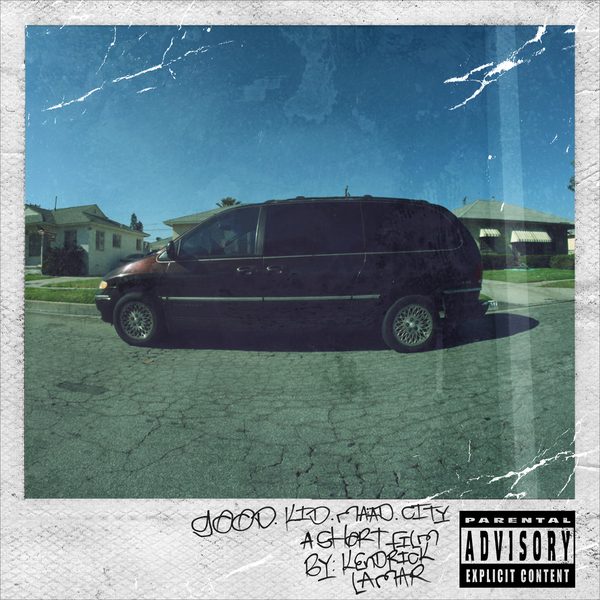
good kid, m.A.A.d city by Kendrick Lamar (2012), № 55 in The Lead-In’s 100 greatest albums. Side two of Low is the founding document of ambient pop and a lot of what came after counts as plagiarism.
good kid, m.A.A.d city by Kendrick Lamar (2012), № 55 in The Lead-In’s 100 greatest albums. Side two of Low is the founding document of ambient pop and a lot of what came after counts as plagiarism.
Twelve tracks in 68 minutes. Subtitled 'A Short Film by Kendrick Lamar.' Recorded across approximately fourteen months at TDE's House of Studios in Carson, California with Dr. Dre executive-producing and a rotating roster of fifteen producers. A concept album structured as a single day in Lamar's seventeen-year-old Compton life, with interstitial voicemails from his actual parents tying the narrative together. The album that turned a Compton mixtape rapper into a mainstream commercial pop figure and inaugurated the West Coast hip-hop renaissance of the 2010s.
Twelve tracks. 68 minutes. A concept album structured as a single day in Kendrick Lamar's seventeen-year-old Compton life, with interstitial voicemails from his actual parents tying the narrative together. Subtitled 'A Short Film by Kendrick Lamar.' The album that turned a Compton TDE-mixtape rapper into a mainstream commercial pop figure, inaugurated the West Coast hip-hop renaissance of the 2010s, and proved that cinematic-conceptual hip-hop could be mainstream commercial pop at the highest register.
Kendrick Lamar Duckworth in autumn 2011 was twenty-four years old, the son of a Chicago-born former Gangster Disciples affiliate who had relocated his family to Compton in 1987 to escape that life, and a mixtape rapper signed to Top Dawg Entertainment, an independent Carson-California label run by Anthony 'Top Dawg' Tiffith. Lamar had released two mixtapes, 'Overly Dedicated' (2010) and 'Section.80' (2011), that had built a substantial underground following without commercial pop reach. Dr. Dre had heard 'Section.80' through Aftermath's A&R department in late 2010 and had signed Lamar to Aftermath/Interscope in spring 2011, with Top Dawg Entertainment retaining co-ownership of Lamar's contract. The first Aftermath-era release was planned for late 2012; the album that became good kid, m.A.A.d city was scheduled to be the commercial breakthrough.
The conceptual frame had been forming for two years. Lamar had been writing autobiographical material for Section.80 and had concluded that the more-effective container for his Compton material was a unified narrative rather than a song-cycle. The structural conceit, a single day in Lamar's seventeen-year-old life, beginning with him driving to meet a girl named Sherane and ending with the album's victory-lap closer 'Compton', was crystallized at TDE's House of Studios (a converted Carson residence the label used as its primary recording facility) in spring 2012. The interstitial voicemails were recorded with Lamar's actual parents (Kenny Duckworth and Paula Oliver) at the family home in Compton; the parents agreed to participate on the condition that the content reflect their actual relationship with Lamar rather than dramatized characters.
Recording ran through summer and autumn 2012 across multiple studios. The bulk of tracking happened at TDE's House of Studios in Carson; additional sessions at Westlake Audio (Hollywood), Larrabee Sound (North Hollywood), and Dr. Dre's home studio in Calabasas. The producer roster was rotating: Sounwave (TDE's in-house producer) was the most-consistent presence; Hit-Boy, Just Blaze, Pharrell Williams, T-Minus, Tha Bizness, Scoop DeVille, DJ Dahi, and seven additional producers contributed individual tracks. Dr. Dre's executive-producer role was supervisory rather than hands-on; he was simultaneously working on Detox (the album that ultimately never released) and on the Compton album that would arrive in 2015. Top Dawg Tiffith ran the day-to-day production decisions.
The album's structural innovation, the concept-album-as-cinematic-narrative approach, was not new to hip-hop. Prince Paul's 3 Feet High and Rising had established the skit-as-album-architecture template in 1989; Snoop Dogg's Doggystyle (1993), Kanye West's My Beautiful Dark Twisted Fantasy (2010), and Lupe Fiasco's The Cool (2007) had all attempted similar narrative containers with varying success. Lamar's specific contribution was the integration of actual-parent voicemails as the narrative spine. The voicemails are not skit-format dramatizations; they are real recordings (or recreations of real conversations) between Lamar and his parents about the events of his teenage years. The integration of biographical reality into a major-label commercial pop product was unprecedented at the album's release register.
Interscope released the album on October 22, 2012 with significant promotional support. The pre-album singles, 'The Recipe' (April 2012, featuring Dr. Dre), 'Swimming Pools (Drank)' (July 2012), and 'B*tch, Don't Kill My Vibe' (October 2012), had built substantial mainstream-rap-radio rotation through summer and autumn 2012. The album debuted at US #2 on the Billboard 200 with 242,000 first-week SoundScan units, the second-largest first-week for a hip-hop album of 2012 (behind Drake's Take Care). 'Swimming Pools' eventually peaked at US #17 on the Hot 100; 'Poetic Justice' (the Drake-featuring single) reached US #25 in spring 2013. The album was certified Platinum (RIAA) by January 2014 and would eventually reach 4× Platinum.
The Grammy Awards in January 2014 produced the album's most-cited cultural moment. good kid, m.A.A.d city was nominated for seven Grammys including Album of the Year (Lamar was the youngest African-American Album of the Year nominee since the category's reform). The album lost in every category to Macklemore & Ryan Lewis's 'The Heist', a controversial result that Macklemore himself publicly acknowledged as unfair in a text message to Lamar that Macklemore subsequently posted to Instagram. The Macklemore-victory framing has shadowed the album's award-season reception; the album's actual commercial trajectory (Platinum then 2× Platinum then 4× Platinum across the subsequent decade) and critical canonization (Library of Congress 2023) suggest that the Grammy result was the moment's miscalibration rather than a lasting verdict.
good kid, m.A.A.d city belongs at #55 because it is the album that proved cinematic-conceptual hip-hop could be mainstream commercial pop at the highest register and inaugurated the West Coast hip-hop renaissance of the 2010s (YG, ScHoolboy Q, Vince Staples, Anderson .Paak, Tyler the Creator's late-period LPs are all in conversation with this album). The integration of biographical-reality interstitials (the actual-parent voicemails) became a structural template every subsequent ambitious hip-hop concept album has worked within. Lamar's specific contribution to the form, the day-in-the-life narrative as commercial pop container, the cinematic frame as marketing strategy, the deliberate refusal of conventional album-radio-hit calculus, set the template for his three subsequent LPs (To Pimp a Butterfly, DAMN., Mr. Morale & the Big Steppers) and for the Pulitzer-Prize-winning canonical hip-hop tradition that has formed around his catalogue. The album's late-period commercial trajectory (4× Platinum a decade after release, Library of Congress in year eleven) confirms a position the music itself had secured by the end of its first chart cycle.
Original first vinyl pressing, Top Dawg / Aftermath / Interscope B0017695-01, a 2xLP Deluxe Edition in a gatefold sleeve, released October 2012 alongside the CD, not in April 2013. Mastering is credited to Brian Gardner and Mike Bozzi, with lacquers cut by Scott Stratton; there is no Bernie Grundman credit. First-press identifiers are the barcode 602537192267 and the runout matrices B0017695-01LP01-A/B and -01LP02-A/B. A genuine 10th-anniversary 2xLP reissue followed in 2022 (variants include translucent Black Ice, opaque Apple Red and Milky Clear, no 'oxblood' edition existed). A repeatedly repressed title, so originals carry little premium, roughly £15-£40.
© The Lead-In · an independent, reader-supported music publication.