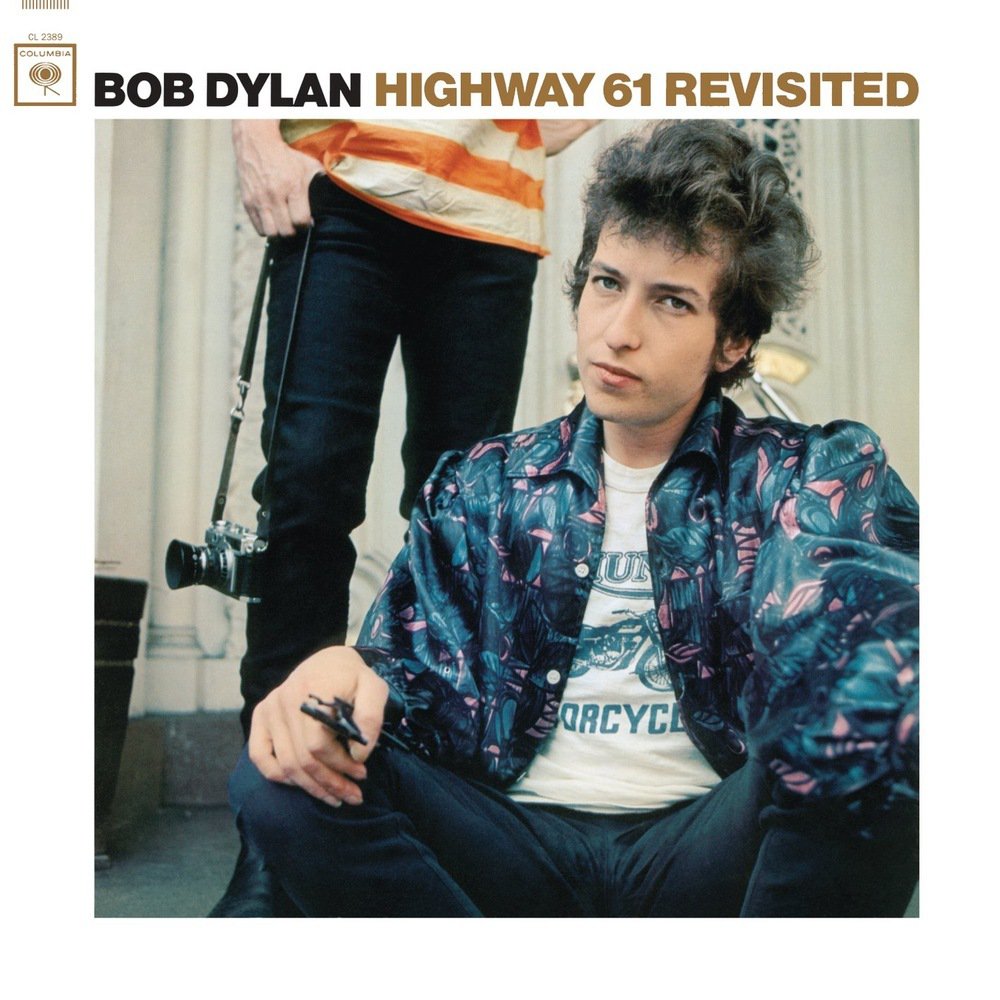
The album that opens with 'Like a Rolling Stone' and never apologizes for what it is. Six days at Columbia 30th Street and Studio A in New York in June and August 1965, with a young Al Kooper improvising the organ part that would change pop, and Bob Dylan completing his transformation from folk singer into the most important songwriter alive.
- Released
- August 30, 1965
- Label
- Columbia
- Producer(s)
- Bob Johnston (most tracks); Tom Wilson ('Like a Rolling Stone')
- Runtime
- 51:36
- Chart peak (US)
- #3 (Billboard 200)
- Chart peak (UK)
- #4 (Record Retailer)
- Certifications
- 2× Platinum (RIAA); estimated 5M+ units worldwide
- Awards & honours
- Grammy Hall of Fame (1999); Library of Congress National Recording Registry (2002); routinely cited as one of the greatest albums in pop
Six recording days in summer 1965, June 15 and 16 for 'Like a Rolling Stone,' July 29 and 30 and August 2 and 4 for the rest of the album. Twelve session musicians most of whom had never met before. Bob Dylan, 24 years old, dictating arrangements from a cigarette-stained sheet of legal pad while playing a Fender Stratocaster he had owned for 3 weeks.
Dylan in mid-1965 was at the most-watched point of his career. He had just returned from the British tour documented in D.A. Pennebaker's 'Don't Look Back.' He had played the controversial electric set at the Newport Folk Festival on July 25 (booed by parts of the audience for the electric reinvention, applauded by parts, the booing widely overstated in subsequent mythology). Bringing It All Back Home, his March 1965 album, had introduced him to electric backing on its first side. He had grown disenchanted with the folk-revival movement that had made him famous; he'd been writing songs in his head for months that didn't fit any folk template he knew. He arrived at Columbia's 30th Street Studio on June 15, 1965, with the lyric to 'Like a Rolling Stone' typed out on hotel-room stationery from his July 1964 tour of California, he'd been carrying it for a year.
The first session was June 15. Tom Wilson, who had produced Bringing It All Back Home, was the producer. The band was Mike Bloomfield (lead guitar, Bloomfield was 22 and had been playing with the Paul Butterfield Blues Band; Dylan had personally telephoned him three days earlier), Paul Griffin (piano), Joe Macho Jr. (bass), Bobby Gregg (drums), and Bruce Langhorne (tambourine, Langhorne would later be the 'Mr. Tambourine Man' of the same-titled song). Dylan played acoustic guitar and harmonica; Al Kooper, a 21-year-old session guitarist who had been brought in to play guitar, found himself sidelined when Bloomfield arrived and took the lead-guitar slot. Kooper drifted to the Hammond B-3 organ in the corner, an instrument he had never played before, and waited to be told to leave.
He wasn't told to leave. Wilson and Dylan listened to take after take of 'Like a Rolling Stone' and grew increasingly unhappy with the band's settling-in process. The fifth or sixth take had Kooper playing the organ figure, eight bars behind the rhythm-section beat, half-improvising the lead, in a way that filled the song's empty space without competing with Bloomfield. Wilson asked Dylan if Kooper should keep playing. Dylan said yes. Wilson asked Kooper if he could really play the organ. Kooper said no. They kept the take anyway. The released version of 'Like a Rolling Stone' is from this session, Take 4 of the second day, June 16. The organ part that has been imitated in pop for sixty years is Kooper improvising as a guitarist who has been moved to an instrument he doesn't play, playing slightly behind the band because he cannot keep up.
Tom Wilson left Columbia shortly after the June sessions. Bob Johnston, a Nashville-based country producer who had been working with Columbia on the side, was brought in for the July and August sessions. The band changed slightly: Bloomfield returned for the second batch; Charlie McCoy (a Nashville session bassist who would also play on Blonde on Blonde the following year) was added on guitar and bass; Russ Savakus replaced Joe Macho on bass; Sam Lay replaced Bobby Gregg on drums for some tracks. The sessions ran in three-day blocks (July 29–30 and August 2 and 4) and produced eight of the album's nine tracks. The final track sequencing was decided in mixing in early August.
What was happening in those rooms was a kind of methodological accident: a young songwriter playing a brand-new instrument (the Fender Stratocaster, 3 weeks old) with a band that had never played his songs before, in a studio whose engineering staff didn't entirely know what they were recording. The album that emerged is the most consequential single accident in the history of pop. Dylan had written most of the songs in his Woodstock home in May and June 1965, long lyric poems, multiple verses, no choruses, lyric structures more in common with Robert Browning's dramatic monologues than with any folk-song template. 'Desolation Row,' the album's 11-minute closer, is a 10-verse piece with no chorus. 'Highway 61 Revisited' is a 5-verse blues with a police-siren whistle on top. 'Ballad of a Thin Man' is a confrontation song addressed to a journalist, possibly Time magazine's Jeffrey Jones, possibly a composite, that has been read for sixty years as the most-savage portrait of the music press ever set to record. 'Just Like Tom Thumb's Blues' is a six-verse travelogue through Juarez, Mexico. 'Tombstone Blues' is a five-verse historical-political collage that references John the Baptist, Belle Starr, Jezebel, Galileo, Beethoven, Ma Rainey, Brother Bill, Cecil B. DeMille, and Gypsy Davy in a single song. The lyrics on Highway 61 Revisited are the most-quoted Dylan lyrics of the 1960s and the most-influential lyric writing in pop.
What the album does that hadn't been done before is treat rock and roll as a vehicle for the kind of writing that had previously been the province of poetry. Dylan was, by 1965, reading Rimbaud, Verlaine, William Blake, Allen Ginsberg, and Jack Kerouac; he had been close with Ginsberg since 1963 and would tour with him in 1975 on the Rolling Thunder Revue. The verses on Highway 61 Revisited are written with the syntactic looseness of Beat poetry and the imagistic density of late-19th-century French Symbolism, set to a 12-bar blues or its variants. The combination had not previously been attempted in pop. Within a year, every serious songwriter in America (Bruce Springsteen, then 16, would later describe hearing 'Like a Rolling Stone' on the radio in New Jersey as the moment he understood what he wanted to do for a living) and most in the UK (Lennon was rebuilding his lyric vocabulary in 1965 in direct response to Dylan) was working through the implications.
The album was released on August 30, 1965, 5 weeks after the Newport Folk Festival, 3 weeks after the final session. It peaked at #3 on the Billboard 200 (held off the top by The Sound of Music soundtrack and Joan Baez's Farewell, Angelina). The single 'Like a Rolling Stone' had already reached #2 on the Hot 100 in July (held off by The Beatles' 'Help!'). The album was widely reviewed; critics struggled to describe it. Robert Shelton in the New York Times called it 'as confident as it is iconoclastic.' The folk press was either ecstatic (Sing Out! magazine reluctantly came around) or hostile (Irwin Silber's 'Open Letter to Bob Dylan' in Sing Out! had appeared the previous November and wouldn't be retracted). The rock-and-roll press, which had not previously existed in any serious form, began to be invented in response to records like this one.
Highway 61 Revisited belongs at #7 because of what it permitted. The six albums above it on this list are inventing more compressed or more emotionally unified statements; Highway 61 is more sprawling, more lyrically maximalist, more loosely produced. But it is the album where pop music decided it could be the vehicle for serious writing, that a three-minute song could carry the kind of ambition previously reserved for novels and poetry. Every serious lyric writer in pop since 1965 has been operating under permission Highway 61 Revisited wrote. The reason it isn't higher is that the songs vary in their hit rate; the album is uneven by design, and 'Highway 61 Revisited' the title track and 'Just Like Tom Thumb's Blues' are not the equal of 'Like a Rolling Stone' or 'Desolation Row.' But the album opens with the song that announced rock as art and closes with an 11-minute lyric epic that proved the form. The albums at the top of this list are the most-important pop records of the modern era; Highway 61 is the moment a 24-year-old folk singer became a 24-year-old something else entirely. Pop hasn't gotten over the transformation.
Pressing guide — the one to own
Original 1965 US mono pressing on Columbia (a US label that reads 'Columbia', not 'CBS'), catalog CL 2389, with the red-and-black 'two-eye' label and the Daniel Kramer cover photograph. The first-press deadwax matrix is XLP 110638 (side 1) / XLP 110639 (side 2)—not the often-quoted 'XSM 110961/110962'. The original was issued in a single-pocket sleeve, not a gatefold. The 'two-eye' label was Columbia's standard design through the mid-1960s.