
№ 92 of 100
Homogenic
Homogenic by Björk (1997), № 92 in The Lead-In’s 100 greatest albums. Björk in a Spanish villa with Mark Bell from LFO and an Icelandic string octet. The album where she figured out she could carry a full record alone.
Homogenic by Björk (1997), № 92 in The Lead-In’s 100 greatest albums. Björk in a Spanish villa with Mark Bell from LFO and an Icelandic string octet. The album where she figured out she could carry a full record alone.
Ten tracks in 44 minutes. Recorded across approximately ten months in Spain (El Cortijo, near Málaga) and London with Björk self-producing alongside Mark Bell (LFO), Howie B, and Markus Dravs. Björk's third solo studio LP, the deliberately fractured electronic-orchestral statement after her year of relentless Post-era touring and the 1996 stalker incident. The album that converted Björk from quirky-pop figure into experimental-pop visionary and consolidated the strings-plus-beats vocabulary every subsequent art-pop LP has worked within.
Ten tracks in 44 minutes. Recorded across approximately ten months in Spain (El Cortijo, near Málaga) and London with Björk self-producing alongside Mark Bell (LFO), Howie B, and Markus Dravs. Björk's third solo studio LP, the deliberately fractured electronic-orchestral statement after her year of relentless Post-era touring and the 1996 stalker incident that had reshaped her relationship to public life. The album that converted Björk from quirky-pop figure into experimental-pop visionary and consolidated the strings-plus-beats vocabulary every subsequent art-pop LP has worked within.
Björk Guðmundsdóttir in summer 1996 was thirty years old, two and a half years past Debut's commercial breakthrough (July 1993, UK #3), one year past Post's commercial peak (June 1995, UK #2), and recovering from one of the most disturbing public events in late-1990s pop-music history. On September 12, 1996, an American stalker named Ricardo López had mailed Björk an acid-letter bomb from his Florida apartment and had then committed suicide by gunshot, filming the entire eighteen-day preparation. Scotland Yard had intercepted the bomb at Heathrow. The video had been recovered from López's apartment. Björk had spent the subsequent months in seclusion at her mother's house in Reykjavík.
By spring 1997 Björk had relocated to Spain, to El Cortijo, a converted farmhouse-and-studio facility near Málaga that she rented for the recording period. The Spanish location was deliberately remote, accessible by car only, and chosen for its isolation from London's and New York's pop-cultural infrastructure. The Post-era collaborators (Nellee Hooper, Howie B, Tricky) were partially replaced by a smaller team: Mark Bell of LFO (the Sheffield techno duo), Howie B (continuing from Post), and Markus Dravs (Brian Eno's then-protégé and engineering collaborator). Eumir Deodato, the Brazilian arranger with deep CTI Records and Frank Sinatra credits, was hired for the string arrangements.
Sessions began at El Cortijo in March 1997 and continued through autumn. The recording methodology was unusual: Björk recorded basic vocal-and-instrumental sketches at El Cortijo, then traveled to London for the Bell electronic-production sessions and the Deodato string-orchestra recording. The Icelandic Symphony Orchestra section was tracked at Reykjavík's Háskólabíó concert hall in late summer; the London additional sessions were at Mayfair Studios and Olympic Studios. The split-location, multi-stage recording is the album's specific production architecture.
The album's central artistic decision was the integration of two opposing sonic vocabularies into a single coherent statement: aggressive electronic-techno rhythm programming (Bell's contribution) and rich-string-arrangement orchestral writing (Deodato's contribution). Previous Björk records had sequenced electronic and orchestral material across separate tracks; Homogenic integrates both within single songs throughout the album. 'Jóga' opens with a string-orchestra introduction that gives way to Bell's drum-and-bass programming; 'Bachelorette' sustains both elements simultaneously across the song's full length. The integration was technically difficult, string arrangements and rhythm programming have substantially different reverb and dynamic characteristics, and Markus Dravs's mixing decisions across the album are the production's central technical achievement.
Sjón, the Icelandic novelist and Björk's longtime lyrical collaborator since the Sugarcubes era, co-wrote 'Jóga' and 'Bachelorette' (the album's most narrative-driven tracks). The remaining lyrics are Björk's own. The album's emotional register is more controlled and more confrontational than Post or Debut, 'Hunter,' 'Unravel,' '5 Years,' and 'Pluto' all address public-life pressures, personal-relationship difficulty, and what Björk has subsequently called 'the cost of being known.' The 1996 stalker incident is not explicitly addressed but its reception-context presence is unmistakable throughout the album.
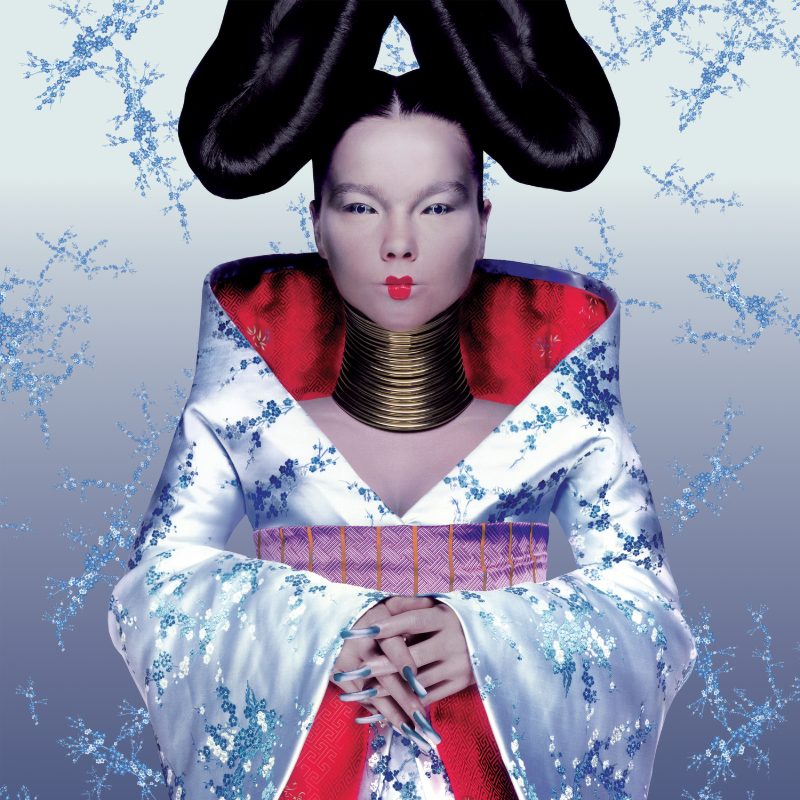
The Alexander McQueen-styled cover image was photographed by Nick Knight in summer 1997 at his London studio. Björk wears a geisha-styled kimono designed by McQueen, with her hair in elaborate updo, against a flat black background. The image is one of the most-recognized commercial-pop covers of the late 1990s and inaugurated McQueen's pop-music collaboration trajectory that would continue through the 2000s.
One Little Indian released the album on September 22, 1997. UK chart entry at #4 was Björk's strongest UK opening to that point. US entry at #28 (Elektra distribution) was her US peak. The album sold approximately 1.5 million units within twelve months and reached lifetime sales of approximately three million. Critical reception was unanimous and unusually expansive, Mercury Prize nomination, Pitchfork retroactive 9.5/10, Rolling Stone four stars, NME Album of the Year (1997). The album's reception consolidated Björk's transition from quirky-pop figure into experimental-pop visionary.
Homogenic belongs at #91 because it is the album that consolidated the strings-plus-beats vocabulary every subsequent art-pop LP has worked within and proved that experimental electronic-orchestral integration could deliver commercial reception at major-label scale. Every art-pop LP of the subsequent twenty-five years, from Sigur Rós's catalogue to Joanna Newsom's Ys (2006, with Van Dyke Parks orchestral arrangements) to Bat for Lashes to FKA twigs's catalogue to Caroline Polachek's catalogue, runs on the proof Homogenic delivered. The Chris Cunningham-directed 'All Is Full of Love' video in MoMA's permanent collection and the Mercury Prize nomination ratify the institutional standing.
Original 1997 UK pressing, One Little Indian TPLP71, the cover photographed by Nick Knight with Bjork styled by Alexander McQueen, wearing his blue-and-white kimono and Shaun Leane's coiled neckpiece. First UK copies came in a printed card inner sleeve. The album is widely regarded as one of the better-pressed One Little Indian titles, and the 1997 original is preferred over the 2000 and later 180-gram reissues. Confirm the TPLP71 catalogue number on the spine and labels to separate an original from a repress.
© The Lead-In · an independent, reader-supported music publication.