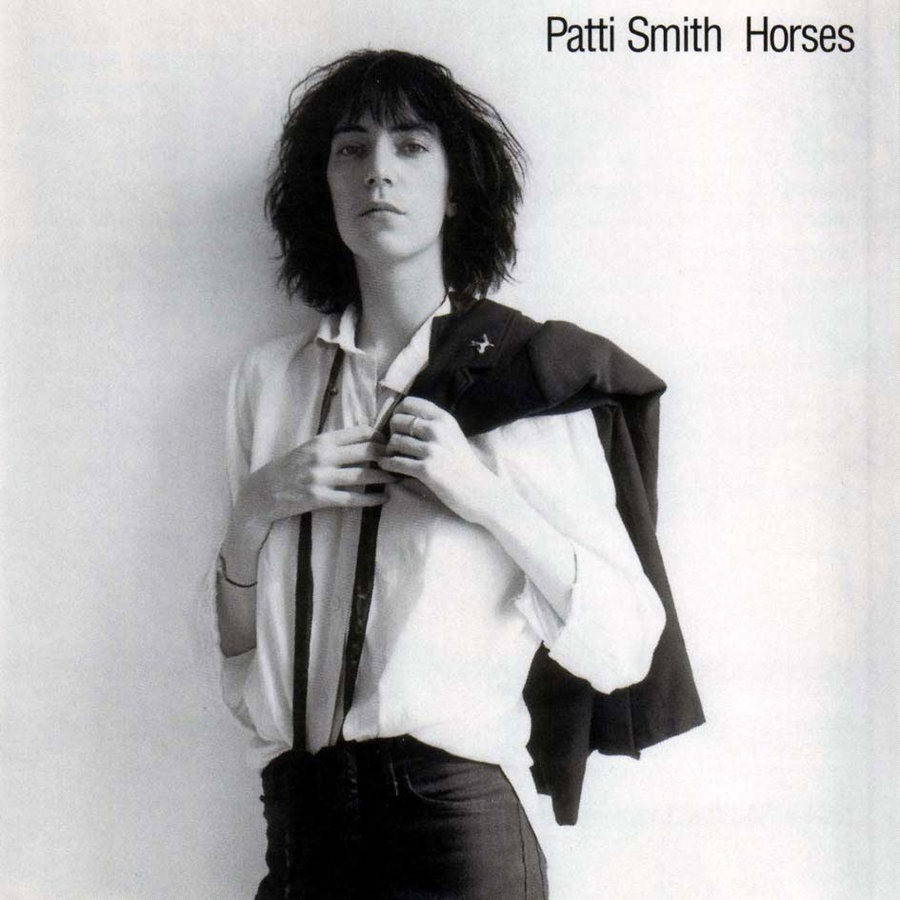
Eight tracks in 43 minutes. Recorded at Electric Lady in August and September 1975 with John Cale producing under conditions of mutual hostility. Released by a label that didn't yet know what to do with her. The album that turned a Lower East Side bookstore poet into the founding figure of New York punk and made every subsequent debate about what a rock front-person could be take Patti Smith as its reference point.
- Released
- November 10, 1975
- Label
- Arista Records (AL 4066)
- Producer(s)
- John Cale
- Runtime
- 43:10 (8 tracks)
- Chart peak (US)
- #47 (Billboard 200, March 1976)
- Chart peak (UK)
- Did not chart on initial release; #69 on 1996 reissue
- Certifications
- Gold (RIAA, November 1976)
- Awards & honours
- Library of Congress National Recording Registry (2009); ranked #26 on Rolling Stone's 500 Greatest Albums (2020); Grammy Hall of Fame (2011)
Eight tracks in 43 minutes. Recorded at Electric Lady Studios in August and September 1975 with John Cale producing under conditions of mutual hostility. The album that turned a Lower East Side bookstore clerk and St. Mark's Poetry Project regular into the founding figure of New York punk, and the record that proved a rock front-person could be a woman whose primary instrument was her voice as language.
Patti Smith was twenty-eight years old when she walked into Electric Lady Studios on August 28, 1975 to begin recording Horses. She had grown up in working-class South Jersey, dropped out of Glassboro State College in 1967 after an unplanned pregnancy and adoption, moved to New York the same year, and spent the following eight years working at Scribner's bookshop on Fifth Avenue, sharing a Chelsea Hotel room with Robert Mapplethorpe, performing poetry at St. Mark's Church-in-the-Bowery, and writing for Creem and Rolling Stone. Her band, Lenny Kaye on guitar (a record-store clerk and music writer she had met in 1971), Richard Sohl on piano, Ivan Kral on bass and rhythm guitar, Jay Dee Daugherty on drums, had been playing the new Bowery venue CBGB through the spring and summer of 1975. Clive Davis had signed her to the newly-formed Arista Records in May 1975 on a one-album option, with a £7,500 advance against future royalties.
John Cale was hired as producer at Smith's insistence, over Davis's preference for someone with a more conventional pop-rock track record. Cale had left the Velvet Underground six years earlier and had been producing other artists' records (Nico's Marble Index, the Stooges' debut, Nick Drake's session work). Smith chose him for the Velvets reference and for the classical-music vocabulary he brought to rock production. The choice was, in retrospect, both inspired and disastrous. Cale wanted what he heard at CBGB, the raw band, captured live, with minimal embellishment. Smith wanted something larger: stacked vocals, ambient textures, the poetry-reading vocabulary she'd been developing for five years. Sohl has said in subsequent interviews that the studio arguments became 'physical at one point' and that Cale walked out of two sessions.
The sessions ran roughly 4 weeks across late August and September 1975 at Electric Lady, the Hendrix-built studio on West 8th Street where Smith's circle had been recording demos since 1973. Engineer Bernie Kirsh ran the desk. The basic tracks were cut live, the band in the live room and Smith in an isolated vocal booth; overdubs were limited to backing vocals (Allen Lanier on 'Elegie,' Tom Verlaine on 'Break It Up') and the occasional second guitar pass. The longer pieces, 'Birdland' at 9 minutes, 'Land' at nine and a half, were recorded in single takes the band had rehearsed for weeks at the West 23rd Street loft Smith and Kaye shared. Cale insisted on no edits within those takes; the version of 'Birdland' on the album is what was played, in one pass, in early September.
The album opens with the most-quoted line in the prehistory of punk: 'Jesus died for somebody's sins, but not mine.' What follows is not a song. It is Smith's 1970 prose poem 'Oath,' delivered over Sohl's gospel piano figure, then mounting in intensity until, at the one-minute-forty-eight mark, Kaye's electric guitar enters, the band falls in behind, and Van Morrison's 1964 garage-rock standard 'Gloria' takes over. The two pieces are interleaved for the remaining 4 minutes of the track. The seam between them is the founding gesture of an entire vocabulary.
The album's eight tracks divide into the long pieces and the short ones. 'Gloria,' 'Birdland,' and 'Land' are the manifestos, extended improvisations built on band riffs Smith improvises lyrics over, the dynamic range from spoken-word whisper to scream covering the entire field. 'Redondo Beach' is the unlikeliest track on the album, a reggae arrangement Smith chose because she wanted, in her words, 'a sunny death song.' 'Free Money' is the most conventional rock song on the record, Kaye's two-chord guitar pattern under a lyric about Smith's mother's lottery fantasies. 'Kimberly' is named for Smith's youngest sister, a meditation on the 1965 lightning storm the lyric describes. 'Break It Up,' co-written with Verlaine and featuring Verlaine's lead guitar, is a dream-narrative about Jim Morrison. 'Elegie,' the closer, is an elegy for Hendrix, written and recorded in his old studio.
The Mapplethorpe cover photograph was taken in February 1975, six months before the album was recorded, at the Greenwich Village apartment of Sam Wagstaff (Mapplethorpe's then-partner and patron). Smith is wearing a white shirt picked up at the Salvation Army on East 4th Street, a black jacket slung over her shoulder, dark trousers, no makeup, hair short and unfussed. Mapplethorpe used available northern window light through the apartment's tall sash windows; the wall behind her is unadorned white plaster with a faint shadow. The session took 30 minutes. Arista's art department asked for the image to be cropped to a conventional portrait orientation; Smith refused. The square crop, full-frame, ungroomed became, within five years, one of the most-imitated portraits in pop music. The triangular shadow on the wall behind Smith's right shoulder is the image's specific signature.
Arista released the album on November 10, 1975 with minimal promotion. Reviews split sharply between the rock press (Lester Bangs in Creem and Robert Christgau in the Village Voice both ecstatic) and the broadsheet rock columns (the New York Times's John Rockwell wary, the Los Angeles Times's Robert Hilburn dismissive). Sales were slow through November and early December. The album debuted on the Billboard 200 at #135 the week of December 6, climbed gradually through the holiday season, entered the top 100 in mid-January, and peaked at #47 in March 1976. It was certified Gold by the RIAA in November 1976, twelve months after release, and has remained continuously in print ever since.
Horses belongs at #51 because it is the album that simultaneously inaugurated New York punk and proved that a rock front-person could be a woman whose primary instrument was her voice as language. Every subsequent female-led rock vocal performance that treats the voice as a literary device rather than a melodic one, PJ Harvey, Kim Gordon, Cat Power, Karen O, St. Vincent, Florence Welch, has Smith in its family tree. The CBGB scene she was part of (Television, Talking Heads, the Ramones, Blondie) was the New York pop counterweight to the contemporaneous London punk insurgency; Horses preceded the first Ramones LP by six months and the Sex Pistols' first single by a year. The Mapplethorpe portrait became as iconic as the music; the album-and-portrait pairing has been the most-imitated single-image-plus-record gesture in pop.
Pressing guide — the one to own
Original 1975 US first pressing, Arista AL 4066, single sleeve with the square Robert Mapplethorpe portrait, light-blue Arista labels reading 'STEREO.' The record was produced by John Cale and cut by Bob Ludwig at Sterling Sound, not Greg Calbi (a 'GC' runout points to the 2005 Legacy remaster). The first-press tell is in the deadwax: the matrix runs AL 4066-SA / AL 4066-SB and carries Ludwig's hand-etched 'STERLING RL' plus the personal inscriptions 'MOM+DAD' and 'DADDY FRANK, LINDA+TODD.' A clean original is plentiful and inexpensive, typically trading around £40-£80.