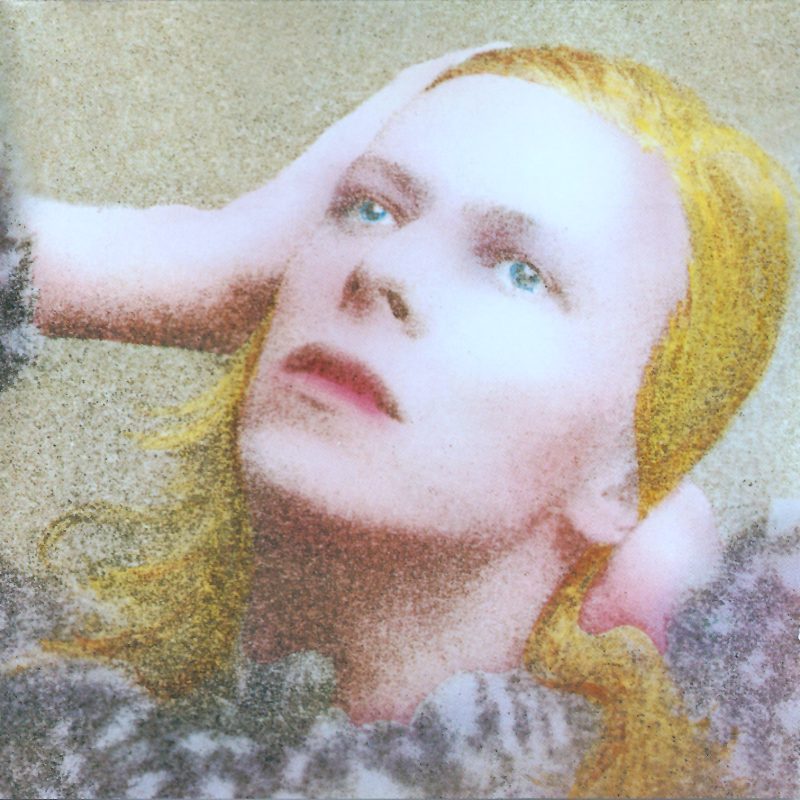
David Bowie's fourth album, the precursor to Ziggy Stardust. Recorded at Trident Studios summer 1971. The album where Bowie became Bowie.
- Released
- December 17, 1971
- Label
- RCA Records
- Producer(s)
- Ken Scott · David Bowie
- Runtime
- 41:55 (11 tracks)
- Chart peak (US)
- #93 (Billboard 200, rose after Ziggy)
- Chart peak (UK)
- #3 (Record Retailer)
- Certifications
- Platinum (RIAA); 4M+ units globally
- Awards & honours
- Library of Congress National Recording Registry (2017); ranked #88 on Rolling Stone's 500 Greatest Albums (2020)
2 weeks at Trident Studios in London with Ken Scott co-producing. Eleven tracks across 42 minutes. The album that turned David Bowie, twenty-four, married, recently a father, signed to a fresh RCA contract after years of commercial failure, from a struggling art-school singer into the songwriter the press would take seriously, and the album that introduced the Spiders from Mars band one year before they recorded Ziggy Stardust.
David Bowie had been recording since 1964 and had been signed and dropped by three different labels by the time he reached Hunky Dory. His 1969 RCA single 'Space Oddity' had been a UK Top 10 hit (a coincidence of timing with the Apollo 11 moon landing); his subsequent records (the Space Oddity album in November 1969, The Man Who Sold the World in November 1970) had failed commercially. By spring 1971 Bowie was twenty-four years old, recently married to Mary Angela Barnett (Angie Bowie), the father of a one-month-old son Duncan (born May 30, 1971), and signed to a new RCA contract that had paid him a meaningful advance for the first time in his career. Hunky Dory was Bowie's second attempt at an artistically serious LP and the first to feature what would become the Spiders from Mars band, Mick Ronson on guitar, Trevor Bolder on bass, and Mick Woodmansey on drums, that would, eight months later, deliver Ziggy Stardust.
Recording began at Trident Studios in central London in June 1971 and was completed in approximately 2 weeks. The studio, owned by the Sheffield brothers, with a custom-built Trident console and a Steinway grand piano that Bowie would use across many subsequent recordings, was the band's preferred London location through the early 1970s. Ken Scott co-produced with Bowie. Scott had engineered George Harrison's All Things Must Pass (1970), Elton John's Tumbleweed Connection (1970), and would go on to produce Supertramp's Crime of the Century (1974). The deliberate decision was to record songs Bowie had been demoing at his home studio at Haddon Hall in Beckenham across the spring of 1971, songs written with his newborn son sleeping in the next room. The domesticity of the writing context informs the album's relative warmth compared to The Man Who Sold the World's gothic darkness.
Rick Wakeman played piano on the album, the album's most distinctive instrumental contribution. Wakeman, then a session musician about to join Yes (he would record Fragile with them in autumn 1971), had been recommended to Bowie by Tony Visconti. The Steinway grand at Trident produced Wakeman's specific contribution: the opening figure of 'Changes' (the chord progression that opens the album), the rolling piano on 'Life on Mars?' (the song's primary harmonic architecture), the harpsichord-like figures on 'Quicksand,' and the dramatic right-hand work on 'The Bewlay Brothers.' Wakeman's piano replaced what would have been a more guitar-dominated arrangement; the deliberate decision to lead with piano gave Hunky Dory a specific sound that distinguishes it from every Bowie album that surrounds it.
The album's eleven tracks operate as a deliberate audition for future versions of Bowie. 'Changes' is the deliberate Tin Pan Alley pop opener, the song that Bowie has said was deliberately written as a hit single (though it failed as one on initial release). 'Oh! You Pretty Things' is the Nietzschean-pop track that Peter Noone (formerly of Herman's Hermits) had taken to UK #12 as a single in spring 1971, before Bowie's own version appeared on Hunky Dory. 'Eight Line Poem' is a slow piano-and-vocal interlude. 'Life on Mars?' is one of the most-cited Bowie songs and the album's primary commercial moment after its 1973 single release reached UK #3. 'Kooks' is the lullaby Bowie wrote for his newborn son. 'Quicksand' is the proto-prog meditation on Western occult traditions. 'Andy Warhol' is the deliberate portrait of the artist Bowie had met in New York in 1971. 'Song for Bob Dylan' is the dual-portrait of Dylan-as-influence-and-disappointment. 'Queen Bitch' is the Velvet Underground tribute. 'The Bewlay Brothers' is the album's most opaque and most-discussed closing track. The deliberate range, Tin Pan Alley pop, proto-prog, folk-confession, art-portrait, is the work of an artist auditioning future versions of himself.
The album was released on December 17, 1971 and was the first Bowie record on RCA to receive serious critical attention. The reviews were strong; Melody Maker, Sounds, and the NME all reviewed Hunky Dory as a major artistic statement. Commercial response was modest on initial release, the album peaked at UK #93 in February 1972 and US #93 in March 1972. The commercial breakthrough came after Ziggy Stardust's June 1972 release: Hunky Dory was re-released and re-promoted following Ziggy's commercial success, eventually reaching UK #3 in September 1972 (nine months after its initial release). The 1973 single release of 'Life on Mars?', pulled from Hunky Dory as a standalone single, reached UK #3 in July 1973 and gave the album its largest commercial moment.
The Spiders from Mars lineup crystallized during these sessions. Mick Ronson, twenty-five years old, from Hull, with a brief Decca solo career behind him, had been recruited by Bowie in March 1970 and had played on The Man Who Sold the World. Trevor Bolder (twenty-one) and Mick Woodmansey (twenty-one) had been recruited from Ronson's previous band the Rats. The four-piece band that recorded Hunky Dory would also record Ziggy Stardust in November 1971 and tour with Bowie continuously through July 1973 (the famous Hammersmith Odeon retirement). Hunky Dory is therefore the album on which the Spiders from Mars lineup auditioned itself; Ziggy Stardust is the album on which it broke through. The two albums together constitute the foundational Bowie text of the 1970s, and Hunky Dory's relatively neglected commercial moment in late 1971 makes it the deeper-cut album that subsequent generations have rediscovered.
Hunky Dory belongs at #43 because it is the album in which Bowie figured out who he was as a songwriter without yet figuring out who he was as a performer. The deliberate range, Tin Pan Alley pop, avant-garde portraits, proto-prog, folk-confession, is the work of an artist auditioning future versions of himself. The commercial breakthrough came eight months later with Ziggy Stardust; by that point Hunky Dory was retroactively reread as the foundational text. The album has aged into its position; it sold poorly on initial release and was rediscovered through the Ziggy success. It is the rare Bowie record that is more loved now than it was at the time. Every subsequent indie-rock songwriter who has aspired to Bowie's specific multi-style mastery (Radiohead, Suede, Arctic Monkeys, Father John Misty) has had to position themselves in relation to this album.
Pressing guide — the one to own
1971 UK first pressing, RCA SF 8244 with the famous Brian Ward portrait cover (Bowie in a deliberately androgynous Hollywood-glamour pose, hand on his face, hair styled in long blonde curls echoing Lauren Bacall photography). Look for the matrix etchings SF 8244-1A / 1B, hand-etched at Trident's mastering room. The original UK pressing has the inner sleeve printed with the full lyric sheet on textured paper; subsequent reissues used smooth-finish stock.