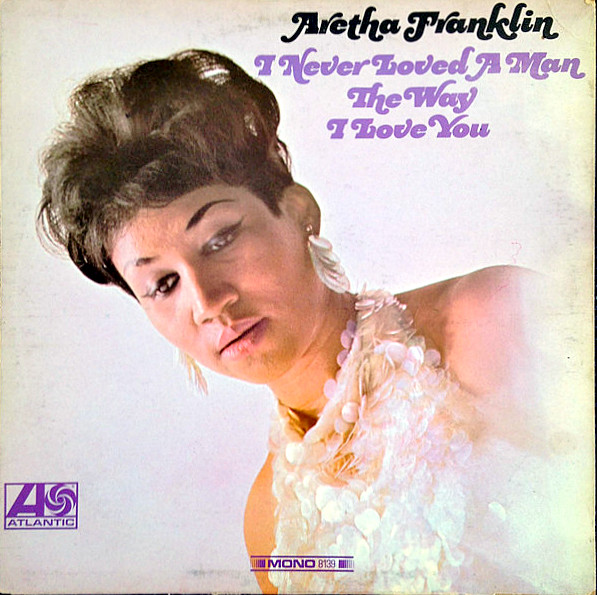
Eleven tracks in 32 minutes. Recorded across approximately 5 weeks at FAME Studios in Muscle Shoals, Alabama (January 1967, one song before the session collapsed) and Atlantic Studios in New York (February-March 1967), with Jerry Wexler producing and the Muscle Shoals Sound Section flown to Manhattan to finish the album. Aretha Franklin's eleventh studio LP but her first for Atlantic Records, the album that turned a Columbia Records gospel-pop-jazz contract artist into the Queen of Soul and provided the template every subsequent soul singer has worked within.
- Released
- March 10, 1967
- Label
- Atlantic Records (US, SD 8139)
- Producer(s)
- Jerry Wexler
- Runtime
- 32:36 (11 tracks)
- Chart peak (US)
- #2 (Billboard 200); #1 (Billboard R&B Albums)
- Chart peak (UK)
- #36 (UK Albums Chart)
- Certifications
- Platinum (RIAA, 1994); Gold (BPI, 1968)
- Awards & honours
- Ranked #84 on Rolling Stone's 500 Greatest Albums (2020); Grammy Hall of Fame (1987); Library of Congress National Recording Registry (1999)
Eleven tracks in 32 minutes. Recorded across approximately 5 weeks at FAME Studios in Muscle Shoals, Alabama (January 1967, one song before the session collapsed) and Atlantic Studios in New York (February-March 1967), with Jerry Wexler producing and the Muscle Shoals Sound Section flown to Manhattan to finish the album. Aretha Franklin's eleventh studio LP but her first for Atlantic Records, the album that turned a Columbia Records gospel-pop-jazz contract artist into the Queen of Soul and provided the template every subsequent soul singer has worked within.
Aretha Franklin in autumn 1966 was twenty-four years old, six albums into a commercially-disappointing Columbia Records contract that had attempted to position her as a Broadway and supper-club vocalist rather than a gospel-soul singer, and unhappy in roughly every dimension of her professional life. She had been signed to Columbia by John Hammond in 1960 at age 18; the six Columbia LPs (1961-1965) had been respectfully reviewed but commercially modest; Hammond had been pushing her toward jazz standards and pop covers in a way that her gospel-trained voice and her Memphis-and-Detroit background didn't naturally inhabit. Jerry Wexler at Atlantic Records had been watching her career for two years; in November 1966, when her Columbia contract expired, he signed her to Atlantic for a $25,000 advance and a promise of creative control over her recording direction.
Wexler's plan was to record Franklin at FAME Studios in Muscle Shoals, Alabama, with the Muscle Shoals Rhythm Section. The FAME house band, Roger Hawkins on drums, Tommy Cogbill on bass, Jimmy Johnson on guitar, Spooner Oldham on keyboards, had recorded the canonical 1960s Southern soul tracks for Otis Redding, Wilson Pickett, Percy Sledge, and other Stax-and-Atlantic-distributed acts. Wexler had been making FAME-recorded LPs since 1965 and considered the Muscle Shoals rhythm section the canonical late-1960s soul backing unit. The first session was scheduled for January 24, 1967; Franklin and her then-husband Ted White flew from Detroit to Muscle Shoals on January 23.
What happened at FAME Studios on January 24-25, 1967 has been the subject of forty-five years of conflicting accounts. The band tracked 'I Never Loved a Man (The Way I Love You)' across a single afternoon session on January 24; the take that appears on the album is the first complete take, with Spooner Oldham's improvised electric piano figure and Roger Hawkins's drum break at 1:50 captured in real-time. The session was joined that evening by an additional trumpeter (Ken Laxton) who had been booked for the following day's session; an argument between Laxton and Franklin's husband Ted White over Laxton's behavior with Franklin escalated through the evening. The dispute culminated in a hotel-room altercation later that night. Aretha and Ted left Muscle Shoals on January 25; the second day of sessions never happened. Wexler returned to New York with one finished song and the Muscle Shoals Rhythm Section's contracts already paid.
Wexler's solution was unprecedented. He flew the Muscle Shoals Rhythm Section to Atlantic Studios in Manhattan to finish the album. The five-week February-March 1967 sessions at Atlantic Studios produced the remaining ten tracks of the album with the FAME band working in a New York studio, a deliberately-unusual production decision that produced the album's specific sonic register. The FAME band's Southern-soul vocabulary applied to Atlantic Studios' deliberately-Northern engineering approach (Tom Dowd's specific approach to soul-music miking and arrangement) became the album's defining sonic feature. The combination of Muscle Shoals rhythm section + Atlantic Studios engineering became the production template for every subsequent late-1960s Atlantic-distributed soul LP.
The album's eleven tracks are a sustained survey of late-1960s Black-American popular-music vocabulary. The Otis Redding 'Respect' cover (track one) is the album's commercial centerpiece; Franklin's reading inverts the song's gender politics by rewriting key lyrics and adding the famous 'R-E-S-P-E-C-T' spell-out coda. The Sam Cooke 'Good Times' and 'A Change Is Gonna Come' (tracks eight and eleven) are the album's most-explicit gospel-pop lineage references. The Ronnie Shannon 'I Never Loved a Man (The Way I Love You)' title track is the FAME-recorded song that produced the album's commercial breakthrough. The Chips Moman / Dan Penn 'Do Right Woman, Do Right Man' (track nine) is the album's most-cited feminist-soul foundational text. The two Franklin-White co-writes ('Don't Let Me Lose This Dream,' 'Dr. Feelgood') and the two Franklin-Carolyn Franklin co-writes ('Baby, Baby, Baby,' 'Save Me') are the album's family-collaborative dimension.
Atlantic released the album on March 10, 1967 with substantial promotional support. The 'I Never Loved a Man' single (released February 1967 as the pre-album) had peaked at US #9 by April; 'Respect' single (released April 1967) peaked at US #1 on June 3 and stayed at #1 for 2 weeks. By summer 1967 the album had been certified Gold by the RIAA; by autumn 1967 it had peaked at US #2 on the Billboard 200 (held off the top spot by Sgt. Pepper's Lonely Hearts Club Band) and was Franklin's first chart-topping success. The album's commercial trajectory transformed Franklin from a Columbia Records cult artist into the Queen of Soul; the subsequent Atlantic LPs (Aretha Arrives, 1967; Lady Soul, 1968; Aretha Now, 1968) would consolidate the position.
I Never Loved a Man the Way I Love You belongs at #61 because it is the album that turned a Columbia Records cult artist into the Queen of Soul and provided the template every subsequent late-1960s and 1970s soul singer has worked within. The FAME-band-plus-Atlantic-engineering production approach became the standard production model for Atlantic-distributed soul LPs through the early 1970s; the Otis Redding 'Respect' cover became the most-imitated song-as-empowerment-anthem in popular music; the deliberately-feminist vocabulary of 'Do Right Woman, Do Right Man' became the foundational text for the late-1960s and 1970s feminist-soul tradition. Franklin's specific vocal vocabulary, the gospel-trained range, the deliberately-aggressive delivery, the call-and-response architecture with the Sweet Inspirations and the Franklin sisters, became the template that every subsequent soul singer (from Gladys Knight through Mavis Staples through Mary J. Blige through Beyoncé) has worked within. The album's sustained catalogue presence and its institutional canonization (Library of Congress 1999, Grammy Hall of Fame 1987) confirm a position the music itself had secured by the end of 1967.
Pressing guide — the one to own
Original 1967 US first pressing on Atlantic, issued in both mono (8139) and stereo (SD 8139), with the Jerry Schatzberg cover photograph of Franklin in a shimmering white dress and the era-correct '1841 Broadway, New York' address on the label. US first pressings carry the boxed black-fan Atlantic logo: the red/purple label denotes mono, the green/blue label stereo (the 'plum' label is the UK pressing, not the US). Tom Dowd and Arif Mardin engineered the sessions. Among 1960s soul collectors the mono is generally the more sought-after original, though both 1967 pressings are legitimate firsts.