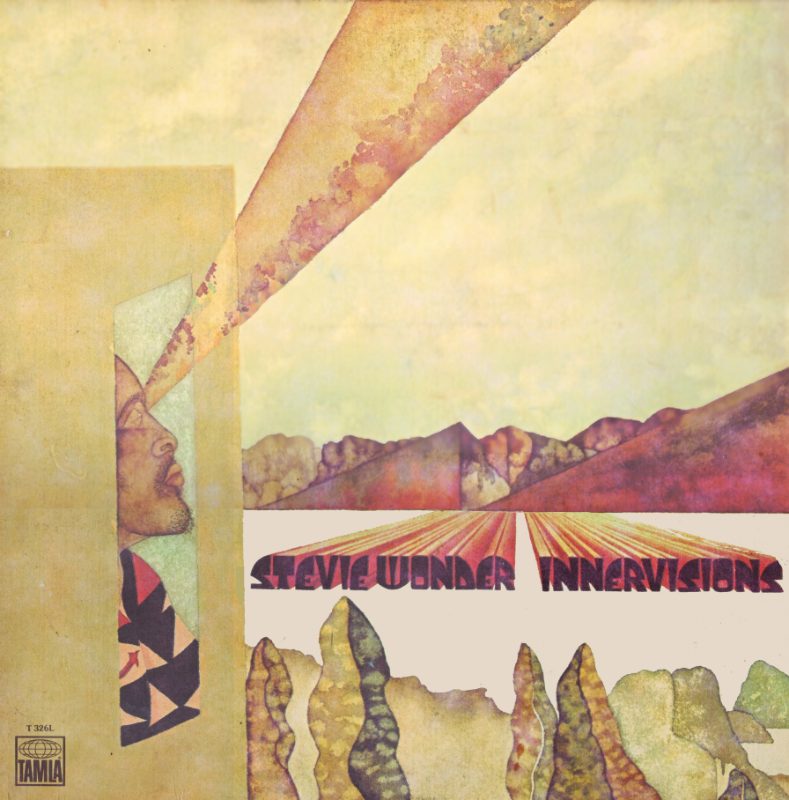
Stevie Wonder at twenty-three, playing almost every instrument himself, locked in a New York studio with a synthesizer the size of a wall, made the record that ended the Motown assembly line for good. Three days after it came out, he nearly died.
- Released
- August 3, 1973
- Label
- Tamla / Motown
- Producer(s)
- Stevie Wonder (associate producers: Robert Margouleff, Malcolm Cecil)
- Runtime
- 44:14
- Chart peak (US)
- #4 (Billboard 200) · #1 (Top Soul Albums, 11 weeks)
- Chart peak (UK)
- #8 (Record Retailer)
- Certifications
- Platinum (RIAA, eventually 2× Platinum); estimated 6M+ units globally
- Awards & honours
- Grammy Album of the Year (1974); Grammy Best Pop Vocal Performance, Male; Grammy Best R&B Vocal Performance, Male ('Superstition' from Talking Book also won that year); Library of Congress National Recording Registry (1999)
The middle album of Stevie Wonder's classic-period run, coming after Talking Book and before Fulfillingness' First Finale, and the one on which he stopped writing songs and started writing arguments. Nine tracks, eight of them his alone, about Vietnam, urban poverty, drug addiction, racial politics, and the search for a God he could still believe in.
Stevie Wonder turned twenty-one in May 1971 and immediately did two things. First, he renegotiated his contract with Motown. The original deal, signed when he was 11 and called Little Stevie Wonder, paid him a child-actor royalty rate and put the rights to his work in Berry Gordy's pocket. The new contract, brokered after Wonder threatened to walk to Atlantic, gave him a million-dollar advance, full creative control, ownership of his publishing through a new company called Black Bull Music, and the right to record where and how he wanted. He was the first Motown artist to win this kind of autonomy. It was, in 1971, almost unimaginable.
Second, he moved to New York. He had spent three months at the Record Plant studio in 1971 with Robert Margouleff and Malcolm Cecil, two engineers who had built an instrument called TONTO, the Original New Timbral Orchestra, the largest analog synthesizer in the world. TONTO was, literally, a wall of Moog, Arp, Oberheim and Serge modules wired together into a single polyphonic instrument. Wonder heard it, sat down, and didn't leave for two years. The albums that came out of those sessions, Music of My Mind (1972), Talking Book (1972), Innervisions (1973), Fulfillingness' First Finale (1974), and Songs in the Key of Life (1976), are the most concentrated five-album run in the history of popular music. Innervisions is the one in the middle.
He played almost every instrument himself. The credit list, when you read it, looks like a misprint: Stevie Wonder, vocals, keyboards, synthesizer bass, drums, harmonica, percussion. Stevie Wonder, vocals, keyboards, synthesizer bass, drums, harmonica, percussion. Track after track. The exceptions are minor: Willie Weeks plays bass on 'All in Love Is Fair,' Ralph Hammer adds an acoustic guitar to 'Don't You Worry 'Bout a Thing,' Yusuf Roahman plays shaker on 'Higher Ground.' Otherwise Wonder is the entire band. The bass on 'Higher Ground', one of the funkiest in the catalogue, is a Moog with the cutoff swept by Wonder's own hand on the panel. The clavinet on 'Living for the City' is Wonder. The drums on 'Higher Ground' are Wonder. The harmonica solo on 'Visions' is Wonder. He recorded all of it across nine months at Mediasound, Record Plant, and Crystal Sound in New York and Los Angeles, working sometimes 36 hours straight, with Margouleff and Cecil running the desk and patching TONTO between takes.
What Wonder wanted to make was a Black urban concept album. Marvin Gaye had cracked the door open with What's Going On in 1971; Curtis Mayfield had carried it through with Roots in 1971 and Superfly in 1972. Wonder went further. Innervisions is not framed as protest exactly, it is framed as report. 'Too High' opens the record with a portrait of a young woman destroying herself with cocaine, sung in a voice somewhere between sympathy and judgment. 'Visions' is a three-and-a-half-minute jazz ballad about the possibility, or impossibility, of a beloved America. 'Living for the City' is a seven-minute documentary about a Black family in Mississippi whose son moves to New York and is set up, arrested, and imprisoned within the first 40 minutes of his arrival, a song that includes a recorded scene of the arrest itself, with actors playing the cops and the judge. 'Higher Ground' is the most explicit articulation of Wonder's belief in reincarnation he ever recorded. 'Jesus Children of America' is a hymn that names Transcendental Meditation and heroin in adjacent verses. 'All in Love Is Fair' is a love song, the only one. 'Don't You Worry 'Bout a Thing' is salsa as cosmopolitan flirtation. 'He's Misstra Know-It-All' closes the album with a direct portrait of Richard Nixon, who would resign within a year.
It is also a sonically singular record. TONTO is not used the way synthesizers are normally used in 1973, as an exotic flavor color on top of a band. Wonder uses it as the bass instrument, the bed instrument, the bass-and-mid-tone fabric across which everything else moves. The clavinet, the rhodes, the moog bass, and Wonder's voice triple-tracked, that is the sound of the record. On 'Living for the City' the entire arrangement except the clavinet is synthesizer. The hi-hat on 'Higher Ground' is a synth. The strings on 'Visions' are synth. Cecil and Margouleff later said they spent more time programming sounds than recording them, every patch was bespoke, often two or 3 hours to dial in, sometimes destroyed after the take so it couldn't be replicated.
Three days after Innervisions was released, on August 6, 1973, Wonder was riding in a car on Interstate 85 outside Salisbury, North Carolina, on his way to a benefit concert. A logging truck in front of his car lost part of its load. A log struck the windshield directly in his face. Wonder was in a coma for four days. His tour manager, holding his hand in the ICU, sang 'Higher Ground' to him; according to several accounts, Wonder's fingers tapped along to the beat. He woke up. He had lost his sense of smell permanently. His face required extensive reconstruction. He recovered well enough to receive the Grammy for Album of the Year five months later, in February 1974, and to record Fulfillingness' First Finale by the end of that year. But the accident is part of the record's history. The album's themes, God, reincarnation, the body's fragility, the urgent insufficient question of how to live, weren't retrospectively imposed. They were already there, three days before he almost died.
Innervisions belongs at #8 because it is the album on which a Black American artist working inside a major white-owned corporation produced, performed, and engineered (with help) a forty-five-minute single-statement record about the state of the country that didn't flinch from any of the country's problems and did not let go of any of the country's beauty. Marvin Gaye had shown it was possible. Wonder showed what could be built on top of what was possible. Within five years the model, autonomous Black artist as producer-arranger-composer-performer, had been used by Prince, by D'Angelo (in the studio if not in 1973), by Sly Stone, by Curtis Mayfield, by every R&B auteur since. Without Innervisions there is no Songs in the Key of Life, no Off the Wall, no Purple Rain, no Voodoo, no To Pimp a Butterfly, no Channel Orange. The road from Berry Gordy's hit factory to the modern auteur Black pop record runs through this album.
Pressing guide — the one to own
Original 1973 US first pressing on Tamla, catalog T-326L (on cover, spine and labels), in a gatefold sleeve with the painted Efrem Wolff cover portrait. The labels carry the brown-and-yellow Tamla design. Note that the famous Braille message reading 'Here is my music, it is all I have to tell you how I feel' belongs to Stevie Wonder's earlier album Talking Book (1972), where it is embossed on the cover—it is not engraved in the Innervisions runout. As with most Motown LPs of the era, several pressing plants (RCA Hollywood, others) handled the original run.