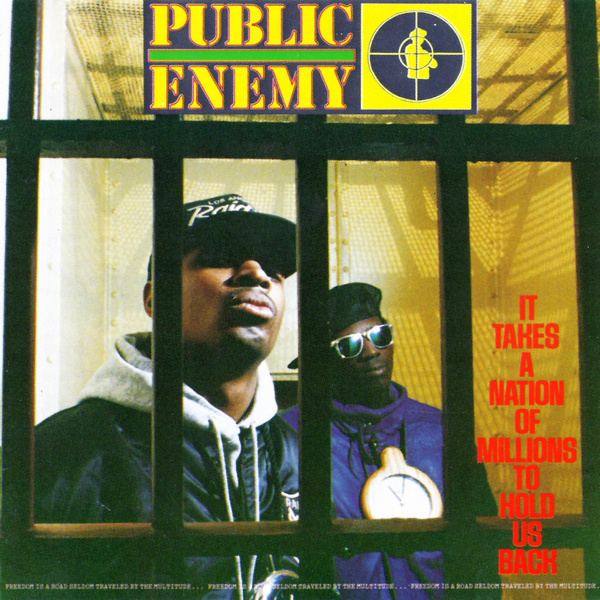
Chuck D and Flavor Flav with the Bomb Squad in production. Hank Shocklee and Eric Sadler chopping up over 200 samples per track. The album that made political hip-hop a commercial form. Released June 28, 1988.
- Released
- June 28, 1988
- Label
- Def Jam / Columbia
- Producer(s)
- The Bomb Squad (Hank Shocklee · Eric Sadler · Bill Stephney) · Chuck D · Flavor Flav
- Runtime
- 57:53 (16 tracks)
- Chart peak (US)
- #42 (Billboard 200) · #1 (Top R&B/Hip-Hop)
- Chart peak (UK)
- #8 (Official Charts)
- Certifications
- Platinum (RIAA); 2M+ units globally
- Awards & honours
- Library of Congress National Recording Registry (2004); ranked #15 on Rolling Stone's 500 Greatest Albums (2020)
Sixteen tracks in 58 minutes. Recorded in eight months at Greene Street and Chung King studios in lower Manhattan with the Bomb Squad's production team using the Akai S900 sampler past its design limits. The album that proved hip-hop could be sustained political statement at the highest commercial register, and the last great Black political album produced before the 1991 Grand Upright copyright ruling made its specific approach to sampling commercially impossible.
Public Enemy had released their debut Yo! Bum Rush the Show in February 1987 to modest commercial response and significant critical interest. Chuck D was 27, a Long Island graphic designer with a degree from Adelphi who had been making hip-hop tapes on local radio for five years. Flavor Flav was 29, the group's hype man and tonal inverse, comedic, paranoid, the clock-wearing visual signature. Producer Hank Shocklee was 31 and had been building the production unit he would call the Bomb Squad (Shocklee, his brother Keith, Eric 'Vietnam' Sadler, and Chuck D himself credited as a producer) since the early 1980s. Rick Rubin, who had signed PE to Def Jam, was 25 and increasingly focused on the Beastie Boys; the second PE album was effectively a Bomb Squad project with Def Jam writing the checks.
Recording began at Greene Street Recording in spring 1987, immediately after the Bum Rush tour, and continued at Chung King Studios in Manhattan through autumn of that year. The Bomb Squad's production approach, layering up to sixteen simultaneous samples per track, pushing the Akai S900 sampler past its 12-second-per-sample memory limit by chaining multiple units, using James Brown breaks both as rhythmic foundation and as harmonic textures, produced a density of sound that no previous hip-hop album had attempted. The sessions used three to four engineers working in parallel; multitracks ran 48 channels and required custom routing through analog mixers because no consumer hip-hop production board could handle the channel count. Sadler has described the sessions in subsequent interviews as 'figuring out what the machine could do while we were using it.'
The album's two singles framed its release. 'Bring the Noise' was released as a 12-inch in January 1988 with a B-side appearance on the Less Than Zero soundtrack the previous September, its specific velocity and Chuck D's machine-gun delivery established the album's vocal vocabulary before the album existed. 'Don't Believe the Hype' followed in May 1988, with a hook structure that became one of the most-quoted in hip-hop history. Both singles charted well on the Billboard R&B chart but didn't cross to the pop Top 40; the album would peak at US #42, fueled almost entirely by R&B chart success and rapidly building college radio play. Within six months of release it had sold one million copies, the first hip-hop album to do so on the strength of political content rather than party tracks.
Professor Griff, the group's Minister of Information, gave the Washington Times interview in May 1989, six months after the album's release, in which he made antisemitic remarks that Chuck D was forced to address publicly. Griff was removed from the group, then briefly reinstated, then removed again. The controversy consumed PE's spring 1989 promotional cycle and overshadowed the album's commercial peak. The group's third album Fear of a Black Planet (April 1990) would be the response, a more disciplined, more focused political statement made under the conditions Nation had created. Nation of Millions remained the group's foundational text and the album the canon was built around.
The cultural impact of Nation of Millions is historically inseparable from the late-Reagan moment in which it appeared. The Howard Beach incident (December 1986), the Tawana Brawley case (autumn 1987-spring 1988), the Bensonhurst killing of Yusef Hawkins (August 1989) framed the album's specific New York racial politics; the Bush-Dukakis presidential campaign's Willie Horton advertising in September 1988 confirmed Chuck D's argument that mainstream American politics had institutionalized anti-Black racism in ways no Reagan-era civil-rights legislation had addressed. The album sold steadily through the Bush years; its political relevance compounded rather than faded. Spike Lee used 'Fight the Power' (eventually released on 1990's Fear of a Black Planet but recorded during the Nation of Millions sessions and originally intended for that album) as the central musical text of Do the Right Thing in summer 1989.
The Bomb Squad's specific sample-density approach became commercially impossible within three years. The December 1991 Grand Upright Music, Ltd. v. Warner Bros. Records Inc. ruling, Markie's 'Alone Again' had used an uncleared Gilbert O'Sullivan sample, established that hip-hop producers had to clear every sample with the original copyright holders before release. Nation of Millions's tracks routinely use eight to twelve uncleared samples per song; under post-Grand Upright clearance economics, the album would have been unmakeable. Hank Shocklee has said in interviews that the album cost about £50,000 to record; under 1992 clearance fees, the same album would have cost £5 million. Nation of Millions is therefore the most extreme document of an aesthetic the law shortly abolished.
It Takes a Nation of Millions to Hold Us Back belongs at #32 because it is the album that proved hip-hop could be sustained political statement at the highest commercial register and the foundational text every politically engaged hip-hop record since, The Coup, Dead Prez, Lupe Fiasco's Food & Liquor, Kendrick Lamar's To Pimp a Butterfly, Run the Jewels' RTJ2, descends from. The Bomb Squad's sample-density production set a sonic ceiling no subsequent hip-hop record has fully matched because the legal conditions under which the album was made no longer exist. Chuck D's specific approach to political lyric writing, documentary, encyclopedic, deliberately educational, established the form for the genre's most ambitious political work for the next four decades. The album sold steadily for a decade, hit Platinum certification in November 1989, and reached three million units sold by the early 2000s. The Library of Congress added it to the National Recording Registry in 2004.
Pressing guide — the one to own
Original 1988 US pressing on Def Jam Recordings, distributed by Columbia, catalog FC 44303 (printed C 44303 on the labels, FC 44303 on the spine). It is a single (non-gatefold) sleeve; the front shows Chuck D and Flavor Flav photographed behind prison bars, shot at Rikers Island, beneath the slogan 'Freedom Is A Road Seldom Traveled By The Multitude.' The record was cut by Direct Metal Mastering at Masterdisk, with 'MASTERDISK DMM' visible in the runout and roots AL 44303 / BL 44303. A later budget reissue carries the BFW 44303 number, so confirm the FC 44303 original.