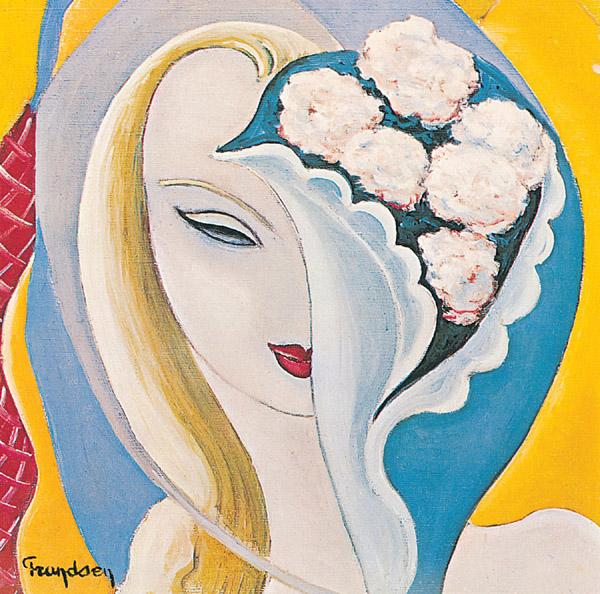
Fourteen tracks across 76 minutes of double LP. Recorded across 4 weeks at Criteria Studios in Miami in August and September 1970 with Tom Dowd producing and Duane Allman arriving on day four after Dowd brought him in from the Allman Brothers' adjacent session. The album that Eric Clapton has called 'the best work I've ever done', a confessional sprawl about Clapton's unrequited love for Pattie Boyd, then George Harrison's wife, released to commercial indifference in 1970 and gradually canonized as one of the great rock double LPs of the 1970s.
- Released
- November 9, 1970 (US) · December 1970 (UK)
- Label
- Atco (US, SD 2-704) · Polydor (UK, 2625 005)
- Producer(s)
- Tom Dowd
- Runtime
- 76:50 (14 tracks across 2 LPs)
- Chart peak (US)
- #16 (Billboard 200)
- Chart peak (UK)
- #68 (initial release); #7 (1972 reissue)
- Certifications
- 2× Platinum (RIAA, 1990); Gold (BPI, 1972)
- Awards & honours
- Ranked #117 on Rolling Stone's 500 Greatest Albums (2020); Grammy Hall of Fame (1999); inducted into Library of Congress National Recording Registry (2003)
Fourteen tracks across 76 minutes of double LP. Recorded across 4 weeks at Criteria Studios in Miami in August and September 1970 with Tom Dowd producing and Duane Allman arriving on day four after Dowd brought him in from the Allman Brothers' adjacent session. A confessional sprawl about Clapton's unrequited love for Pattie Boyd, then George Harrison's wife. Released to commercial indifference in 1970 and gradually canonized across the 1970s as one of the great rock double LPs of the era.
Eric Clapton in summer 1970 was twenty-five years old, three months past the disastrous Blind Faith breakup, eighteen months past the end of Cream, and freshly returned from a Mad Dogs and Englishmen tour with Delaney and Bonnie Bramlett that had transformed his musical vocabulary. He had been in love with Pattie Boyd, his close friend George Harrison's wife, for nearly a year; he had told her so privately at a Beatles event in autumn 1969, and she had refused. He was using heroin (a habit he would not fully escape until 1974), drinking heavily, and unhappy in roughly every dimension of his personal life. His musical partnership with Delaney and Bonnie's rhythm section, Bobby Whitlock on keyboards and vocals, Carl Radle on bass, Jim Gordon on drums, had become the closest thing to a working band Clapton had had since Cream. The four of them moved into Clapton's Hurtwood Edge estate in Surrey in May 1970, began rehearsing immediately, and were calling themselves Derek and the Dominos by June. The 'Derek' moniker was Clapton's deliberate attempt to evade his Eric Clapton commercial expectations; in early 1970 audiences at the band's first concerts were told they were watching 'Derek and the Dominos' and were specifically not told that Derek was Clapton.
Tom Dowd booked Criteria Studios in Miami for the band's first studio sessions in late August 1970. Dowd had produced the Allman Brothers' first two records at Criteria and was simultaneously working on what would become the Allmans' third LP (Eat a Peach, eventually released 1972) at the same studio. On the fourth day of the Derek and the Dominos sessions, August 28, 1970, Duane Allman dropped by the studio at Dowd's invitation to play on a couple of tracks. He stayed for the next ten days, played on eleven of the album's fourteen tracks, and transformed the album from a competent Clapton-band project into the two-guitar masterpiece it became.
The recording sessions ran from August 25 through October 1, 1970, approximately 5 weeks at Criteria. Dowd's working method was deliberately conservative: the band tracked live in Criteria's Studio B with minimal isolation, Clapton singing in the same room as the band; overdubs were limited to occasional second guitar passes (mostly Allman's slide work) and Whitlock's keyboard textures. The Criteria room sound, Studio B was a 30x40-foot room with deliberately warm acoustics designed for Atlantic Records' soul sessions, became part of the album's specific signature. Carl Radle and Jim Gordon's rhythm section locked in within the first week of sessions; their rhythm bed for the title track 'Layla' was tracked across one long Saturday afternoon in September.
What the album delivers is the most-controlled blues-rock performance of Clapton's career. The fourteen tracks include three blues standards (the Big Bill Broonzy 'Key to the Highway,' the Billy Myles 'Have You Ever Loved a Woman,' the Jimmy Cox 'Nobody Knows You When You're Down and Out'), a Jimi Hendrix cover ('Little Wing,' recorded ten days before Hendrix's September 18 death), and ten Clapton-Whitlock co-writes. The album's specific emotional architecture, the entire 76 minutes is a single extended confession of unrequited love for Pattie Boyd, was unprecedented for a major-label blues-rock LP. The title track 'Layla' (a name derived from the seventh-century Persian poet Nizami's 'Layla and Majnun,' which Clapton had been reading) is the album's emotional peak; the lyric ('What'll you do when you get lonely / and no one's there') is the most-direct love confession Clapton has recorded.
The album's release on November 9, 1970 produced minimal commercial response. The double-LP format (priced at $9.98, double the standard LP price) was a commercial liability in late 1970; Atco's marketing department didn't have a strong promotional strategy for a band whose lead member wasn't officially identified. The first single 'Layla' (released March 1971) peaked at US #51, a substantial commercial disappointment for what should have been Clapton's commercial peak. The album charted at US #16 by late January 1971 but fell off the chart by March. By summer 1971, the band had effectively dissolved; Clapton, depressed by both the commercial failure and his continued unrequited love for Pattie Boyd, retreated into a heroin habit that wouldn't lift until early 1974. Duane Allman died in a motorcycle accident on October 29, 1971, the album's two-guitar partnership was over a year after the recording.
The album's commercial trajectory was rewritten by the 1972 reissue. Polydor's UK office released 'Layla' as a single again in May 1972; the song reached UK #7. Atco re-released the album in the US the same summer; it reached US #16 again and stayed on the Billboard 200 for 15 weeks. By autumn 1972 the album had been certified Gold by the RIAA and was being widely cited as one of the great double LPs of the era. By 1974 the album was canonical; by 1990 it had reached 2× Platinum (US) and was Library-of-Congress-eligible. The album's specific commercial pattern, initial failure, gradual canonization across the subsequent decade, eventual canonical status, is the rock-album equivalent of the Velvet Underground arc.
The personnel narrative around the album has produced one of the more-painful sustained sets of tragedy in rock history. Duane Allman died in a motorcycle accident in 1971 (October 29); Carl Radle died of kidney failure (1980, age 37); Jim Gordon developed severe schizophrenia and in 1983 killed his mother during a psychotic episode (Gordon is currently still serving a sixteen-years-to-life sentence at the California Men's Colony state prison). Bobby Whitlock is the only surviving Dominos member as of 2026 (Clapton remains a working musician but was not a Dominos member in the technical sense after October 1970). Pattie Boyd eventually left George Harrison for Clapton in 1974 and the two were married 1979-1989. The album's emotional intensity, a sustained love confession by a young Eric Clapton about a woman who would eventually marry him, became, in retrospect, the foundational text of the Boyd-Clapton biographical arc.
Layla and Other Assorted Love Songs belongs at #57 because it is the album that consolidated the two-guitar blues-rock vocabulary that would define the decade and provided the template every subsequent extended-double-LP-as-emotional-statement (the Stones' Exile on Main St., the Allmans' Eat a Peach, Elton John's Goodbye Yellow Brick Road, Bruce Springsteen's The River) has worked within. The album's commercial trajectory, initial commercial failure followed by gradual canonization, is the rock-album-as-art-statement template that has continued to define what 'critically important' means in the LP era. The Boyd-Clapton biographical context that the album emerged from has made it one of the most-cited sustained love-statement albums of the rock era; Clapton has said in print that the album is 'the best work I've ever done.' The specific commercial pattern (failure, then canonization) is what every art-rock LP from 1971 onward has aspired to.
Pressing guide — the one to own
Original 1970 US first pressing, Atco SD 2-704, a double LP in a gatefold sleeve. The front cover is not a photograph but a painting, 'La Fille au Bouquet' by Frandsen de Schomberg (credited on the jacket), so disregard any 'Frances Crawford' photo credit. The first-press label is the yellow Atco with the '1841 Broadway, New York' rim text, not orange. Mastering is credited to Dennis Drake, not 'Dennis King,' and there is no 'DK' runout; the matrix family is ST-C-702043 through 046 (sides A-D) with various plant codes (Terre Haute, Presswell, Philips, Monarch) etched in the deadwax. A high-pressing hit, so originals are modest, roughly £35-£100.