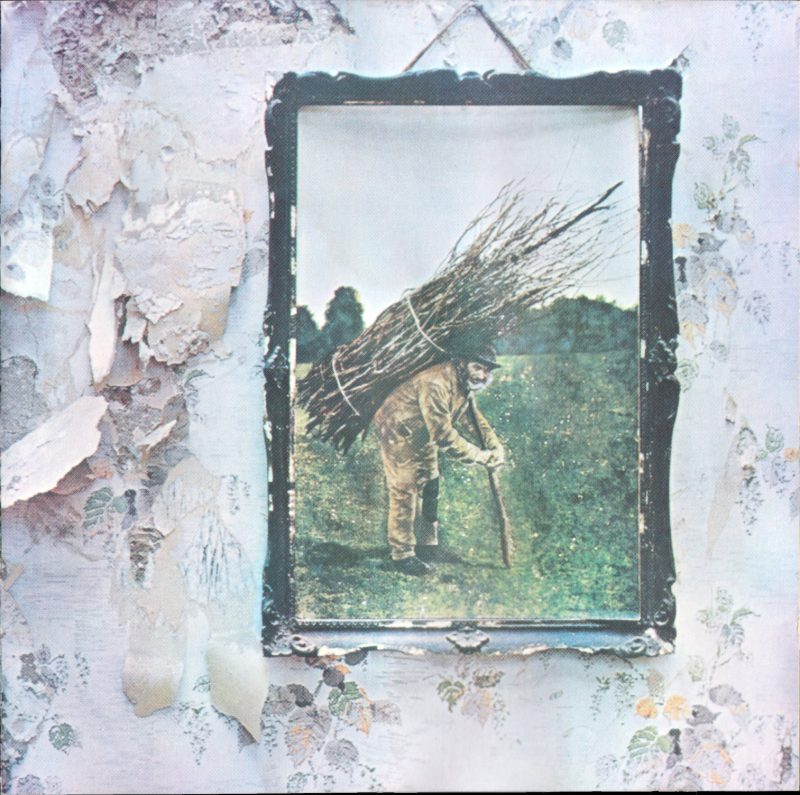
Four young men, a Victorian country house with no central heating, the Rolling Stones Mobile Studio parked on the drive, and a refusal to put their names or the album title on the sleeve. Released as a backlash against critics who had panned Led Zeppelin III. Eight tracks, none of them filler. 'Stairway to Heaven' alone has been played by FM radio more than three million times.
- Released
- November 8, 1971 (UK) · November 8, 1971 (US)
- Label
- Atlantic Records (UK & US) · Sing Music (Australia)
- Producer(s)
- Jimmy Page · Engineer: Andy Johns
- Runtime
- 42:39 (8 tracks)
- Chart peak (US)
- #2 (Billboard 200)
- Chart peak (UK)
- #1 (Record Retailer, 5 weeks)
- Certifications
- Diamond, 24× Platinum (RIAA, 2021); estimated 37M units globally, the band's bestselling album
- Awards & honours
- Library of Congress National Recording Registry (2017); Grammy Hall of Fame for 'Stairway to Heaven' (1996); ranked #58 on Rolling Stone's 500 Greatest Albums (2020); ranked #1 on multiple all-British-rock polls since 1990
Led Zeppelin III, released in October 1970, had been savaged by the critical press for being too acoustic, too Tolkien-inflected, not rock enough. The band's response was to release an album with no title, no band name on the sleeve, and four symbols representing each member where the credits would normally go. It became one of the best-selling rock albums in history.
Led Zeppelin had spent eighteen months on the road from 1969 through summer 1970. They had released three studio LPs in that period, Led Zeppelin (January 1969), Led Zeppelin II (October 1969), and Led Zeppelin III (October 1970), and had become, between them and the touring, the highest-grossing rock band in the world. They were also, by the spring of 1971, exhausted. The reception of Led Zeppelin III the previous autumn had been hostile. Rolling Stone had called it 'a sad let-down'; Melody Maker had given it a B-minus; the consensus was that the band had abandoned the riff-rock of the first two albums for an acoustic, Tolkien-and-Celtic dilution. Jimmy Page, the band's leader and producer, took the criticism personally. He decided, with the rest of the band's consent, that the fourth album would be released without a title, without the band's name on the sleeve, and without any of the conventional marketing apparatus that had attended the first three.
What he wanted to make, he told the band, was something between Led Zeppelin II's blues-rock heaviness and Led Zeppelin III's acoustic-folk turn, a record that proved the band could do both, on a single album, without either approach apologizing for the other. The band moved into Headley Grange, a former Victorian poorhouse in Hampshire that had become a rented rural recording space throughout the late 1960s, in November 1970. They brought the Rolling Stones Mobile Studio with them, parked it on the gravel drive, and ran cables into the house. Andy Johns engineered. The house had a stone-floored entrance hall with a high stairwell, a kitchen, and several large unfurnished rooms. The band lived and recorded there for 4 weeks in December 1970 and January 1971.
The drum sound of 'When the Levee Breaks' was discovered by accident. John Bonham's kit had been set up in the entrance hall, the only room with enough space, and Andy Johns dropped two Beyer M-160 microphones from the second-floor landing to record the kit from a distance. The natural reverb of the stone-and-wood hall, combined with the long-distance miking, produced one of the most distinctive drum sounds ever committed to tape: enormous, low, oceanic, with a sustained snare that decays into the room. Bonham played a deliberately slow, slightly behind-the-beat pattern. Page double-tracked the guitar. The combination became one of the foundational documents of rock drum-room aesthetics; the drum break alone has been sampled by the Beastie Boys, Eminem, Massive Attack, Mike Oldfield, and dozens of other artists, and is widely regarded as the most-sampled drum performance in popular music.
Other songs were recorded with similarly opportunistic methods. 'Black Dog' was recorded at Island Studios in London after the Headley Grange sessions; the song's stop-start structure was John Paul Jones's deliberate attempt to write something the band 'couldn't dance to,' the bass riff syncopated against the drums in a way that requires careful counting. 'Rock and Roll' was recorded at Headley Grange in a single afternoon after John Bonham, while taking a break, started playing the introduction of Little Richard's 'Keep A-Knockin'' on the kit; Page joined in with a guitar riff he had been carrying around, Plant improvised the lyric, and Jones added bass. The song was finished in under 3 hours. 'Stairway to Heaven,' which would become the album's centerpiece, was written by Page and Plant during a few days at Bron-yr-Aur, a remote Welsh cottage they'd been using as a writing retreat; the song was recorded in pieces across the Headley Grange and Island sessions, with John Paul Jones's recorder section overdubbed in London.
'Stairway to Heaven' itself, 8 minutes long, structurally unconventional (no chorus, three distinct sections, an extended outro), with no obvious single-edit potential, was released only as a promotional single to radio stations. Atlantic Records initially considered it unreleasable as a commercial single; the song became a hit anyway, eventually becoming the most-played song on US FM radio of all time. The 'four sections' structure, slow opening with acoustic guitar and recorder, medium-tempo middle section with electric guitar entering, faster bridge with the drum kit entering, then the long ascending outro with Page's most-famous solo and Plant's most-cited vocal performance, became one of the most-imitated song structures in popular music. Heavy metal as a genre would draw on its slow-build template for the next forty years; progressive rock would lift its multi-section approach wholesale.
The album's most controversial decision, to release it with no title, no band name, and no credits on the sleeve, instead representing each member with a self-chosen symbol, caused significant friction with Atlantic Records. The label considered the approach commercial suicide; Robert Plant has said in print that the band's negotiations to keep the symbol-only sleeve nearly delayed the release by six months. The four symbols were chosen by each member: Jimmy Page's 'ZoSo' (a stylized 'Zoso' that has been variously interpreted as an occult sigil or as a personal monogram); John Paul Jones's interlocking triskele; John Bonham's three interlocking circles (which Bonham reportedly chose from a Pabst Blue Ribbon label); Robert Plant's feather-on-circle. The album would be referred to in subsequent years as 'Led Zeppelin IV,' 'Untitled,' 'Four Symbols,' 'Zoso,' 'Runes,' or sometimes simply '[symbols].' The title-less approach became as iconic as the music.
Released on November 8, 1971, with minimal promotion (Atlantic was still uncertain whether to push it), the album debuted at #2 on the Billboard 200, kept out of the top spot only by Carole King's Tapestry, which had held #1 for the previous six months. It reached #1 in the UK for 5 weeks. It produced no Top 40 single in the US (because no single was released; 'Black Dog' charted at #15 in Billboard but as a non-A-side promo). It produced no Top 40 single in the UK either. And yet, propelled by FM radio airplay and the band's continuing tour, the album sold one million copies in its first three months and remained on the Billboard 200 for over five years. By 1974 it was the band's bestselling album. By 1990 it had passed twenty million US units sold. By 2021 the RIAA had certified it at 24× Platinum, Diamond status, with global sales now estimated at 37 million copies.
Led Zeppelin IV belongs at #17 because it is the album on which a band at the peak of its commercial powers chose to refuse the conventions of rock-album marketing, title, credits, single releases, anything that would identify the work as theirs, and produced, on the strength of the music alone, one of the bestselling albums in history. The album is the proof that a rock LP could be self-effacing and commercially absolute at the same time. The eight tracks are all classic-rock canonized: 'Black Dog,' 'Rock and Roll,' 'The Battle of Evermore,' 'Stairway to Heaven,' 'Misty Mountain Hop,' 'Four Sticks,' 'Going to California,' 'When the Levee Breaks.' Each song has been quoted, sampled, or cited as a foundational text by successive generations of rock musicians. The album sits in 2026 as the single most-influential heavy rock record ever made, not because it invented heavy metal (it didn't) but because it proved that heavy could be elegant, that mysticism could be a marketing strategy, that the absence of a band name could be a kind of branding.
Pressing guide — the one to own
Original 1971 UK first pressing, Atlantic 2401 012 (the 'K 50008' number is a later reissue), on the red/plum Atlantic label, in a gatefold sleeve with the framed hermit painting outside and the four runic symbols inside. The UK lacquers were cut by George Peckham, not Robert Ludwig; the celebrated 'RL' hot-cut-that-skips story belongs to the US Led Zeppelin II (SD 7208), not to IV. The sought first-state UK copies are the red/plum 'Superhype' publishing examples. Clean originals command high prices, sealed copies considerably more.