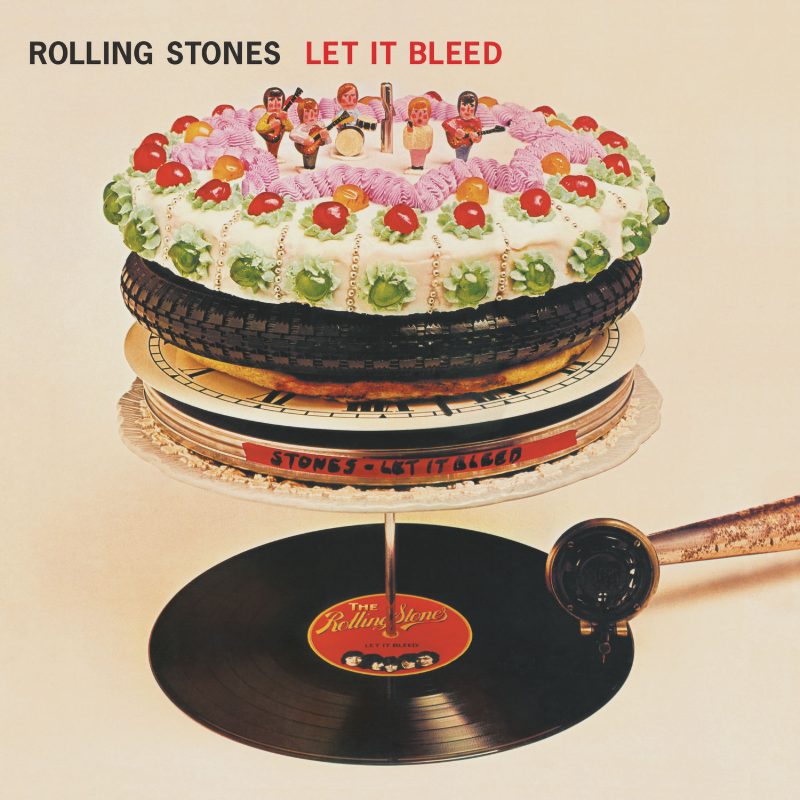
The Rolling Stones' final 1960s album. Brian Jones's last contribution before death; Mick Taylor's first. Released December 5, 1969 (UK).
- Released
- December 5, 1969
- Label
- Decca (UK) · London (US)
- Producer(s)
- Jimmy Miller
- Runtime
- 42:21 (9 tracks)
- Chart peak (US)
- #3 (Billboard 200)
- Chart peak (UK)
- #1 (Record Retailer)
- Certifications
- 2× Platinum (RIAA); 5M+ units globally
- Awards & honours
- Library of Congress National Recording Registry (2017); ranked #40 on Rolling Stone's 500 Greatest Albums (2020)
Six months at Olympic Studios in London and at Elektra Sound Recorders in Los Angeles, with the Stones in transition from a Brian Jones band into a Mick Taylor band. Nine tracks across 42 minutes. The album that closed the Stones' 1960s, the album that introduced Mick Taylor's guitar to the band's sound, and the album whose December 5 release was followed 24 hours later by the Altamont killing that became the symbolic end of the 1960s American counterculture.
The Rolling Stones had spent 1968 producing Beggars Banquet, released December 6, 1968, the album that re-established the band as serious artistic competitors to the Beatles after the failed Their Satanic Majesties Request (1967). Beggars Banquet had been a deliberate return to blues-rock fundamentals; Let It Bleed was conceived as its continuation. Recording began at Olympic Studios in London in February 1969 with the Brian Jones-Mick Jagger-Keith Richards-Bill Wyman-Charlie Watts lineup that had been the Stones since 1962. Brian Jones, the band's founder and original musical leader, was by early 1969 in deep mental-health and drug-related decline; his contributions to the early Let It Bleed sessions were minimal and his presence at Olympic was sporadic. Jones was officially asked to leave the band on June 8, 1969. He was found dead in his swimming pool on July 3, 1969, at age 27. Mick Taylor, the twenty-year-old guitar player from John Mayall's Bluesbreakers, had been hired as Jones's replacement on June 13, 1969, 3 weeks before Jones's death.
The album's recording therefore spans two different Rolling Stones lineups. Tracks recorded before June 1969 (most of 'Midnight Rambler,' 'You Got the Silver,' parts of 'Gimme Shelter') feature Jones as a contributing member; tracks recorded after June 1969 (most of the rest of the album) feature Mick Taylor. Jones's actual contributions to the released album are minimal, autoharp on 'You Got the Silver' (his last formal Stones session, in May 1969), some percussion on 'Midnight Rambler.' The album is therefore the first Stones LP to be recorded primarily as a Taylor-band rather than a Jones-band, even though Jones's name appears in the credits and his presence shadows the project. Mick Taylor's specific contribution, clean, blues-rooted lead guitar playing that was technically more accomplished than Jones had been since 1966, became one of the album's distinguishing features.
Recording across 1969 took place at multiple studios. Olympic Studios in Barnes, London was the primary location through spring 1969. The band relocated to Elektra Sound Recorders in Los Angeles in June 1969 for several weeks of sessions; Glyn Johns (the band's principal engineer since Their Satanic Majesties) continued as engineer at both locations. Jimmy Miller, the American producer who had produced Beggars Banquet and would produce all subsequent Stones albums through Goat's Head Soup (1973), was the album's credited producer. Miller's specific contribution was the rhythmic emphasis the Stones developed during this period; he was an accomplished drummer himself and would often demonstrate desired drum parts to Charlie Watts.
The album's nine songs are a deliberate map of the late-1960s rock vocabulary the Stones were operating in. 'Gimme Shelter' opens the album with Merry Clayton's unforgettable wailing vocal on the chorus, recorded at a single 3 AM session at Elektra Sound in Los Angeles in October 1969 (Clayton, eight months pregnant, was called from her home in the middle of the night by producer Jimmy Miller after the regular session vocalist had been unable to deliver the part). 'Love in Vain' is the Stones' cover of Robert Johnson's 1937 blues, the credit dispute (initial pressings credited Jagger-Richards; subsequent pressings corrected the credit to Robert Johnson) became one of the album's enduring controversies. 'Country Honk' is the country-rendering of 'Honky Tonk Women' (which had been released as a single in July 1969 in its electric version; the album version is the slower acoustic original arrangement). 'Live with Me' is bass-and-saxophone-led blues-rock. 'Let It Bleed' is the title track. 'Midnight Rambler' is the album's seven-minute Boston Strangler-themed centerpiece. 'You Got the Silver' is Keith Richards's first solo lead vocal on a Stones album. 'Monkey Man' is bass-and-piano-led rock. 'You Can't Always Get What You Want' closes the album with the London Bach Choir's opening choral arrangement (recorded at Olympic in October 1969) and a deliberately extended seven-minute build.
Mick Taylor's recruitment was the band's deliberate response to Jones's deteriorating capacity. Taylor was twenty years old when he joined; he had been a featured guitar player in John Mayall's Bluesbreakers (the same band that had launched Eric Clapton's career four years earlier) since 1967. Taylor was technically the most accomplished lead guitarist the Stones had ever had; his contribution to Let It Bleed, primarily on 'Country Honk,' 'Live with Me,' and 'Love in Vain', established the more virtuosic guitar approach that would define the band's 1969-74 period. Taylor would play with the Stones through Goat's Head Soup (1973), Sticky Fingers (1971), Exile on Main St. (1972), and It's Only Rock 'n Roll (1974) before resigning in December 1974. The Taylor-era Stones is generally considered the band's strongest five-year period.
The album was released on December 5, 1969, 24 hours before the Altamont Free Concert at which the Hells Angels security stabbed and killed eighteen-year-old Meredith Hunter in front of the stage during the Stones' performance of 'Under My Thumb.' The album was therefore released into the immediate aftermath of one of the most-mythologized events in modern rock history. The Maysles brothers' documentary Gimme Shelter (released December 1970) captured the Hunter killing on film and made Altamont the central symbolic event in the post-Woodstock cultural narrative. Let It Bleed's chart performance was strong despite the cultural moment, UK #1 in December 1969 and US #3, but the album has been read since 1969 as inseparable from Altamont, whose specific violence the album's title and themes seemed to predict.
Let It Bleed belongs at #42 because it is the album in which the Stones lost their founder, gained their virtuoso guitarist, closed the 1960s, and watched the decade end in a stabbing at their own free concert. The record is bracketed on one end by Brian Jones's funeral in July 1969 and on the other by Meredith Hunter's killing on December 6, 1969. The lyrics, 'rape, murder, it's just a shot away' on the opener; 'you can't always get what you want' on the closer, were written before either event and read afterward as if they'd been responding to both. The album sits at the precise hinge between the Stones-as-1960s-band and the Stones-as-the-band-that-survived-the-1960s. Everything they would record after, including the great Sticky Fingers and Exile on Main St. that followed in the next three years, descends from the working partnership they established here, Jagger, Richards, Watts, Wyman, and Mick Taylor.
Pressing guide — the one to own
1969 UK first pressing, Decca SKL 5025 with the original Robert Brownjohn cake-sculpture cover (a stacked-cake assemblage designed by Brownjohn with bicycle parts, vinyl records, a clock face, and additional decorative elements stacked on a pedestal). Look for the matrix etchings SKL 5025-A-1 / B-1, hand-etched at Decca's West Hampstead pressing plant. The original UK gatefold (some pressings) opens to reveal Brownjohn's full cake-construction process; later pressings dropped the gatefold for cost reasons.