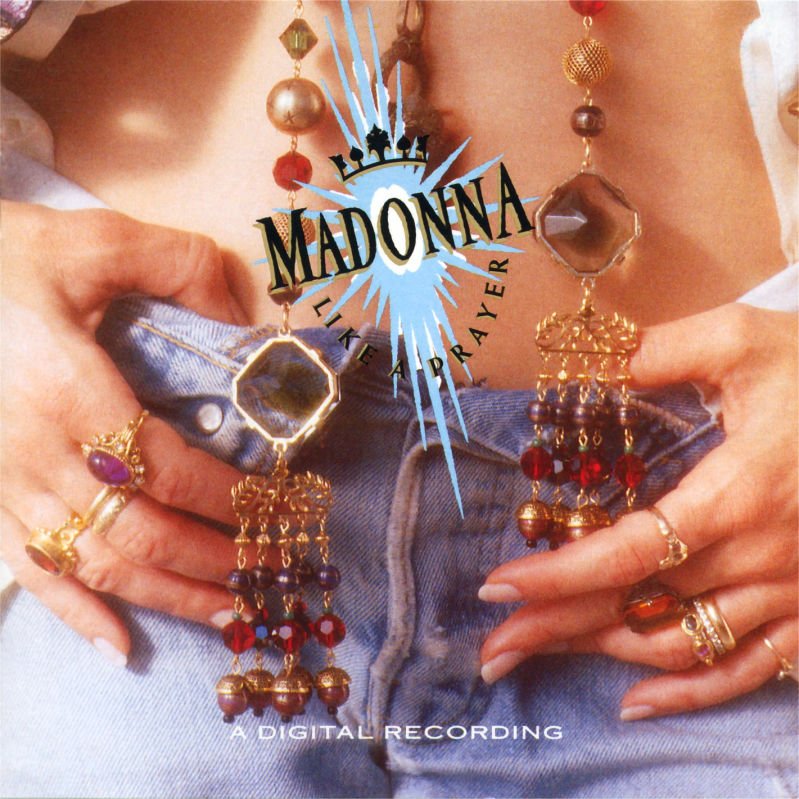
Eleven tracks in 51 minutes. Recorded across approximately ten months at Johnny Yuma Recording in North Hollywood with Madonna co-producing alongside Patrick Leonard and Stephen Bray. Madonna's fourth studio LP, the deliberately confessional, religiously charged, family-and-marriage statement that consolidated her transition from dance-pop singles artist to album-making cultural figure. Released into the most publicly contested Pepsi promotional partnership in pop-music history.
- Released
- March 21, 1989
- Label
- Sire / Warner Bros. (US, 1-25844)
- Producer(s)
- Madonna · Patrick Leonard · Stephen Bray (with Prince co-writing on 'Love Song')
- Runtime
- 51:01 (11 tracks)
- Chart peak (US)
- #1 (Billboard 200, 6 weeks)
- Chart peak (UK)
- #1 (UK Albums Chart, 3 weeks)
- Certifications
- 4× Platinum (RIAA, 1995); 4× Platinum (BPI, 1993)
- Awards & honours
- Grammy nomination Album of the Year (1990); ranked #100 on Rolling Stone's 500 Greatest Albums (2020); MTV VMA Best Female Video for 'Like a Prayer'
Eleven tracks in 51 minutes. Recorded across approximately ten months at Johnny Yuma Recording in North Hollywood with Madonna co-producing alongside Patrick Leonard and Stephen Bray. The fourth Madonna LP, the deliberately confessional, religiously charged, family-and-marriage statement that consolidated her transition from dance-pop singles artist to album-making cultural figure. Released into the most publicly contested Pepsi promotional partnership in pop-music history.
Madonna in summer 1988 was thirty years old, three studio albums and roughly seventy million records into her career, four years removed from her 1985 marriage to Sean Penn (finalized as divorce on January 5, 1989, three months before Like a Prayer's release), and at a structural decision point. The previous LP, True Blue (1986), had been her commercial peak, US #1 for 5 weeks, UK #1 for 34 weeks, twenty-five million units sold. Her 1987 You Can Dance remix LP and 1988 'Who's That Girl' soundtrack had been transitional contractual obligations. Sire and Warner Bros. wanted a True Blue follow-up; Madonna wanted to make an album.
Patrick Leonard had been Madonna's primary musical collaborator since the 1985 Virgin Tour, where he had been musical director. He had co-produced True Blue's title track and several other tracks; their working relationship was the closest creative partnership Madonna had had with any producer to that point. Stephen Bray, Madonna's pre-fame Detroit bandmate and longtime collaborator, was the secondary producer. The two-producer split, Leonard for the ballads and orchestral material, Bray for the dance-floor tracks, defined the album's sequencing.
Sessions began at Johnny Yuma Recording in North Hollywood in September 1988 and ran through January 1989. The Yuma studio was Leonard's home-base facility; the album's basic tracks were cut there with session musicians (the True Blue rhythm section largely retained: Jonathan Moffett on drums, Pat McCarthy on bass, Bruce Gaitsch on guitar). The Andraé Crouch Singers, the Black gospel choir that anchored the title track, were recorded at a separate session at Yuma in October 1988.
Madonna's lyrical decision for the album was the central artistic move. The True Blue songs had been romantic-narrative pop. Like a Prayer's eleven tracks were autobiographical confession: 'Till Death Do Us Part' on the Sean Penn marriage's violent decline, 'Promise to Try' on her mother's 1963 death from breast cancer when Madonna was 5, 'Oh Father' on her father Silvio's emotional distance, 'Keep It Together' on her siblings, 'Spanish Eyes' on AIDS losses in the gay-male community she had grown up dancing in. The shift from third-person romantic pop to first-person autobiographical statement is the album's defining artistic decision.
The Prince collaboration on 'Love Song' was negotiated across late 1988. Prince and Madonna had been romantic and creative partners briefly in 1985; the collaboration was their first and only formal credit together. The track was recorded across two studios, Madonna's vocal at Yuma, Prince's guitar at Paisley Park in Minneapolis, with stems exchanged via overnight courier. The collaboration's existence is more remarkable than the track itself; 'Love Song' is the album's least-streamed Leonard / Bray track, suggesting that Madonna-and-Prince didn't produce sustained chemistry.
Pepsi had signed Madonna in February 1989 to a $5 million sponsorship deal, at the time the most expensive celebrity-endorsement contract in beverage-industry history. The 'Like a Prayer' Pepsi commercial premiered during the Cosby Show on March 2, 1989. The accompanying Madonna 'Like a Prayer' music video premiered on MTV the following day. The video included burning crosses, stigmata, Madonna kissing a Black saint, and a deliberate visual reference to the Black Madonna of Częstochowa, imagery the Catholic League, the American Family Association, and the Vatican explicitly denounced. Pepsi cancelled the commercial partnership on April 4, 1989; Madonna retained the $5 million advance.
Sire released the album on March 21, 1989. The CD packaging was scented with patchouli oil, a deliberate aesthetic gesture by Madonna referencing church incense. The album debuted at US #1 the week of April 8, 1989 with first-week sales of approximately 485,000 SoundScan units. It held US #1 for 6 weeks. UK #1 for 3 weeks. By Christmas 1989 the album had sold roughly 10 million units worldwide; lifetime sales have exceeded 15 million.
Critical reception was extraordinary. Rolling Stone's J.D. Considine treated the album as Madonna's first 'serious' work; Robert Christgau gave it A+; the Village Voice ran a Stephanie Zacharek cover feature. The album received a Grammy nomination for Album of the Year (1990, lost to Bonnie Raitt's Nick of Time). Madonna's transition from dance-pop singles artist to album-making cultural figure was complete by mid-1989.
Like a Prayer belongs at #87 because it is the album that proved a commercial dance-pop star could make a confessional, religiously charged, family-and-marriage statement and have it deliver six US #1 weeks, $5 million in Pepsi advance revenue, and a Grammy Album of the Year nomination, without commercial concessions. Every subsequent pop-album-as-cultural-statement (Lauryn Hill's Miseducation, Britney's In the Zone, Beyoncé's Lemonade, Taylor Swift's Folklore) descends from the proof Like a Prayer delivered. The Pepsi cancellation, the Vatican denouncement, and the title-track video's MTV banning produced the controversy-as-commercial-asset template that has defined pop-marketing for thirty-five years. The album's continuing presence in Madonna's live setlists across her 2023-24 Celebration Tour confirms the canonical-text status.
Pressing guide — the one to own
Original 1989 US pressing on Sire, catalog 9 25844-1 (the runout/secondary number 1-25844 also appears), a single LP with printed lyric inner — and famously, first pressings were scented with patchouli, the specific sealed-copy collector target. Herb Ritts shot the midriff cover. Mastering was by Bob Ludwig at Masterdisk using DMM, not Doug Sax / The Mastering Lab — the deadwax stamps "MASTERDISK DMM," with no "TML-S" present. A multi-million seller, so loose originals are common and cheap; sealed copies with intact scent command the premium.