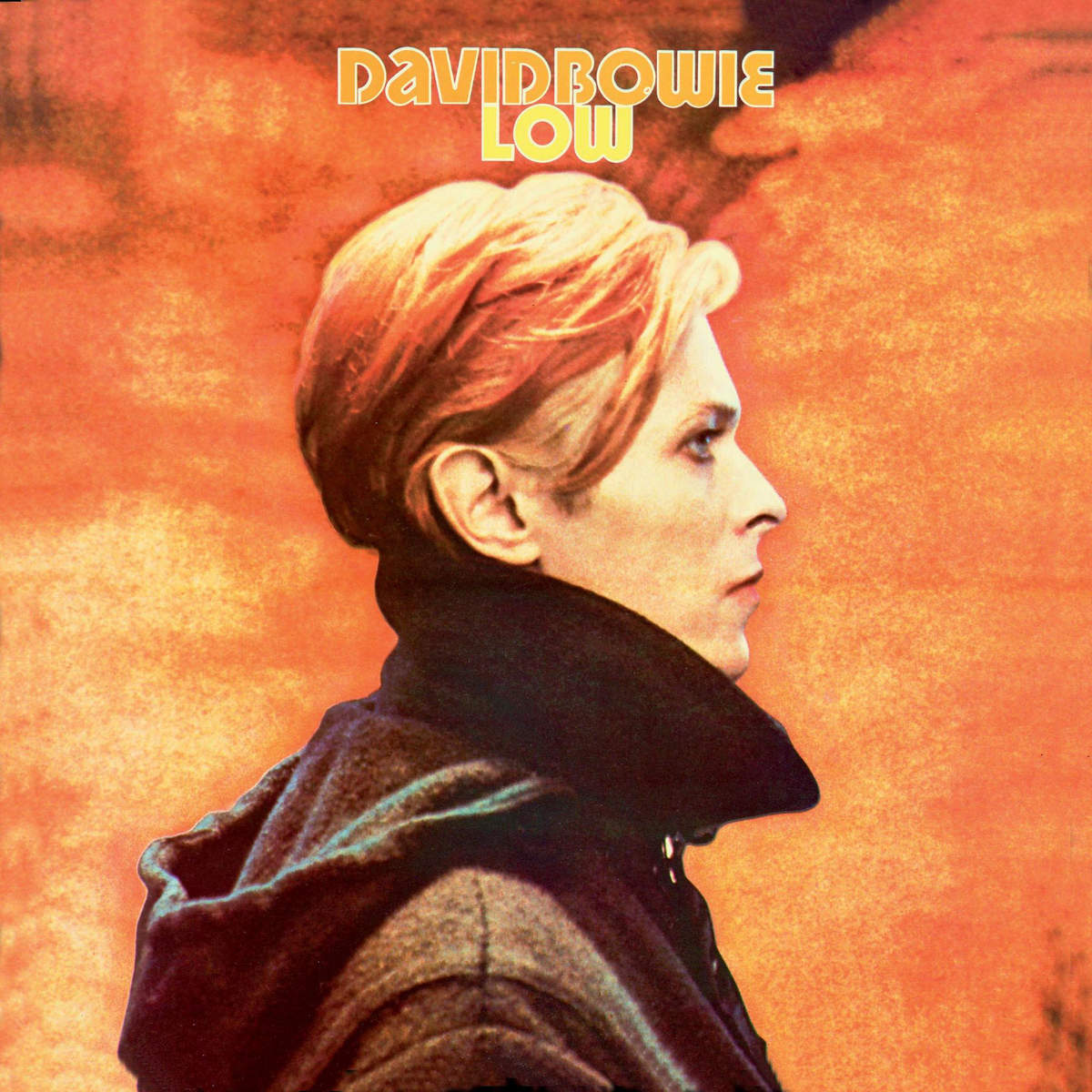
Eleven tracks in 39 minutes. Recorded across September and October 1976 at the Château d'Hérouville in northern France and Hansa Tonstudio Studio 2 in West Berlin, with Brian Eno as Bowie's first formal collaborator and Tony Visconti as co-producer. Side one is seven song-form pop pieces averaging 3 minutes; side two is four ambient instrumentals averaging six. The first album of the Berlin trilogy and the record that introduced 1970s rock to the idea that an LP could be structurally divided between vocal songs and pure-instrumental compositions without commercial penalty.
- Released
- January 14, 1977
- Label
- RCA Victor (US, CPL1-2030) · RCA Victor (UK, PL 12030)
- Producer(s)
- David Bowie · Tony Visconti
- Runtime
- 38:43 (11 tracks)
- Chart peak (US)
- #11 (Billboard 200)
- Chart peak (UK)
- #2 (UK Albums Chart)
- Certifications
- Gold (RIAA, 1977); Platinum (BPI, 1977)
- Awards & honours
- Ranked #206 on Rolling Stone's 500 Greatest Albums (2020); Grammy Hall of Fame (2024); inducted into the Library of Congress National Recording Registry (2017)
Eleven tracks in 39 minutes. Recorded across September and October 1976 at the Château d'Hérouville in northern France and Hansa Tonstudio Studio 2 in West Berlin, with Brian Eno as Bowie's first formal collaborator and Tony Visconti as co-producer. Side one is seven song-form pop pieces averaging 3 minutes; side two is four ambient instrumentals averaging six. The first album of the Berlin trilogy, and the record that introduced 1970s mainstream rock to the idea that an LP could be structurally divided between vocal songs and pure-instrumental compositions without commercial penalty.
David Bowie in summer 1976 was 29, six months past Station to Station, and trying to escape Los Angeles. The Isolar Tour had ended in May; Bowie had returned briefly to the UK (the Victoria Station 'salute' incident was that summer) and had then relocated, first to a rented villa near Geneva and then, with Iggy Pop in tow, to a sublet apartment at 155 Hauptstrasse in the West Berlin neighborhood of Schöneberg. He was attempting to dry out from the sustained cocaine consumption that had defined the Station to Station year. He was reading Christopher Isherwood. He was painting (the Schöneberg studio later produced the 'Heroes' cover photograph). And he was, for the first time in three years, working without an active drug habit, a fact that subsequent interviews have made central to the Berlin trilogy's specific clarity.
The plan to record with Brian Eno had been forming since spring. Eno had left Roxy Music in 1973 and had spent the intervening three years making his own ambient and art-pop records (Here Come the Warm Jets, 1973; Taking Tiger Mountain, 1974; Another Green World, 1975; Discreet Music, 1975). Bowie had heard Discreet Music in early 1976 and had reached out through Tony Visconti about a possible collaboration. Eno agreed; the working method would be experimental and the time commitment limited, Eno was simultaneously producing Talking Heads' first sessions and working on his own Before and After Science. Bowie booked Château d'Hérouville (the Strawberry Studios facility in a converted manor house north of Paris, where Elton John had recorded Honky Château and Pink Floyd had cut sections of Obscured by Clouds) for September 1976. Eno arrived on the fifth day of sessions; Iggy Pop's The Idiot was being mixed concurrently in the same studio.
The working method at Hérouville was specific. The Carlos Alomar / George Murray / Dennis Davis rhythm section that had recorded Station to Station was brought across; Roy Young joined on keyboards, Ricky Gardiner on additional guitar. Tony Visconti, the album's co-producer (alongside Bowie himself; Eno is credited only on side two instrumentals), brought the Eventide Harmonizer, a pitch-shifting digital processor newly released that year, and applied it to Davis's snare drum as the standard signal-processing treatment. The 'Eventide snare', a deeply processed, pitch-shifted, gated drum sound, became one of the most-imitated production decisions of the late 1970s. Phil Collins's drum sound on Peter Gabriel III (1980) and the entire 1980s drum-machine aesthetic descend from it.
Side one's seven songs were recorded conventionally, the band tracked live in Hérouville's main room, Bowie added vocals across the following 2 weeks. The sequencing is deliberate: 'Speed of Life' is an instrumental opener, 'Breaking Glass' is a fragment, 'What in the World' is a pop song with Iggy Pop on backing vocals, 'Sound and Vision' is the album's hit single (UK #3, US #69), 'Always Crashing in the Same Car' is a Roy Young-piano-led mid-tempo, 'Be My Wife' is the most-conventional song on the record, 'A New Career in a New Town' closes side one with a four-bar Bowie harmonica line over a synthesizer pattern. Side one is, by any 1976 standard, a perfectly normal Bowie record: short songs, pop hooks, Mick Jagger-quoting vocal moments, mid-tempo throughout. The unusual feature is the song-lengths, nothing on side one runs longer than 3:33, and the persistent lyric brevity (some songs have fewer than fifty words).
Side two is the structural argument the album makes. Four instrumentals, two co-credited to Eno ('Warszawa,' 'Subterraneans'), one to Eno alone ('Art Decade'), one to Bowie alone ('Weeping Wall'). 'Warszawa' is built on a piano figure Eno had Bowie's four-year-old son Duncan (Zowie at the time, later Duncan Jones the film director) hum into a tape recorder during a studio visit; Bowie transposed the hum into the song's central melodic motif. Eno's working method through the side-two sessions was the Oblique Strategies cards he had developed with Peter Schmidt the previous year, a deck of prompt-cards Eno would draw from when the band reached an impasse. The cards' specific contributions to the recordings have been catalogued in subsequent interviews; 'Honor thy mistake as a hidden intention' is reportedly the card that produced the 'Warszawa' synthesizer arrangement. The four instrumentals total roughly 20 minutes; they were recorded across 3 weeks of Hérouville sessions and finished as overdubs at Hansa Tonstudio Studio 2 in West Berlin in late October and November.
RCA's response to the album as delivered was hostile. The label had been expecting another Station to Station, a US Top 5 record, two pop singles, a six-month touring cycle. What they received was an LP whose entire second side was instrumental, whose vocal songs were all under 4 minutes, and whose lead single ('Sound and Vision') withheld the vocal entry until 93 seconds in. RCA executives reportedly threatened not to release the album; Bowie's manager Michael Lippman is reported to have responded that Bowie wouldn't change a note. The album was released January 14, 1977 with minimal radio promotion. 'Sound and Vision' was released as the lead single in February; it reached UK #3 within 5 weeks (driven heavily by BBC use of the instrumental section as a continuity-music bed across BBC1 and BBC2). The album peaked at UK #2 (held off by the soundtrack to The Slipper and the Rose), and at US #11. Critical reception was polarized: the broadsheet rock press were uncertain how to read side two, the avant-garde press were ecstatic. By the end of 1977, with Heroes already on the chart and Iggy Pop's Berlin-vintage Lust for Life and The Idiot circulating, Low's reputation had begun to consolidate as the most-important Bowie record of the period.
Low belongs at #58 because it is the album that introduced 1970s mainstream rock to the idea that an LP could be structurally divided between vocal songs and pure-instrumental compositions without commercial penalty. Every subsequent art-rock LP that has used a side-one/side-two structural division for genre-or-mode reasons, The Cure's Disintegration, Radiohead's Kid A, Björk's Vespertine, every post-rock LP, every ambient-LP-paired-with-pop-songs record, traces partly to Low's specific architectural decision. The Eno collaboration that Low inaugurated extended through Heroes (October 1977) and Lodger (May 1979) and produced one of the most-consequential producer-artist partnerships of the late 1970s; Eno's subsequent U2 (Joshua Tree, Achtung Baby), Talking Heads (Remain in Light), and Coldplay productions trace their working method partly to the Low sessions. The processed-drum sound the album introduced became the 1980s drum aesthetic. The album's late-period critical canonization (Pitchfork ranked it the best Bowie LP in their 2016 obituary retrospective) confirms a position the music itself had held since the late 1970s.
Pressing guide — the one to own
Original 1977 US first pressing, RCA Victor CPL1-2030, single sleeve with a printed inner and fan-club insert (some copies a 20-inch poster). The cover is an altered film still from 'The Man Who Fell to Earth,' designed by George Underwood, neither Steve Schapiro nor Robert Frank shot it. The 1977 US label is the black 'Nipper' RCA Victor design, not orange (RCA had revived the Nipper label in late 1976). The US lacquers were cut by Greg Calbi at Sterling Sound, confirmed by 'STERLING gc' stamped in the deadwax (Indianapolis 'I' plant). The UK first press carries the parallel PL 12030 prefix. A common LP, typically around £20-£60.