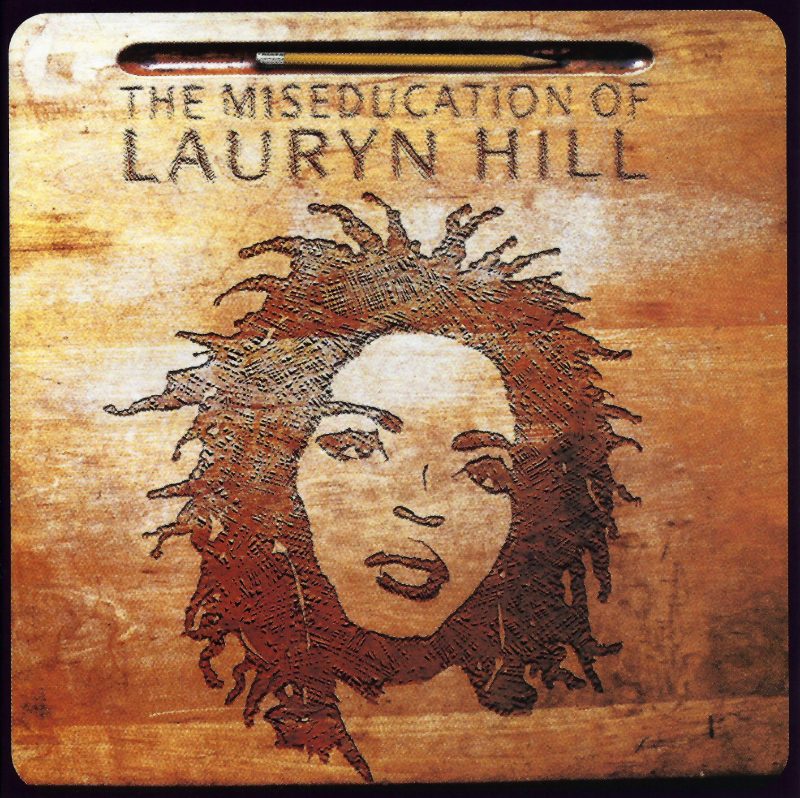
The first hip-hop album to win the Grammy for Album of the Year. The album where a 22-year-old former Fugee combined live-band soul, gospel, reggae, and rap into a single coherent statement of late-1990s Black womanhood, and then, having made one of the great albums of her generation, made no further albums.
- Released
- August 25, 1998
- Label
- Ruffhouse / Columbia
- Producer(s)
- Lauryn Hill (with credits contested by collaborators, see myths)
- Runtime
- 77:48 (16 tracks plus interludes)
- Chart peak (US)
- #1 (Billboard 200), debuted at #1 with 422,624 first-week units, a record for a female artist at the time
- Chart peak (UK)
- #2
- Certifications
- Diamond (RIAA, 10× Platinum); estimated 19M+ units worldwide
- Awards & honours
- 5 Grammy Awards including Album of the Year (1999), first hip-hop album ever to win the category; Library of Congress National Recording Registry (2015); routinely cited as the greatest hip-hop album by a solo female artist
Hill was 22. The Fugees had broken up acrimoniously a year earlier; she was pregnant with her first child; she had decided to make an album that wasn't a Fugees album. She booked Tuff Gong studio in Kingston, Jamaica, and put together a band of musicians her own age. The result is the rare album that delivered on its hype and then surpassed it.
The Fugees had finished. The Score (1996) had sold 6 million copies in the US alone and made Lauryn Hill, Wyclef Jean, and Pras Michel the biggest hip-hop crossover act of the mid-90s. By early 1997 the group was no longer the group. Hill's romantic relationship with Wyclef had ended; she was newly partnered with Rohan Marley (son of Bob); she was pregnant; and she had decided that the next album wouldn't be a Fugees album. She had been writing, songs and verses and full-band arrangements, for over a year. She wanted the next record to sound like nothing the Fugees had made and like nothing else in 1997 hip-hop.
She booked Tuff Gong studio in Kingston, Jamaica, the studio Bob Marley had built, then owned by his estate. She brought a band: drummer James 'Poyser' Poyser (who would shortly become one-third of The Roots' touring rhythm section), bassist Loris Holland, guitarist Johari Newton, keyboardist Vada Nobles, and horn arrangements in the brothers James and Larry Mizell style done by trumpeter Kenneth Whalum III's father, Kenneth Whalum Jr. There was a string section flown down from New York for some sessions. There was a gospel choir. There was Mary J. Blige (on 'I Used to Love Him'), D'Angelo (on 'Nothing Even Matters'), and Carlos Santana (on 'To Zion').
The Tuff Gong sessions ran from late 1997 through summer 1998. Hill produced the album herself, though, as the credits would later be contested, several musicians who worked on the record (Vada Nobles, Tejumold Newton, the 'New Ark' production crew of Vada, Tejumold, Rasheem Pugh, and Johari Newton) sued in 1998 claiming uncredited co-production. The case was settled out of court in 2001 for an undisclosed sum widely reported as £5 million. The album's production credit remained 'Lauryn Hill' on the sleeve; the secondary literature has been arguing about the contributions of the New Ark crew for twenty-five years. This is not a minor footnote. What is unquestionably Hill's is the songwriting, the lead vocals, the structural conception, and the willingness to take aesthetic risks no other rapper-singer of her generation was taking. What is more disputed is the granular work of arrangement and production. The truth, almost certainly, is that the album is hers in the way that an auteur film is the director's, recognizably the work of one author working with collaborators whose contributions were essential and partly uncredited.
What the album does that hadn't been done is fuse hip-hop, soul, gospel, reggae, and traditional songcraft into a single album with no genre-switching seams. 'Lost Ones' opens with a hip-hop beat and lyric (about the Fugees, named only obliquely) and ends in a reggae chorus. 'Ex-Factor' is a slow R&B ballad with no rapping at all. 'To Zion' is a gospel song with Santana's guitar. 'Doo Wop (That Thing)' alternates a hip-hop verse and a fifties doo-wop chorus and was the first hip-hop song to win Best R&B Song at the Grammys. 'Final Hour' is the most pure hip-hop track on the record, a lyrical exercise in the dense-rhyme tradition. 'When It Hurts So Bad' is a soul ballad. 'Forgive Them Father' is a reggae song with a gospel chorus. The album refuses to choose a genre, and the refusal is the album's argument.
Interleaved through the songs are six interludes, short classroom-skit conversations with teenagers at New York's High School of Music and Art (now the LaGuardia HS for the Performing Arts), which Hill had attended. The students are discussing love, what it is, who deserves it, whether it is worth pursuing. The skits were recorded over a single afternoon at the school. They serve a function similar to the interviews on Dark Side of the Moon: they place the album inside a community, not a single artist's head. The album's thesis, that love is a curriculum, and the curriculum is incomplete in conventional schools, is reinforced by every interlude.
The album's central concern is the difference between the love you have learned (from movies, from religion, from R&B radio) and the love you actually receive. The lyrics are more autobiographical than Hill has ever fully acknowledged, 'Ex-Factor' is widely understood to be about Wyclef, 'To Zion' is about her son Zion (whom her family and label had encouraged her to abort), 'Lost Ones' is about the Fugees breakup, 'I Used to Love Him' is about the same period in her relationship history. But the album works as an argument even if you don't know the biography. The argument is: women raised in Black American Christianity, with hip-hop and soul as cultural inheritance, are operating with a set of love-teachings that haven't equipped them for what love actually requires. The album doesn't claim to fix this. It documents it.
When it was released on August 25, 1998, the album debuted at #1 on the Billboard 200 with 422,624 units sold, the largest first-week sales by a female artist in the SoundScan era at that point. It went diamond within two years. The lead single, 'Doo Wop (That Thing),' was the first song by a female rapper to debut at #1 on the Hot 100. At the 1999 Grammys, Hill won five awards including Album of the Year, the first hip-hop album in the category's forty-one-year history. She was 23. The album had been on shelves for five months. The trajectory looked, in early 1999, like the start of a career that would define R&B for the next two decades.
She didn't release another studio album. The MTV Unplugged performance of 2001 documented a Hill who was struggling, under-rehearsed, alternately defiant and tearful, performing songs she had written since Miseducation but which she wouldn't finish recording. Subsequent collaborations and tours have continued, but there has been no second studio LP. The reasons are personal, professional, legal, spiritual, and possibly aesthetic, Hill has rarely explained, but has given enough interviews over the years that the picture is roughly: the success of Miseducation produced demands she didn't want to meet, and meeting them would have meant repeating herself. She chose silence over repetition. It is the longest-running second-album silence in pop history; she has been working on the follow-up for twenty-seven years.
Miseducation ranks at six because it is the most singular crossover album of the 1990s and the moment hip-hop became album-art in the canonical sense. The five albums above it (What's Going On, Pet Sounds, Revolver, Kind of Blue, Dark Side of the Moon) are all male-led; Miseducation is the highest-ranked album by a solo Black woman on this list. It sits among the most-canonized albums in popular music, the rock and jazz landmarks of the 1960s and 70s, and holds its own against all of them. Miseducation is the rare hip-hop record that earns this rank against that company. The reason it isn't higher is that the album's reach occasionally exceeds its grasp, a few tracks are less than their best moments, and the production-credit dispute, while not affecting the record's quality, complicates the auteur argument that the ranks above it can make more cleanly. But the album is the most influential single statement by an American female artist in the modern era, and the case for it being among the ten greatest albums of all time has only strengthened since 1998.
Pressing guide — the one to own
Original 1998 US double LP on Ruffhouse/Columbia, C2 69035, in a gatefold sleeve with Eric Johnson's cover photograph. The 1998 vinyl was a short run—CD was the primary format—so clean originals are scarce. The first-press deadwax matrices run on 69562 (sides A/B) and 69563 (sides C/D), not 'C2 69035-A…D'. Lyrics are printed on the inner sleeves rather than in a separate booklet, and complete copies need those intact.