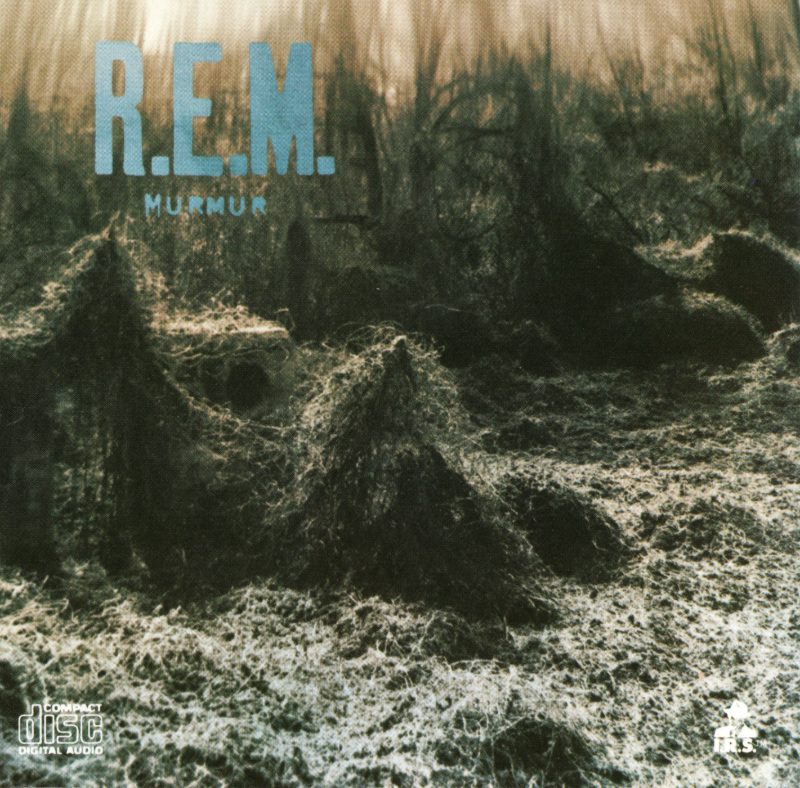
Twelve tracks in 44 minutes. Recorded across approximately 5 weeks at Reflection Sound Studios in Charlotte, North Carolina in January and February 1983 with Mitch Easter and Don Dixon co-producing. R.E.M.'s debut LP, four University of Georgia students from Athens producing one of the founding texts of American indie rock. The album that consolidated the deliberately-arpeggio jangle-guitar vocabulary that would define college rock through the decade and provided the template every subsequent American indie-rock LP has worked within.
- Released
- April 12, 1983
- Label
- I.R.S. Records (US, SP-70604) · I.R.S. Records (UK, IRS-70014)
- Producer(s)
- Mitch Easter · Don Dixon
- Runtime
- 44:11 (12 tracks)
- Chart peak (US)
- #36 (Billboard 200)
- Chart peak (UK)
- Did not chart on initial release
- Certifications
- Gold (RIAA, 1991)
- Awards & honours
- Rolling Stone Album of the Year (1983); ranked #197 on Rolling Stone's 500 Greatest Albums (2020); Grammy Hall of Fame (2024); Library of Congress National Recording Registry (2021)
Twelve tracks in 44 minutes. Recorded across approximately 5 weeks at Reflection Sound Studios in Charlotte, North Carolina in January and February 1983 with Mitch Easter and Don Dixon co-producing. R.E.M.'s debut LP, four University of Georgia students from Athens producing one of the founding texts of American indie rock. The album that consolidated the deliberately-arpeggio jangle-guitar vocabulary that would define college rock through the decade and provided the template every subsequent American indie-rock LP has worked within.
R.E.M. in autumn 1982 was four University of Georgia students from Athens: Peter Buck (guitar), Mike Mills (bass and backing vocals), Bill Berry (drums), and Michael Stipe (vocals). The band had been gigging continuously since April 1980 at the 40 Watt Club and other Athens venues; their independent-released 'Radio Free Europe' single (Hib-Tone, July 1981) had established them as a regional underground force. I.R.S. Records, the British-American independent label founded by Miles Copeland in 1979, signed the band in spring 1982; the deal allowed creative control while I.R.S. provided major-label distribution through A&M. The plan for the debut LP was that it would consolidate the band's regional underground reputation into a national commercial presence.
Recording began at Reflection Sound Studios in Charlotte, North Carolina in January 1983 with producers Mitch Easter (the Let's Active frontman who had recorded the band's 1982 'Chronic Town' EP) and Don Dixon. The Reflection facility had been Easter's choice for its deliberately-warm acoustics and its specific console (a Trident A-Range with API outboard processing). The recording approach was deliberately-conservative: the band tracked live in the studio's live room with Stipe's vocals in an isolated booth; overdubs were limited to Peter Buck's occasional second guitar parts and Mike Mills's piano contributions. The sessions ran approximately 5 weeks across January and February 1983.
The album's twelve tracks consolidate the band's specific working method. The deliberately-arpeggio jangle-guitar vocabulary that Peter Buck had developed through the 1981-82 Athens shows became the album's structural anchor; Mike Mills's deliberately-elevated bass lines and backing vocal harmonies provided the secondary architecture; Bill Berry's deliberately-restrained drumming kept the deliberately-controlled tempo; Michael Stipe's deliberately-mumbled vocal delivery and deliberately-impressionistic lyrics gave the album its specific tonal signature.
The album's specific sonic register, the deliberately-warm acoustic atmosphere, the deliberately-arpeggio guitar vocabulary, the deliberately-restrained drumming, the deliberately-mumbled vocal delivery, became the foundational template for American indie rock through the 1980s. Every subsequent jangle-pop and college-rock band of the period (the Replacements, the dB's, Let's Active, Pylon, the Three O'Clock, the Bangles, the Long Ryders) operates within the vocabulary R.E.M.'s debut established. The R.E.M.-as-template for American indie rock has been continuous since the album's 1983 release.
I.R.S. released the album on April 12, 1983 with substantial promotional support. The album debuted at US #173 on the Billboard 200 and gradually climbed through the summer; it peaked at US #36 by October 1983 (driven by the 'Radio Free Europe' single's renewed radio rotation and college-radio play). Rolling Stone named the album Album of the Year for 1983, ahead of Michael Jackson's Thriller. The album's commercial trajectory, modest debut, gradual climb to US #36, sustained college-radio rotation, transformed R.E.M. from an Athens underground band into a national commercial presence; the subsequent I.R.S. LPs (Reckoning 1984, Fables of the Reconstruction 1985, Lifes Rich Pageant 1986) would consolidate the position.
The album's cultural impact has been continuous since the mid-1980s. R.E.M.'s specific working method (the deliberately-collaborative band democracy, the deliberately-arpeggio jangle-guitar vocabulary, the deliberately-mumbled vocal delivery) was widely imitated through the late 1980s and early 1990s. The Athens, Georgia indie-rock scene that emerged in R.E.M.'s wake (the B-52's, Pylon, the dB's, Love Tractor) was widely covered in the rock press; the deliberately-college-radio aesthetic that R.E.M.'s I.R.S. catalogue established became the foundational template for American indie rock. The album's commercial trajectory has been the steady canonization-via-R.E.M.-subsequent-success template; cumulative US sales reached Gold (1M units) by 1991, with the album charting continuously on college and rock catalogue charts since 1983.
Murmur belongs at #63 because it is the album that consolidated the deliberately-arpeggio jangle-guitar vocabulary that would define American indie rock through the decade and provided the template every subsequent American indie-rock LP has worked within. The R.E.M.-as-template for American indie rock has been continuous since 1983; the deliberately-college-radio aesthetic became the foundational template for the entire late-1980s and early-1990s American indie-rock tradition. The album's specific contribution to American rock, the deliberately-collaborative band democracy, the deliberately-arpeggio jangle-guitar vocabulary, the deliberately-mumbled vocal delivery, the deliberately-impressionistic lyrics, set the template that has continued through the present. The Library of Congress National Recording Registry induction in 2021 confirms a position the music itself had secured by the end of R.E.M.'s 1980s I.R.S. catalogue.
Pressing guide — the one to own
Original 1983 US pressing on I.R.S. Records, catalog SP-70604 (manufactured and distributed by A&M), mastered and cut by Greg Calbi at Sterling Sound. The front cover is the kudzu-covered landscape; the back of the original sleeve shows the railroad trestle, both photographed by Sandra-Lee Phipps. Calbi's known runout signature is a small etched baseball, not a 'BL' mark. The album was pressed at several plants (RCA Indianapolis, Electrosound, Monarch), so first-press runouts carry differing plant codes alongside the SP-070604 matrix.