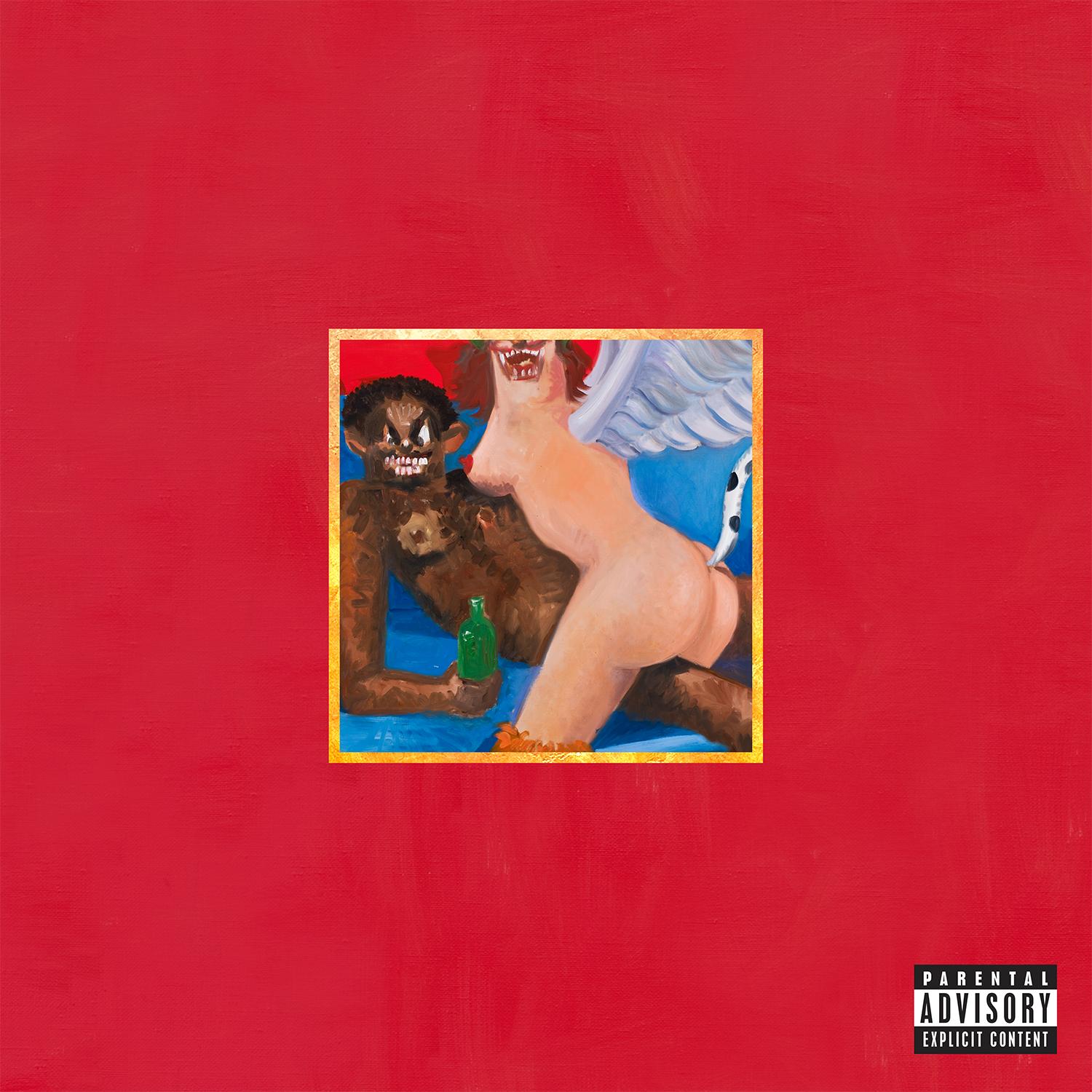
Thirteen tracks in 68 minutes. Recorded across approximately eleven months at Avex Honolulu Studios in Hawaii and at multiple Manhattan and Los Angeles studios, with Kanye West producing alongside a rotating cast of fifteen producers and approximately thirty guest collaborators. Made in the aftermath of West's 2009 VMA interruption of Taylor Swift and the resulting public-image collapse; finished during his self-imposed Hawaii exile. The maximalist hip-hop concept album that consolidated West's working method (the Honolulu camp model) and provided the template every subsequent ambitious 2010s hip-hop LP has worked within.
- Released
- November 22, 2010
- Label
- Roc-A-Fella Records / Def Jam Recordings (B0014695-02)
- Producer(s)
- Kanye West (primary, co-produced every track) · Jeff Bhasker · No I.D. · RZA · Mike Dean · Bink · S1 · Emile · DJ Frank E · Plain Pat · Pete Rock · Q-Tip · Symbolyc One
- Runtime
- 68:35 (13 tracks)
- Chart peak (US)
- #1 (Billboard 200); #1 (Billboard Top R&B/Hip-Hop)
- Chart peak (UK)
- #16 (UK Albums Chart)
- Certifications
- 3× Platinum (RIAA, 2018); Gold (BPI, 2014)
- Awards & honours
- Pitchfork score of 10.0 (one of only seven 21st-century LPs to receive the rating); ranked #17 on Rolling Stone's 500 Greatest Albums (2020); seven Grammy nominations (Album of the Year nomination, lost to Arcade Fire's The Suburbs); inducted into Library of Congress National Recording Registry (2025)
Thirteen tracks in 68 minutes. Recorded across approximately eleven months at Avex Honolulu Studios in Hawaii and at multiple Manhattan and Los Angeles studios, with Kanye West producing alongside a rotating cast of fifteen producers and approximately thirty guest collaborators. Made in the aftermath of West's September 2009 VMA interruption of Taylor Swift and the resulting public-image collapse; finished during his self-imposed Hawaii exile. The maximalist hip-hop concept album that consolidated West's working method (the Honolulu camp model) and provided the template every subsequent ambitious 2010s hip-hop LP has worked within.
Kanye West in autumn 2009 was thirty-two years old, four albums into a transformational hip-hop career, and at the lowest public-image point of his life. On September 13, 2009, at the MTV Video Music Awards, he interrupted Taylor Swift's acceptance speech for Best Female Video to declare that Beyoncé's 'Single Ladies' had been more deserving. The moment was televised live and reached approximately 12 million US viewers; President Obama's subsequent off-the-record remark calling West a 'jackass' (captured by an open microphone the following month) consolidated West's status as the moment's cultural villain. Within 2 weeks of the VMA incident, West had cancelled his tour, withdrawn from public appearances, and effectively gone into self-imposed exile. He relocated to Avex Honolulu Studios in Hawaii in late October 2009 and remained there, with brief trips back to the mainland, until the album's autumn 2010 completion.
The Avex Honolulu sessions, widely known as the 'Hawaii sessions', became the album's central working method and one of the most-discussed studio environments of contemporary hip-hop. West's approach was to invite an extraordinary rotating cast of producers, rappers, vocalists, and engineers to Honolulu, where they would work in 12-to-24-hour sessions at Avex Studios A and B. The roster across the eleven months included Jay-Z, Pusha T, Kid Cudi, Rick Ross, Nicki Minaj, Justin Vernon, Drake, RZA, Q-Tip, Pete Rock, Bink, No I.D., Mike Dean, Jeff Bhasker, Emile, Plain Pat, DJ Frank E, S1, Symbolyc One, Bon Iver, Charlie Wilson, John Legend, Elly Jackson, Alicia Keys, Elton John, Raekwon, Cyhi the Prince, Swizz Beatz, Chris Rock, Bryan-Michael Cox, plus several engineers and assistants. At the peak in early 2010, approximately fifteen people were living in West's Honolulu rental property and working at Avex Studios continuously.
The working method had no precedent in commercial hip-hop. West's approach was to assemble the rotating cast around specific tracks-in-progress and have multiple producers work on the same track in parallel, with West making final arrangement decisions across multiple revisions per day. Mike Dean (the album's chief mixer and a primary co-producer) has said in subsequent interviews that the typical Avex session day began at 4 PM, ran through to roughly 8 AM the following morning, with multiple producers working simultaneously on different tracks in adjacent rooms. The album's production credits reflect this: every track has multiple co-producers; some tracks ('All of the Lights,' 'Lost in the World') have six or more credited producers. The deliberately-collaborative working method produced the album's specific maximalist aesthetic; West has said in subsequent interviews that the Honolulu sessions were 'the most-creative time of my life.'
The album's thirteen tracks include collaborations with approximately thirty guest vocalists across nine of the thirteen tracks. The roster of vocalist guests, Jay-Z, Pusha T, Rick Ross, Nicki Minaj, Justin Vernon, Kid Cudi, Drake, Rihanna, Charlie Wilson, John Legend, Elly Jackson, Alicia Keys, Elton John, Bon Iver, Raekwon, Cyhi the Prince, Chris Rock, is unprecedented in scope for any commercial hip-hop LP. The album's production budget reflects this: the multi-guest 'All of the Lights' (track five) reportedly cost £500,000 alone in clearance fees and guest fees; the cumulative production budget for the album is estimated at £3-4 million across recording, sample clearance, guest fees, and the Runaway short-film promotional production. The Roc-A-Fella/Def Jam parent company's bet on the album's commercial success was substantial.
The album's promotional cycle ran from June 2010 (the 'Power' single release) through November 2010 (the album release date). West's strategy was deliberately structured around a series of high-profile cultural moments: the August 2010 'Runaway' VMA Awards short-film premiere (which restored West's public-image position after the 2009 incident); the October 2010 'Runaway' short-film theatrical premiere at the New York Film Festival; the November 2010 album release; the December 2010 'My Beautiful Dark Twisted Fantasy' promotional photo shoot that featured West with the rejected 'crucifix' cover art. The promotional cycle was the most-elaborate marketing campaign for any hip-hop album to that point.
Def Jam released the album on November 22, 2010 with substantial promotional support. The album debuted at US #1 on the Billboard 200 with 496,000 first-week SoundScan units, the largest first-week for any hip-hop album of 2010 and the third-largest first-week for any album that year. 'Power,' 'All of the Lights,' and 'Runaway' had been pre-album singles; the resulting commercial momentum was strong. The album was certified Platinum (RIAA) within 4 weeks of release; would eventually reach 3× Platinum in 2018. The Grammy Awards in February 2011 produced seven nominations including Album of the Year (West lost to Arcade Fire's 'The Suburbs'); the result confirmed the album's critical canonization without giving the categorical institutional recognition that would come with the Library of Congress induction in 2025.
The critical reception consolidated the album's canonical status within months of release. Pitchfork's December 6, 2010 review, scored 10.0 by Ryan Dombal, was one of the most-significant Pitchfork scores of the 2010s decade, only the seventh 21st-century LP to receive the perfect score. Rolling Stone, the New York Times, Spin, Vibe, the Source, and approximately every major music publication produced extended-positive reviews. The album's specific cultural register, the maximalist concept album, the multi-guest collaboration method, the deliberately-emotional confessional content, the orchestral-and-electronic production discipline, was widely cited as the foundational text for the 2010s ambitious-hip-hop canon. Kendrick Lamar's good kid, m.A.A.d city (2012), Drake's Take Care (2011), Frank Ocean's Channel Orange (2012), and J. Cole's 2014 Forest Hills Drive (2014) all draw on the working method My Beautiful Dark Twisted Fantasy established.
My Beautiful Dark Twisted Fantasy belongs at #60 because it is the album that consolidated the maximalist hip-hop concept album form for the 2010s and provided the template every subsequent ambitious hip-hop LP has worked within. The Honolulu camp working method, the rotating cast of producers and guests in a sustained creative environment, became the standard production model for major-label hip-hop concept albums (Kendrick Lamar's TDE House of Studios, Frank Ocean's 'Blonde' working method, every Drake LP's Toronto-collaboration approach). The deliberately-orchestral-and-electronic production discipline (Mike Dean's mixing, Jeff Bhasker's keyboards, the multiple-producer-per-track architecture) became the dominant maximalist production aesthetic. The deliberately-confessional emotional register (the 'Runaway' acceptance of personal failings, the 'Lost in the World' existential confrontation) established the template for hip-hop's emotional-autobiographical turn that has continued through the present. West's subsequent catalogue (Watch the Throne 2011, Yeezus 2013, The Life of Pablo 2016, Ye 2018, JIK 2019, Donda 2021) all extend or react against the MBDTF working method. The album is the consolidated statement of West's specific 2008-2010 creative arc and the foundational document of contemporary commercial hip-hop's ambitious-concept-album tradition.
Pressing guide — the one to own
Original first US vinyl pressing, Roc-A-Fella / Def Jam B0014695-01, a 3xLP issued in November 2010 alongside the CD (there is no separate January 2011 vinyl). Packaging is a die-cut tri-fold sleeve with five inserts and a 24-inch George Condo poster. Condo painted five cover variants; the standard retail cover was the winged-nude 'phoenix' painting (the one flagged as 'banned'), with the ballerina image used by retailers that refused it, no 'crucifix' cover is documented. Mastered by Vlado Meller, with lacquers cut by Ray Janos at Sterling Sound ('RJ STERLING' in the deadwax), pressed by United Record Pressing. Complete copies with all inserts and poster trade around £60-£150.