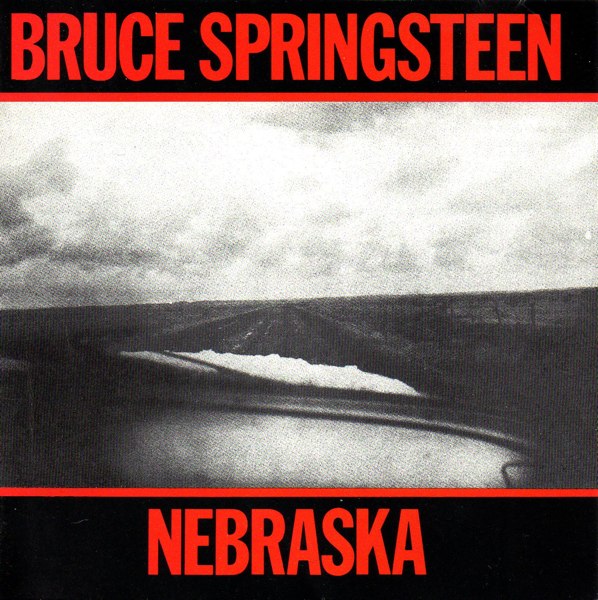
Ten tracks in 41 minutes. Recorded on a Tascam 144 Portastudio four-track cassette recorder at Springsteen's rented house in Colts Neck, New Jersey, across two evenings in January 1982, intended as demos for the E Street Band but released as-is after the band recordings failed to match the four-track cassette intimacy. The album that proved a major-label commercial-rock artist could release a deliberately lo-fi solo-acoustic LP without commercial concession, and inaugurated the bedroom-recording-as-commercial-product template thirty years before bedroom-electronic became a commercial form.
- Released
- September 30, 1982
- Label
- Columbia Records (US, TC 38358)
- Producer(s)
- Bruce Springsteen
- Runtime
- 40:50 (10 tracks)
- Chart peak (US)
- #3 (Billboard 200, October 1982)
- Chart peak (UK)
- #3
- Certifications
- Platinum (RIAA, 1995)
- Awards & honours
- Ranked #150 on Rolling Stone's 500 Greatest Albums (2020); the founding text of the lo-fi commercial-rock LP
Ten tracks in 41 minutes. Recorded on a Tascam 144 Portastudio four-track cassette recorder at Springsteen's rented house in Colts Neck, New Jersey, across two evenings in January 1982, intended as demos for the E Street Band but released as-is after the band recordings failed to match the four-track cassette intimacy. The album that proved a major-label commercial-rock artist could release a deliberately lo-fi solo-acoustic LP without commercial concession, and inaugurated the bedroom-recording-as-commercial-product template thirty years before bedroom-electronic became a commercial form.
Bruce Springsteen in autumn 1981 was thirty-two years old, six years past Born to Run's commercial breakthrough, three years past Darkness on the Edge of Town's critical consolidation, and one year past The River's commercial peak (US #1, Platinum, 1980, the album that had finally delivered Springsteen the chart-topper Born to Run had not quite reached). He had spent the second half of 1981 on the River World Tour, finishing in Cincinnati on September 14. He had returned to a rented house at 7B Telegraph Hill Road in Colts Neck, New Jersey, where he intended to write the next E Street Band LP.
The writing period extended from October 1981 through early January 1982. Springsteen had been reading widely, Terrence Malick's 'Badlands' screenplay, Flannery O'Connor's short stories, Bobbie Ann Mason's 'Shiloh and Other Stories,' a copy of the FBI's Most Wanted profile of Charles Starkweather. The songs that emerged from this period were narrative-character pieces: small-town American working-class voices, often desperate, often violent, almost never resolved. The vocabulary was deliberately different from the Born to Run / Darkness / River anthemic-rock register.
On January 3, 1982, Springsteen's guitar tech Mike Batlan arrived at Telegraph Hill Road with a Tascam 144 Portastudio four-track cassette recorder Springsteen had asked him to buy. The intention was to cut demos that Springsteen could bring to the E Street Band for full-band recording at the Power Station in Manhattan. Springsteen set up the Portastudio in the bedroom of the rented house, recording his acoustic guitar and harmonica through two Shure SM57 microphones into the four-track cassette. Across approximately two evenings on January 3-4, 1982, he recorded fifteen songs.
The four-track cassette was carried in Springsteen's jacket pocket for the following three months. He played the demos for Jon Landau, his manager and producer, and for the E Street Band. The band recorded full-band versions of most of the songs at the Power Station between February and April 1982. The band recordings failed. Springsteen has said in interviews that the E Street arrangements 'killed' the songs, that the band performances added energy the songs didn't want and lost the intimacy the four-track cassette had captured. Multiple E Street Band recordings exist as Born in the USA-era outtakes; some were eventually released on the 1998 Tracks compilation.
By June 1982 Springsteen and Landau had decided to release the four-track cassette demos as the album itself. The decision required substantial technical work, the cassette recordings were on a Tascam Portastudio cassette tape with substantial hiss, the levels were inconsistent, and several songs needed additional Springsteen overdubs (some guitar harmonies, occasional second-vocal tracks). The album was assembled by transferring the cassette to half-inch analog tape at the Power Station, then re-recording essential overdubs through the Power Station's professional chain. The final mix retained the four-track cassette source as the album's defining sonic signature.
Columbia released the album on September 30, 1982. The promotional decision was deliberately minimal: no singles for US radio, no music videos, no Springsteen interview tour, no live performances. 'Atlantic City' was released as a UK-only single in November 1982 (UK #7). The album debuted at US #4 the week of October 16, climbed to #3 the following week, and stayed on the Billboard 200 for 32 weeks. UK chart entry at #3 was the band's UK commercial peak to that point. Critical reception was extraordinary, Robert Christgau A+, Rolling Stone five stars, NME and Melody Maker both treating the album as the year's definitive American-rock statement.
The album's commercial reception was complicated by the absence of singles. Sales accumulated steadily across 1982-83 rather than peaking on release; the RIAA Platinum certification didn't come until 1995, thirteen years after release. The album wasn't a launch-week event in the Born to Run sense; it was a slow-burn catalogue release that has remained continuously in print since 1982.
Nebraska belongs at #88 because it is the album that proved a major-label commercial-rock artist could release a deliberately lo-fi solo-acoustic LP without commercial concession, and inaugurated the bedroom-recording-as-commercial-product template that has since defined Iron & Wine, Bon Iver's For Emma Forever Ago (recorded similarly in a Wisconsin cabin), Sufjan Stevens's home-recording catalogue, Phoebe Bridgers, Adrianne Lenker, and roughly every subsequent serious singer-songwriter LP that treats home-recording as a sustained artistic decision rather than a compromise. The Scott Cooper-directed Deliver Me from Nowhere (2025), narrating the album's January 1982 recording with Jeremy Allen White playing Springsteen, ratifies the album's status as the founding text of the bedroom-singer-songwriter form. The 2020 Rolling Stone #150 ranking confirms institutional canonization.
Pressing guide — the one to own
Original 1982 US pressing on Columbia, listed under catalog TC 38358 (the labels and deadwax carry the side matrices AL/BL 38358); single LP with a stiff-paper lyric inner sleeve and David Kennedy's cover photograph. The album famously has no liner essay, and the label is the early-1980s "Columbia" wordmark design — not a 1950s–60s "walking eye." Mastering was by Dennis King at Atlantic Studios, not Bob Ludwig/Masterdisk; the runouts etch "ATLANTIC STUDIOS D.K." (Ludwig and Marcussen were only mastering consultants). A multi-platinum record, so clean originals are common, roughly $15–30.