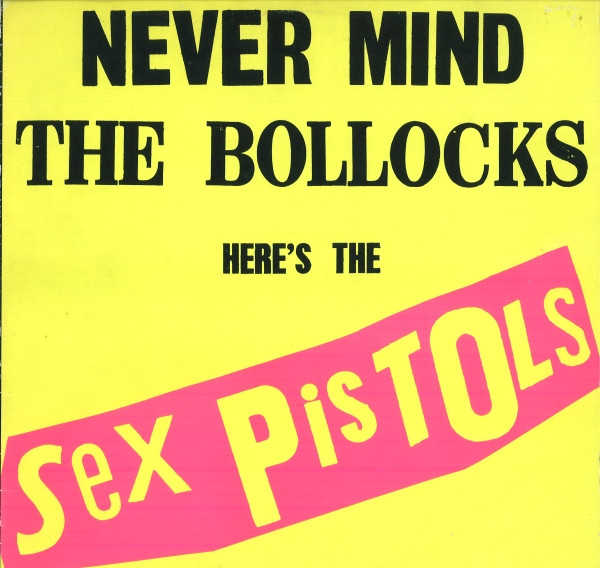
Twelve songs in 39 minutes. One studio album in three years of band existence. Banned by Boots, WHSmith, and Woolworths; the title prosecuted as obscene; the cover designed in cut-up ransom-note typography. The Sex Pistols' only studio LP, and the document that reset British rock.
- Released
- October 28, 1977
- Label
- Virgin Records (UK) · Warner Bros. (US)
- Producer(s)
- Chris Thomas · Bill Price
- Runtime
- 38:39 (12 tracks)
- Chart peak (US)
- #106 (Billboard 200)
- Chart peak (UK)
- #1 (Record Retailer)
- Certifications
- Gold (RIAA); 2× Platinum (BPI); estimated 3M+ units globally
- Awards & honours
- Ranked #19 on Rolling Stone's 500 Greatest Albums (2020); Library of Congress National Recording Registry pending; Mojo magazine's 'punk album of all time' poll regular #1
By the time the album came out, the band had had three different bassists, a US-record-deal shouting match in Notting Hill, and the most-prosecuted album cover in British retail history. Twelve songs. Three of them banned from radio. The single best-selling banned record in UK chart history.
The Sex Pistols had existed for less than three years when they finally released their only studio album. They had been formed in 1975 by Steve Jones (guitar), Paul Cook (drums), and Glen Matlock (bass) under the management of Malcolm McLaren, who ran a King's Road clothing shop called SEX. McLaren had recruited John Lydon (renamed Johnny Rotten) as the band's lead singer in August 1975 after Lydon walked into the shop wearing a customized Pink Floyd t-shirt with 'I HATE' scrawled above the band name. The band signed to EMI in October 1976. They released the single 'Anarchy in the U.K.' in November 1976. They appeared on the Bill Grundy TV show on December 1, 1976, swore on live television, and were dropped by EMI within the week. They signed to A&M in March 1977 in front of Buckingham Palace; they were dropped six days later after Sid Vicious threw a toilet bowl through a record-company executive's office window. They signed to Virgin in May 1977, the only label willing to take them.
Recording began in May 1977 at Wessex Sound Studios in Highbury (the same room where the Clash would record London Calling two years later). Chris Thomas, who had worked with the Beatles, Roxy Music, and Procol Harum, produced. Bill Price engineered. By the time the sessions began, Glen Matlock had left the band over musical disagreements with Lydon; Sid Vicious (John Beverley), a friend of Lydon's with no musical training, had replaced him. Vicious could not play bass. Most of the basslines on the album were played by Steve Jones, with Sid Vicious credited but actually playing on only one full track ('Bodies').
The songs themselves were a Steve Jones-and-Glen Matlock writing collaboration that ran through the band's first eighteen months; Matlock co-wrote ten of the twelve album tracks before his departure. Jones's chord-and-power-chord guitar approach defined the album's sonic vocabulary. Chris Thomas's production was muscular and surprisingly polished, closer to a Roxy Music or Procol Harum album than to what the British music press was calling 'punk' in 1977.
The songs across the album are a survey of what the band was angry about: 'Holidays in the Sun' opens with the Berlin Wall as setting; 'Bodies' is about abortion told from the position of disgust at all parties; 'God Save the Queen' (released as a single in May 1977 to coincide with the Silver Jubilee) called the Queen 'a fascist regime' and was banned by the BBC; 'Anarchy in the U.K.' is the band's first single, included on the album; 'EMI' is the band's revenge song against their first label; 'No Feelings,' 'Liar,' 'Problems,' 'Seventeen,' 'Submission,' 'Pretty Vacant,' and 'New York' fill out the running order. The album's lyrical sensibility is unrelentingly hostile; the music is more melodic and structurally conventional than the lyrics suggest.
Released October 28, 1977, the album reached #1 on the UK Record Retailer chart within 2 weeks. Boots, WHSmith, and Woolworths refused to stock it because of the title; the album was nevertheless the year's bestselling UK LP. The album cover, designed by Jamie Reid using cut-up ransom-note-style typography, was the subject of an obscenity trial in November 1977 in Nottingham; the prosecution lost, and the title 'Bollocks' was ruled not obscene. The US release in November 1977 (Warner Bros.) reached only #106 on the Billboard 200, but the album's UK cultural impact was overwhelming.
The band toured the US in January 1978, played seven dates, and broke up at Winterland in San Francisco on January 14, 1978. Lydon walked off stage after the final encore, said 'Ever get the feeling you've been cheated?' into the microphone, and quit the band. Sid Vicious died of a heroin overdose in February 1979 while on bail for the alleged murder of his girlfriend Nancy Spungen. Jones, Cook, and Matlock continued in various combinations through the 1980s; the band reunited multiple times across subsequent decades. Lydon formed Public Image Ltd. in 1978, releasing some of the most-cited post-punk records of the late 1970s.
Never Mind the Bollocks belongs at #24 because it is the document of UK punk's commercial peak, the moment the movement reached its broadest cultural penetration before fragmenting. The album is also unusually well-made; the production is the album's secret weapon, and the songwriting (largely Jones and Matlock's) is more melodic than the band's reputation suggests. The album opens punk as a vocabulary that every subsequent UK rock band has had to position itself against. Without it there is no The Clash's London Calling, no Joy Division, no The Specials, no The Jam at their best, no Stone Roses, no Oasis, no Arctic Monkeys. The road from pub-rock to indie runs through this record.
Pressing guide — the one to own
Original 1977 UK pressing, Virgin V 2086, in stereo with the sky-blue 'twins' label. The true first state is the 11-track version: 'Submission' is absent from both the disc and the rear-sleeve listing (earliest matrices in the A1-A3 / B1-B3 range), before the album was recut to add it as a twelfth track. The earliest packages also included a one-sided 7-inch of 'Submission' (its own catalogue number VDJ 24, with a blank groove on the flip), often alongside a folded Jamie Reid poster and hype sticker. Complete copies with the 7-inch and poster intact trade around £400 and up.