
№ 19 of 100
OK Computer
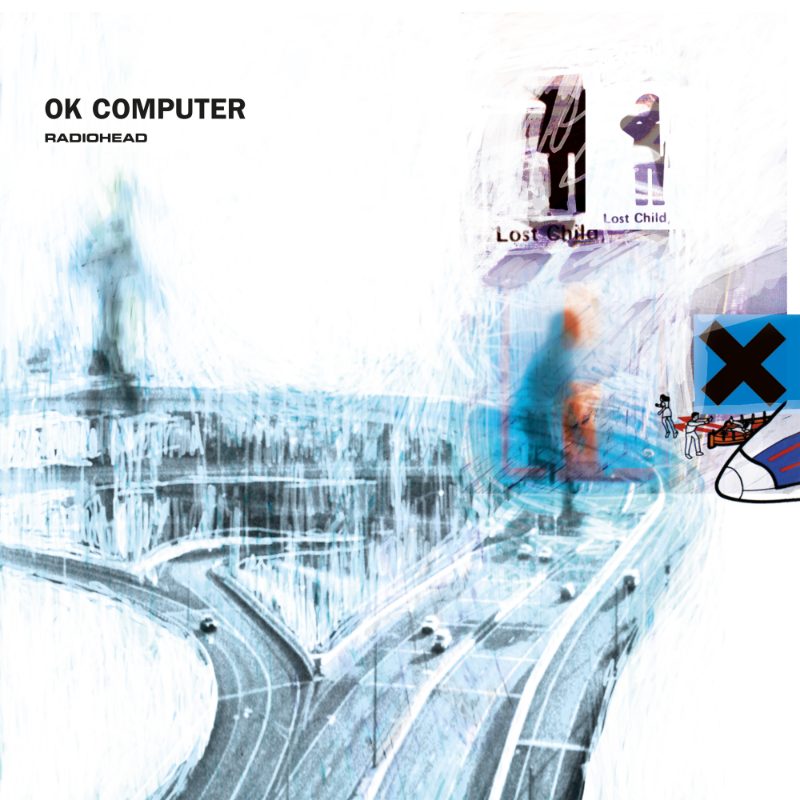
OK Computer by Radiohead (1997), № 19 in The Lead-In’s 100 greatest albums. Computers were a punchline when Radiohead wrote this. They'd become a prophecy before the decade ended.
OK Computer by Radiohead (1997), № 19 in The Lead-In’s 100 greatest albums. Computers were a punchline when Radiohead wrote this. They'd become a prophecy before the decade ended.
Five Oxford-educated former students of Abingdon School, fleeing the success of The Bends, took over a 14th-century manor house in Bath owned by Jane Seymour and made a 53-minute album that predicted the 21st century before it had started. It came out in June 1997. It is still telling us things we haven't figured out.
An album about technology by a band that did most of its recording on analog tape in a country house with no broadband. About surveillance by men who refused to do interviews. About late capitalism by a group that, two years later, would refuse to release a single from their next album. The prophecy worked because the prophets had nothing to gain by being right.
Radiohead came out of The Bends, their 1995 second album, as the most-acclaimed British rock band of their generation. Critics had begun comparing them to U2 (the favorable comparison) and Pink Floyd (the unfavorable one). They had toured for nearly two years in support of the album. Their singer Thom Yorke had begun, in interviews, to express what would soon become the band's defining attitude: a complicated discomfort with the apparatus of pop success. By the spring of 1996, the band had decided not to make another conventional rock album. They had spent six months at a converted apple-shed studio (Canned Applause) in Didcot, Oxfordshire, attempting to record, and produced approximately three tracks they were willing to keep. Yorke, in his own subsequent description, had begun to feel 'a kind of revulsion' toward the music. They scrapped the Didcot sessions and moved, in late summer 1996, to a fourteenth-century stone manor house in Bath called St. Catherine's Court, owned by the actress Jane Seymour, who had been renting it out for years to art-school photographers and the occasional band. The room rates were generous; the house was furnished; the band brought their own gear, set up in different rooms for different songs, and lived there together for four months.
Their new producer Nigel Godrich, 25 years old and on his first solo production credit, came with them. Godrich had been working as an engineer for John Leckie (their Bends producer) and had been promoted by the band itself. The arrangement that emerged in St. Catherine's Court was unconventional: each band member's instrument was set up in a different room of the house, Jonny Greenwood's guitar in the library, Phil Selway's drum kit in the great hall, Yorke's vocals in the ballroom, Colin Greenwood's bass in the kitchen, Ed O'Brien's effects rig in a corridor. Cables ran throughout the house. Godrich operated from a portable mixing console in the main downstairs room. The band tracked songs in pieces, often improvising arrangements as they went. Many of the album's most distinctive sounds, the strange spatial qualities of 'Let Down,' the natural-reverb of 'No Surprises,' the buried guitar parts on 'Climbing Up the Walls', are products of the unusual recording environment.
What the band wanted to make, in Yorke's later description, was 'an album about the future that came from the present.' He was reading Noam Chomsky, J.G. Ballard, Eric Hobsbawm, and a great deal of Naomi Klein's pre-No Logo journalism. He was thinking about surveillance, the rise of biotech, the alienation of digital work, the moral consequences of the late-capitalist consumer economy. The lyrics, across the 12 tracks, would touch all of these subjects, but rarely literally. 'Karma Police' is a portrait of office-bullying culture told from the bully's perspective, ending with a Yorke ad-lib ('For a minute there, I lost myself') that became one of the band's most-quoted lyrics. 'Paranoid Android' is 6 minutes of polystylistic prog-rock referencing 'Bohemian Rhapsody' structurally but inhabiting a much darker emotional register. 'Subterranean Homesick Alien' is an alien-abduction reverie about wanting to be 'taken away from this.' 'Fitter Happier' is 2 minutes of a computerized synthesized voice (the Macintosh PlainTalk Fred) reading a list of optimization aspirations ('Fitter, happier, more productive, comfortable, not drinking too much') over a slow piano-and-distant-noise bed. 'No Surprises' is a lullaby about wanting to die quietly. 'Exit Music (For a Film)' was written for the Baz Luhrmann adaptation of Romeo + Juliet but appears on the album. 'Lucky' was first released for a War Child compilation in 1995 and rerecorded for the album.
It is also a sonically unprecedented record. Godrich and the band used analog tape (Studer A800 16-track), but they also used the studio in a way that no major-label rock band had done before. The cinematic spatial quality of the album, the sense that you are listening to music in a particular building rather than in a studio, was deliberate. Jonny Greenwood's keyboards (Hammond, Wurlitzer, Mellotron, a sampled Ondes Martenot) are layered to create harmonic textures that no rock band had quite produced. The use of the Macintosh PlainTalk 'Fred' computer voice on 'Fitter Happier' was the first time a major rock album had used a computer as a vocalist for an entire track. The drum sounds, particularly on 'Airbag' and 'Climbing Up the Walls', are deliberately unnatural, with multiple takes layered on top of each other and significant editing through Pro Tools (a relatively new technology in 1996). The album is the first major-label rock album to be partially edited in the digital domain; it is also, somehow, one of the warmest-sounding rock albums of its era.
The album was released in June 1997 to immediate critical praise and uncertain commercial expectations. Capitol Records, the band's US label, had reportedly expressed concern about the album's commercial potential, with one executive describing it in print as 'commercial suicide.' The first single 'Paranoid Android' was a six-minute song with no chorus that reached #3 in the UK; the second single 'Karma Police' reached #8 UK and became the band's first US Top 100 single (#69). The album peaked at #1 in the UK and #21 in the US; sales reached one million in the UK by 1998 and three million in the US by 2000. By any standard outside the Britpop hit parade, this was extraordinary commercial success for a record that did almost nothing pop music had ever rewarded. The album won the Grammy for Best Alternative Music Album in 1998 and was nominated for Album of the Year (Bob Dylan's Time Out of Mind won that category).
What OK Computer did, beyond the sales and the critical reception, was redefine what a rock album could be in the late 1990s. The Britpop era, the Oasis-Blur dichotomy, had been the defining UK rock narrative for two years. OK Computer's success ended Britpop as a critical project. Radiohead's success made it impossible to argue that pop-rock couldn't be ambitious; it also made it possible for the band, two albums later (Kid A in 2000), to abandon rock as a genre entirely. The album's vocabulary, the deliberately unnatural drum sounds, the layered keyboard textures, the computer voice, the cinematic spatial quality, the dystopian lyrics, became the vocabulary of post-Radiohead rock. Coldplay, Travis, Muse, Snow Patrol, the Strokes (whose first album was a deliberate rejection of OK Computer's approach), every major British and American rock band of the 2000s and 2010s would have to position themselves relative to this record. The album's influence has been so pervasive that it is now difficult to remember what alternative rock sounded like before 1997.
OK Computer belongs at #19 because it is the album on which a rock band at the height of its commercial trajectory chose to refuse the conventions of rock-album marketing and produced, on the strength of the music alone, the most-acclaimed alternative rock LP of the late twentieth century. The album is the proof that a rock LP could be self-effacing, ambitious, dystopian, and commercially successful at the same time. Its prophetic accuracy about the 21st century, surveillance, late-capitalist alienation, the rise of the algorithm, is now thirty years old and still operative. The album sits in 2026 as the alternative rock canon's central document, the record by which subsequent ambitious British rock has been measured.
Original 1997 UK first pressing, Parlophone NODATA 02, a double LP in a gatefold sleeve with Stanley Donwood / Thom Yorke ('Tchock') artwork. The deadwax carries satirical hand-etched 'Fitter Happier' slogans (such as 'I'LL BE HAPPY TO HELP YOU') rather than any 'Music for Quiet Listening' inscription. The original was pressed on standard-weight vinyl; the heavier audiophile reissues came later. Clean sealed first pressings carry a healthy premium on the secondary market.
© The Lead-In · an independent, reader-supported music publication.