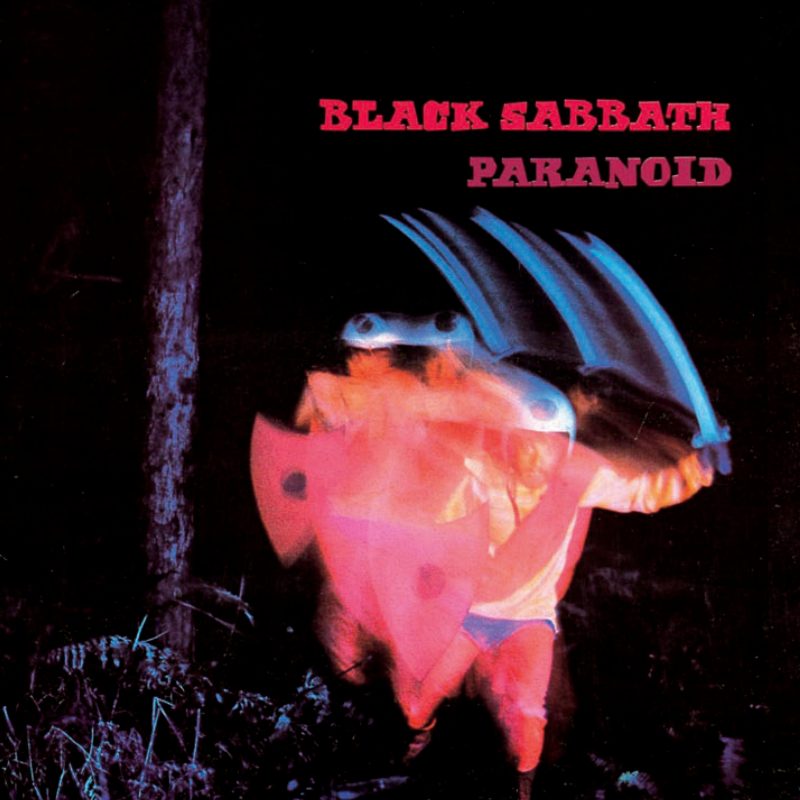
Black Sabbath's second album, released six months after their debut. The album that codified heavy metal. Released September 18, 1970 (UK).
- Released
- September 18, 1970 (UK) · January 7, 1971 (US)
- Label
- Vertigo (UK) · Warner Bros. (US)
- Producer(s)
- Rodger Bain
- Runtime
- 41:48 (8 tracks)
- Chart peak (US)
- #12 (Billboard 200)
- Chart peak (UK)
- #1 (Record Retailer)
- Certifications
- 4× Platinum (RIAA); 6M+ units globally
- Awards & honours
- Library of Congress National Recording Registry (2020); ranked #131 on Rolling Stone's 500 Greatest Albums (2020); routinely #1 on heavy metal polls
Five days at Regent Sound and Island Studios in London with Rodger Bain producing. Eight tracks across 42 minutes. The album that turned Black Sabbath, four working-class musicians from the deindustrializing West Midlands of Birmingham, into one of the bestselling rock acts of the early 1970s and effectively invented heavy metal as a sustainable commercial form.
Black Sabbath had formed in Birmingham in August 1968 under the name Earth, gigging the working-men's-club circuit across the English Midlands. The four members, Tony Iommi (guitar), Geezer Butler (bass), Bill Ward (drums), and Ozzy Osbourne (vocals), were all from Aston, the heavily industrial working-class district of Birmingham that the band would later cite as central to its specific aesthetic. Iommi had famously lost the tips of his middle and ring fingers in a sheet-metal factory accident in 1965, on his last day of work before quitting to play music full-time; the metal-stamping injury directly produced his specific guitar tone (he used thimble-shaped finger extensions, switched to lighter-gauge strings, and tuned his guitar down to reduce string tension). Earth changed its name to Black Sabbath in August 1969 after Butler's lyric for the eponymous track that would open the band's debut album. The first Black Sabbath album was released in February 1970 and had reached UK #8 and US #23, a substantial commercial breakthrough for a band that had been on the working-men's-club circuit eighteen months earlier.
Paranoid was recorded in five days at Regent Sound Studios and Island Studios in London in June 1970, with Rodger Bain producing and Tom Allom engineering. The band was on tour through most of 1970, Sabbath performed approximately 250 shows that year, and the recording was sandwiched into a brief gap between European dates. The deliberate speed was both economic (the band's contract with Vertigo Records gave them limited studio time per album) and aesthetic (the band had developed all the material live and wanted to capture the live energy on tape). The album was tracked essentially live in the studio with minimal overdubs; the basic tracks for most songs were completed in single takes. Bain's role was minimal in arranging terms, the band knew the songs, but central in engineering decisions, particularly the deliberate low-frequency emphasis on Iommi's guitar and the way Bill Ward's drum kit was miked.
The title track was the album's accident. The band had completed the seven other tracks and discovered that the running time was approximately 3 minutes short of the standard 1970 LP length. Iommi has said in subsequent interviews that the band wrote 'Paranoid' in less than an hour as filler material during a lunch break on day four of recording; the lyrics were written by Geezer Butler in about 20 minutes; the song was tracked in two takes and overdubbed in less than an hour. The deliberate speed and economy of the writing-and-recording produced a 2:48 song with a specific rhythmic urgency that the rest of the album's longer tracks didn't have. The track was released as the album's lead single on August 7, 1970, reached UK #4 in September, and became Black Sabbath's only UK Top 5 single ever. The success drove the album's commercial breakthrough, listeners who came in for the single stayed for the heavier seven other tracks.
The album's eight songs are a deliberate map of the heavy-metal vocabulary that the band would establish. 'War Pigs' opens the album with the most explicitly political lyric Black Sabbath ever recorded, Butler's text addresses Vietnam directly ('generals gathered in their masses, just like witches at black masses'). 'Paranoid' is the speed-of-arrival single. 'Planet Caravan' is the album's pastoral psychedelic interlude (drums replaced by hand percussion, jazz-influenced guitar). 'Iron Man' is the album's most-imitated song structurally, the descending guitar figure that opens the track is the most-copied metal riff in the genre's history. 'Electric Funeral' addresses nuclear war. 'Hand of Doom' addresses heroin addiction returning from Vietnam. 'Rat Salad' is a drum-feature instrumental. 'Fairies Wear Boots' is psychedelic-blues. The album's vocabulary, slow-tempo heavy riff, deliberately doom-laden lyrical themes, Iommi's specific down-tuned guitar tone, Ward's behind-the-beat drumming, became the foundation for the entire genre of heavy metal that the band's commercial success made commercially viable.
The album was released on September 18, 1970 in the UK and January 7, 1971 in the US. Jimi Hendrix died in London on the same day Paranoid was released. The transition was symbolic but not arbitrary, the lighter, blues-derived rock of the late 1960s was giving way to the heavier, riff-driven approach Black Sabbath formalized. Paranoid reached UK #1 in October 1970 (Sabbath's only UK #1) and US #12. First-year sales were approximately 1 million units. The album's chart performance was particularly notable given the critical reception: most major UK and US rock-music publications either ignored Black Sabbath or reviewed the band negatively. Lester Bangs in Rolling Stone gave the album one of its most-quoted negative reviews. The critical establishment's hostility to early-1970s heavy metal would persist for decades; the album's commercial scale was always larger than mainstream critics recognized.
The Paranoid lineup of Sabbath would record three more albums in the following three years (Master of Reality 1971, Vol. 4 1972, Sabbath Bloody Sabbath 1973) at approximately the same pace and same level of commercial success. The band's first six albums (through 1975's Sabotage) constitute the canonical Sabbath catalog; Ozzy Osbourne would be fired from the band in April 1979 and replaced by Ronnie James Dio. The Paranoid-era Sabbath has been retrospectively recognized as one of the most influential lineups in rock history, every metal band of the next fifty years has acknowledged the debt. Metallica, Slayer, Megadeth, Anthrax, Pantera, Slipknot, Tool, System of a Down, and dozens of others have cited Paranoid as the foundational text. The Library of Congress added Paranoid to the National Recording Registry in 2022.
Paranoid belongs at #40 because it is the album that established the commercial template for heavy metal, the heavy-riff song structure, the doom-and-war lyrical preoccupations, the working-class urban-industrial origin, the deliberately slow tempo that distinguished metal from the faster blues-rock it descended from. Five days of recording, eight tracks, one accident filler single that became the band's biggest commercial moment: the album is a study in how the specific economic conditions of 1970 working-class British rock production (low budget, limited studio time, deliberately fast recording, a producer who left the band alone) produced a foundational genre statement. The band would continue recording for the next five decades; the genre would continue expanding. Paranoid remains the foundational document of both.
Pressing guide — the one to own
1970 UK first pressing, Vertigo 6360 011 with the famous Spiral Vertigo label design (the original Vertigo 'swirl' label that the label used 1969-1973). Look for the matrix etchings 6360 011-A-1 / B-1, hand-etched at Philips Phonogram. The original UK gatefold sleeve has the deliberately abstract photograph of Roger Brown (a friend of the band) holding a sword in front of a tree, a leftover image from the abandoned 'War Pigs' album-title concept that was retained as the album cover after the title was changed.