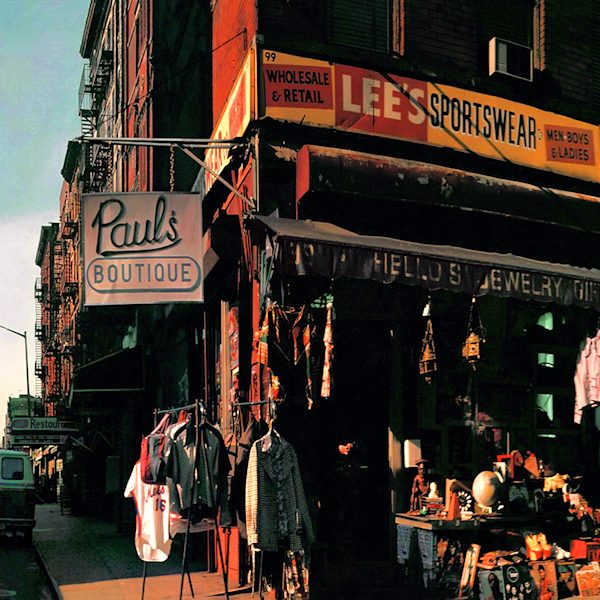
Fifteen tracks in 53 minutes. Recorded at Mario Caldato Jr.'s G-Son Studios in LA with the Dust Brothers producing. The Beastie Boys' second LP. The album that consolidated sample-collage hip-hop as a sustained artistic form before Grand Upright made the approach commercially impossible.
- Released
- July 25, 1989
- Label
- Capitol Records (US, C1-91743)
- Producer(s)
- The Dust Brothers · Beastie Boys
- Runtime
- 53:23 (15 tracks)
- Chart peak (US)
- #14 (Billboard 200)
- Chart peak (UK)
- #44 (UK Albums Chart)
- Certifications
- 2× Platinum (RIAA, 1999)
- Awards & honours
- Library of Congress National Recording Registry (2017); ranked #155 on Rolling Stone's 500 Greatest Albums
Fifteen tracks in 53 minutes. Recorded across approximately eight months at the Dust Brothers' Mario Caldato Jr.-engineered G-Son and Record Plant studios in Los Angeles. The Beastie Boys' second LP, released by Capitol Records in July 1989 after the band's acrimonious split from Def Jam and Rick Rubin. The commercial disappointment that became the canonical sample-collage LP, the album that pushed dense, multi-source sampling to a level no subsequent record could legally replicate after the 1991 sampling-law decisions, and inaugurated the maximalist-sample-collage vocabulary every subsequent crate-digging producer has worked within.
The Beastie Boys in early 1988 were three New York musicians, Mike D (Michael Diamond), MCA (Adam Yauch), and Ad-Rock (Adam Horovitz), coming off the extraordinary commercial success of Licensed to Ill (1986), the first hip-hop LP to reach US #1 and a 10× Platinum commercial event. The band had split acrimoniously from Def Jam and Rick Rubin over unpaid royalties; they signed with Capitol Records and relocated to Los Angeles, leaving behind the New York hip-hop infrastructure that had produced their debut.
In Los Angeles the band connected with the Dust Brothers, Mike Simpson and John King, a production duo who had been building extraordinarily dense sample collages for a planned instrumental project. The collaboration was the album's founding creative decision: the Dust Brothers' multi-source sample beds, layered far more densely than any contemporary hip-hop production, became the foundation over which the three Beasties rapped. Mario Caldato Jr. engineered.
The album's central artistic decision was the unprecedented density of its sampling. Where Licensed to Ill had used relatively spare, identifiable samples, Paul's Boutique layered dozens of sources simultaneously, an estimated 100 to 300 samples across the album, depending on the counting methodology. The samples were uncleared, drawn from across five decades of recorded music: the Beatles, Led Zeppelin, Sly Stone, Curtis Mayfield, the Ramones, Pink Floyd, dozens more. The album was recorded in the brief window before the 1991 Grand Upright Music v. Warner Bros. decision established that uncleared sampling was copyright infringement; Paul's Boutique couldn't legally be made after 1991. The album is a document of a sampling freedom that no longer exists.
The album's structure was equally ambitious. The closing 'B-Boy Bouillabaisse' is a twelve-and-a-half-minute nine-part suite, a deliberate medley of song-fragments that resists conventional track structure. The album refuses the commercial-pop single-and-filler structure of Licensed to Ill; it is a deliberate album-as-statement rather than a singles-vehicle.
Capitol released the album on July 25, 1989. Commercial reception was a substantial disappointment relative to Licensed to Ill, the album reached US #14 (against Licensed to Ill's #1) and sold approximately 900,000 units in its first eighteen months (against Licensed to Ill's millions). The lead single 'Hey Ladies' reached US #36. Capitol and the music press treated the album as a commercial failure on release; the band's commercial standing appeared to have collapsed.
The critical-and-commercial reframing came across the 1990s. Critics increasingly recognized the album's sample-collage ambition; producers increasingly cited it as foundational; the post-1991 sampling-law environment made the album's density a documented impossibility that elevated its standing. By the 2000s Paul's Boutique was widely treated as the canonical sample-collage LP and as one of the most-influential hip-hop records ever made. RIAA 2× Platinum certification eventually confirmed sustained catalogue sales.
Critical reception, in retrospect, has been extraordinary and unanimous; subsequent critical-poll positioning placed Paul's Boutique among the canonical hip-hop LPs. The 2020 Rolling Stone ranking confirms the institutional standing.
Paul's Boutique belongs at #78 because it is the canonical sample-collage LP, the album that pushed dense, multi-source sampling to a level no subsequent record could legally replicate after 1991. Every subsequent DJ Shadow Endtroducing (1996), Avalanches Since I Left You (2000), J Dilla Donuts (2006), and the entire crate-digging sample-collage tradition runs on the proof Paul's Boutique delivered. The album's commercial-failure-to-canonical-text trajectory is one of the most-cited rehabilitation narratives in commercial-pop history.
Pressing guide — the one to own
Original 1989 US pressing on Capitol Records, catalog C1-91743, a single LP in a two-panel gatefold with an inner picture sleeve (band photo and lyrics), mastered via Direct Metal Mastering at Masterdisk. Note that the famous panoramic Ludlow/Rivington Street fold-out jacket is a separate, scarcer first-year 'Special Limited Edition' multi-panel variant — the standard first press is the regular gatefold. Beware the European pressing (064-7 91743 1), which uses C1-91743 only as an inner-sleeve part number. Clean originals are accessible, often around the mid-to-high two figures.