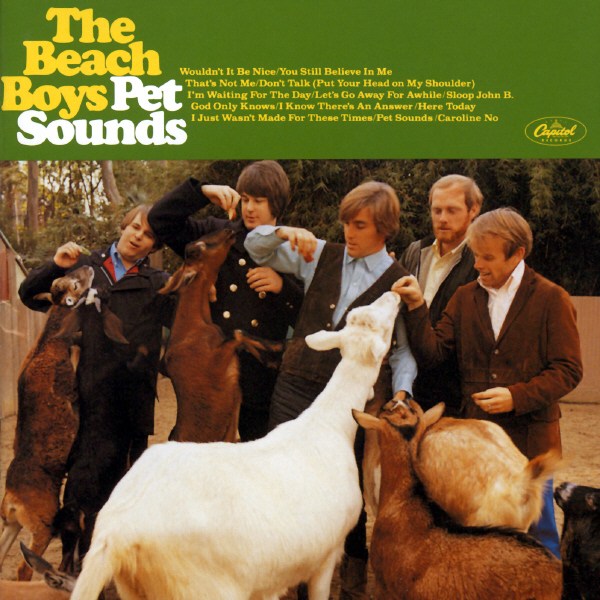
The album where a twenty-three-year-old surf-pop savant locked himself in a Hollywood studio with the best session musicians on the West Coast and built, instrument by instrument, the first pop record that admitted out loud how much being young hurt.
- Released
- May 16, 1966
- Label
- Capitol
- Producer(s)
- Brian Wilson
- Runtime
- 35:58
- Chart peak (US)
- #10 (Billboard 200), Capitol's lowest-charting Beach Boys LP in three years at the time
- Chart peak (UK)
- #2 (held off the top by The Sound of Music soundtrack)
- Certifications
- Platinum (RIAA); estimated 4M units worldwide across formats
- Awards & honours
- Grammy Hall of Fame (1998); Library of Congress National Recording Registry (2004); near-permanent fixture in critical 'greatest albums' polling since the 1970s
Capitol Records thought it was a flop. The English press thought it was a masterpiece. Brian Wilson thought it was an offering to his brothers, his bandmates, and a producer he'd never met named Phil Spector, and then his brothers and bandmates told him they didn't get it.
By December 1965, Brian Wilson had not toured with The Beach Boys in eleven months and had no intention of going back. He had walked off a plane the previous winter, had a nervous breakdown at thirty thousand feet, and told his brothers Carl and Dennis that he was staying home from now on to make records. The records he had in mind wouldn't sound like Surfin' U.S.A. The pretext was that he needed to be in the studio while they were on the road, working on the next Beach Boys album so it would be ready when they got back. The pretext was true. What he didn't tell them was that he was building the record for himself.
The catalyst, as everybody has known for sixty years, was Rubber Soul. Wilson heard it in December, took it home, played it through, and went, by his own later account, to his piano with the realization that an album could have no filler. Every song on Rubber Soul, he decided, was a song the band believed in. He resolved to make an album with no songs he didn't believe in. He called Tony Asher, a copywriter at Carson/Roberts who'd been recommended by a friend, and asked him to come over and write lyrics. Asher, who barely knew Wilson, would spend 3 weeks at his house in January and February of 1966 helping him put words to melodies Wilson had been compiling for months.
The recording happened at four studios across Los Angeles between January 18 and April 13, 1966, Western, Gold Star, Sunset Sound, and Columbia, almost entirely without the other Beach Boys present. Wilson used the Wrecking Crew: Hal Blaine on drums, Carol Kaye on bass, Glen Campbell on guitar, Larry Knechtel on piano, Steve Douglas on tenor saxophone, plus harpsichordists, accordionists, cellists, theremin players, two cans of empty Coca-Cola bottles, and a thirty-four-year-old jazz drummer named Frankie Capp ringing a bicycle bell. The instrumental tracks were finished before the band ever heard a note. When Mike Love arrived to lay vocals, he allegedly told Brian some of these lyrics were depressing, and asked who was going to dance to this. The argument over whether he said exactly that has lasted six decades. He almost certainly said something like it.
The instruments are not behaving like a band. They are behaving like a question that doesn't expect to be answered. Listen to the second verse of 'You Still Believe in Me': an accordion, a sleigh bell, a bass harmonica, a clarinet, and a piano played with a bicycle horn somewhere in the back. None of these instruments belongs on a pop song. None of them belongs near each other. And yet the arrangement isn't busy, it's gentle, almost weightless. Wilson had absorbed Phil Spector's Wall of Sound through every pore (he tracked at Gold Star, Spector's studio; he hired Spector's engineer, Larry Levine; he used Spector's musicians) and then did something Spector never did: he made the wall transparent. You can hear inside it.
The songs, taken as a sequence, describe one young person's emotional life over the course of a relationship that may or may not be ending. 'Wouldn't It Be Nice' opens with the most innocent question on the album and closes with the most adult one. 'You Still Believe in Me' is gratitude that approaches embarrassment. 'That's Not Me' is the album's structural pivot, a confession that the narrator has been faking it. The instrumental 'Let's Go Away for Awhile' arrives like an exhale, and then 'Sloop John B', the one song Mike Love insisted on, the one song most people knew when the album dropped, punches the entire sequence in the chest with its bald homesickness. Side two opens with 'God Only Knows,' the song Paul McCartney has called the greatest ever written and which Wilson called the most spiritual thing he'd done, and proceeds to disassemble itself: 'I Know There's an Answer' (originally 'Hang On to Your Ego,' rewritten under band pressure), 'Here Today,' 'I Just Wasn't Made for These Times,' the instrumental title cut, and 'Caroline, No', the final song, where Brian Wilson sings alone, two octaves below where he wanted to, mourning a girl whose hair he says got cut and somehow making it sound like the end of a life.
It is a record about the moment innocence catches up with you. Asher and Wilson were both twenty-three when they wrote it. Wilson had been a hitmaker since nineteen. He was watching his own youth slide off into the past in real time, and he had decided that the way to honor it was to record his terror about losing it. The harmonies, which everybody talks about, are not what makes Pet Sounds great. The harmonies are what makes Pet Sounds Pet Sounds. What makes it great is that they are deployed in service of a thirty-six-minute argument that growing up is a small ongoing grief.
Capitol released it. Capitol disliked it. Within months the label put out Best of The Beach Boys to recoup, and Wilson would later say he never recovered. The myth that follows, Brian retreating to his bed, the legendary unfinished Smile sessions collapsing under their own weight by 1967, the decade-long withdrawal, is partly a story about Pet Sounds. He had reached for the album he believed he was supposed to make and it had not been understood at home. In the UK, where the album hit #2 and Melody Maker called it a milestone immediately, Lennon and McCartney played it constantly through the spring of 1967 and openly acknowledged that Sgt. Pepper, which is also on this list, was a direct attempt to better it. The race that produced Pepper was a race Brian Wilson lost out loud and won quietly forever.
Pet Sounds belongs at #2 on this list because every pop album made in the sixty years since that uses arrangement as emotion, every Big Star record, every Elliott Smith record, every High Llamas record, every Sufjan Stevens record, every Father John Misty record, every Phoebe Bridgers record, is descended from the decisions Brian Wilson made in those four LA studios between January and April of 1966. The reason it isn't number one is that What's Going On synthesizes the same orchestral-pop ambition with a politics Pet Sounds never reaches for. But you cannot make the case for the album above it without standing on the album below it. They are in conversation. Marvin Gaye was twenty-three the year Pet Sounds came out. He was paying attention.
Pressing guide — the one to own
Original 1966 US mono pressing, Capitol T-2458, on the black label with the rainbow 'colorband' rim (not a 'star band'); the Capitol logo sits at the top of the label on these. Mono is the connoisseur's choice: Brian Wilson mixed the album in mono and never approved a true stereo. The 1966 'stereo' DT-2458 is Duophonic (reprocessed fake stereo), not a real stereo mix. The commercial issue is a standard single sleeve.