
№ 79 of 100
Pink Moon
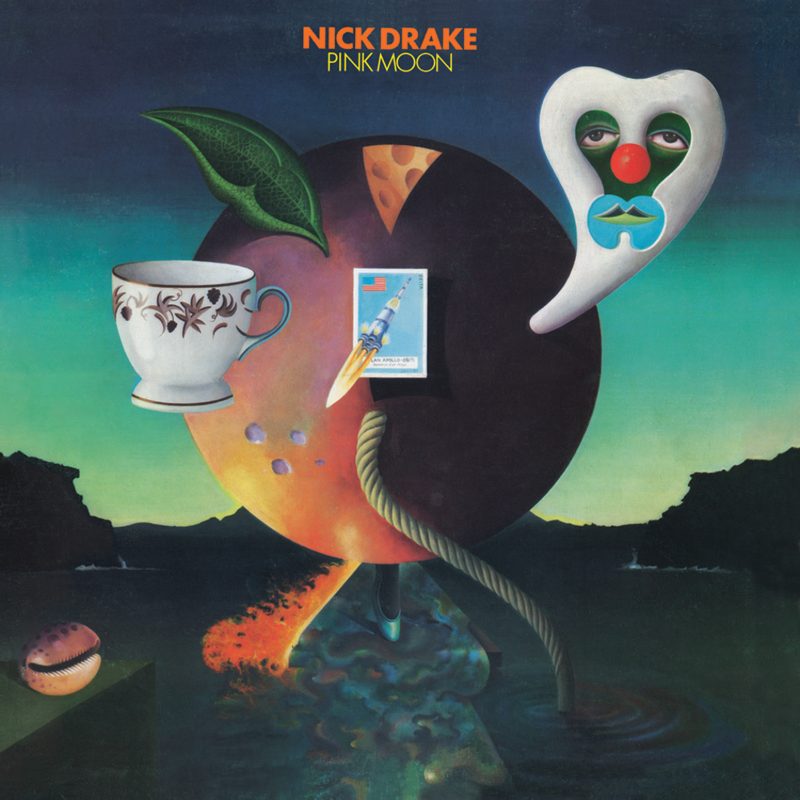
Pink Moon by Nick Drake (1972), № 79 in The Lead-In’s 100 greatest albums. Nick Drake alone at his parents' house with one microphone. 28 minutes, eleven songs, no overdubs. He was dead within two years.
Pink Moon by Nick Drake (1972), № 79 in The Lead-In’s 100 greatest albums. Nick Drake alone at his parents' house with one microphone. 28 minutes, eleven songs, no overdubs. He was dead within two years.
Eleven tracks in 28 minutes. Recorded across two days at Sound Techniques Studios in London in late October 1971 with John Wood engineering and Nick Drake performing solo. Nick Drake's third and final studio LP, recorded with no overdubs, no producer credit, no commercial promotion.
Eleven tracks in 28 minutes. Recorded across two late-night sessions at Sound Techniques Studio in London in October 1971 with John Wood engineering and Nick Drake performing entirely solo, voice and guitar, with a single piano overdub. Drake's third and final LP, released by Island Records in February 1972, two and a half years before his death from an antidepressant overdose at twenty-six. The album that consolidated the solo-acoustic-confessional vocabulary as a sustained form and inaugurated the intimate, sparse singer-songwriter template every subsequent home-recorded confessional LP has worked within.
Nick Drake in autumn 1971 was twenty-three years old, two LPs into an Island Records catalogue that had received critical respect but almost no commercial reception. Five Leaves Left (1969) and Bryter Layter (1971) had both been elaborately arranged, string sections, jazz musicians, full-band backing arranged by Robert Kirby and others, and both had sold poorly. Drake's mental health had deteriorated substantially; he had withdrawn from live performance, found promotional work impossible, and was suffering from a depression that would worsen across the subsequent three years.
The decision for Pink Moon was a radical reduction. Where the first two LPs had been elaborately produced, Drake wanted the third to be solo, voice and guitar only, no arrangements, no backing musicians. He contacted John Wood, the Sound Techniques engineer who had recorded his first two LPs, and arranged two late-night sessions in October 1971. Producer Joe Boyd, who had overseen the first two LPs, had relocated to Los Angeles; Pink Moon was made without him.
The recording was extraordinarily spare. Across two late-night sessions Drake recorded all eleven tracks, voice and guitar performed together, live, in single takes, with only a single piano overdub (on the title track) departing from the solo format. The total runtime is 28 minutes. The album's sparseness is its argument: where the first two LPs had buried Drake's voice in arrangement, Pink Moon presents it without mediation, the most direct document of a singer-songwriter's voice that the commercial-pop catalogue had produced to that point.
Drake's guitar technique is central to the album's effect. He played in a range of altered tunings, non-standard tunings he had developed himself, that produce the album's distinctive harmonic voicings and that made his songs notoriously difficult for other guitarists to reproduce. The intricate fingerpicking, the unusual chord shapes, the rhythmic complexity: the guitar work is as much the album's voice as the singing.
Drake reportedly delivered the finished master tapes to Island Records by leaving them at the front desk without speaking to anyone, a gesture consistent with his withdrawal from the music-industry infrastructure. Island released the album on February 25, 1972 with minimal promotion. Drake gave no interviews, made no live appearances, and shot no promotional material. The album sold a few thousand copies on release.
Drake died on November 25, 1974, of an overdose of amitriptyline (a prescribed antidepressant); the coroner ruled the death a suicide, though the question of intent has been debated. He was 26. At the time of his death all three of his LPs were commercial failures; he was almost entirely unknown.
The commercial-and-critical reframing came across the subsequent decades. Drake's catalogue was championed by successive generations of musicians; the 1979 Fruit Tree box set, the 1985 reissues, and the gradual accumulation of critical advocacy elevated his standing. The 1999 use of 'Pink Moon' in a Volkswagen Cabrio television commercial produced a substantial commercial revival, the album sold more copies in the months after the commercial than in the previous twenty-seven years combined.
Pink Moon belongs at #79 because it is the album that consolidated the solo-acoustic-confessional vocabulary as a sustained form. Every subsequent home-recorded confessional singer-songwriter LP, from Elliott Smith's catalogue to Bon Iver's For Emma, Forever Ago (2007) to Sufjan Stevens's Carrie & Lowell (2015) to the entire intimate-singer-songwriter tradition, runs on the proof Pink Moon delivered. The album's posthumous-canonization trajectory is one of the most-cited rehabilitation narratives in commercial-pop history; the Rolling Stone ranking confirms the institutional standing.
Original 1972 UK pressing on Island Records, catalog ILPS 9184, in a matt gatefold sleeve (green printed lyrics inside left, negative portrait inside right) — not a single sleeve. The first-press label is Island's 'pink rim' design (pink island/palm-tree logo, '1972' printed), pressed by The Gramophone Co. and printed by Tinsley Robor. A true earliest copy pairs the pink-rim label with the A-1U side-A runout; the final few hundred 'transitional' copies carry the later 'palm tree' label but retain the early runout. Clean originals are scarce and valuable, with a Discogs median around the high hundreds.
© The Lead-In · an independent, reader-supported music publication.