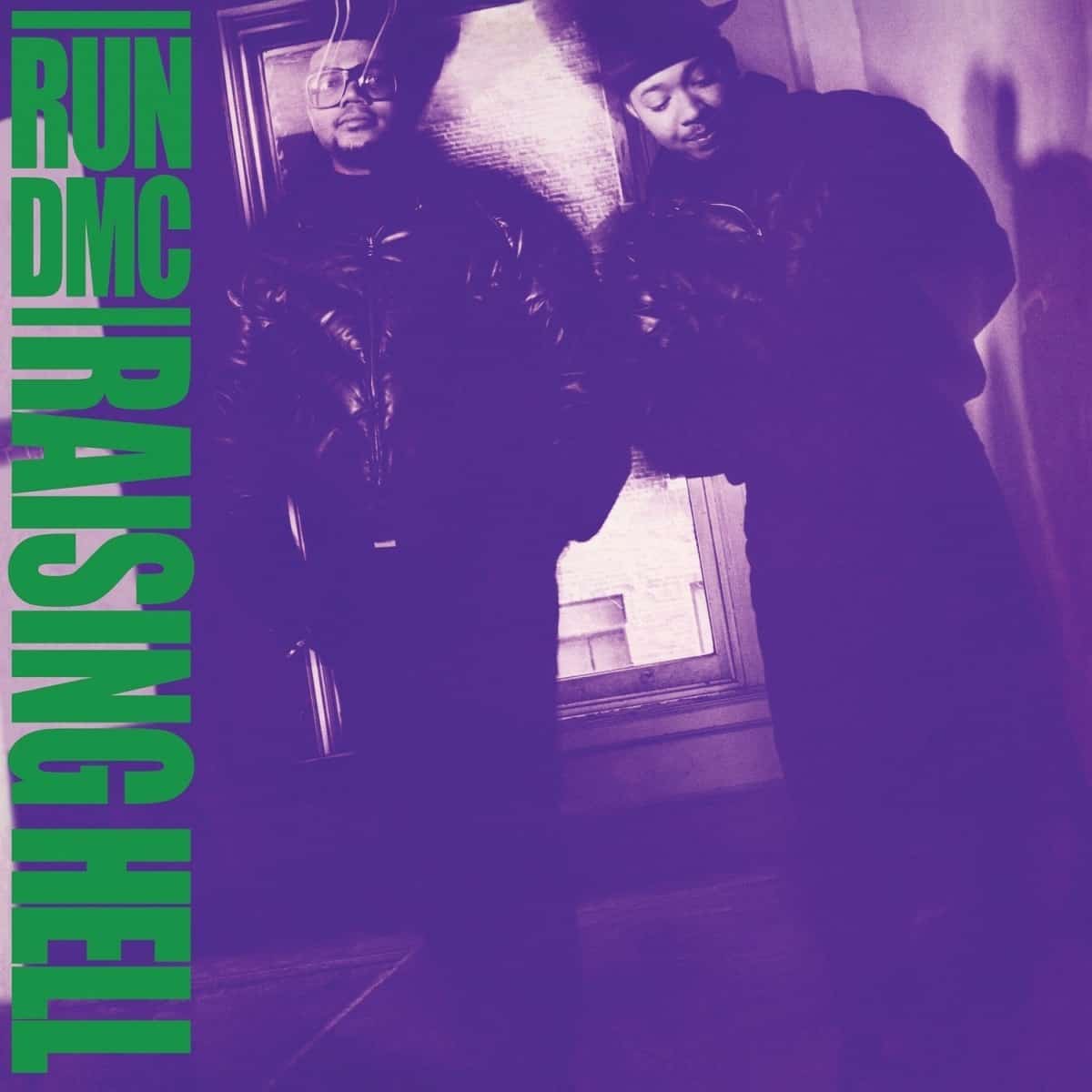
Eleven tracks in 37 minutes. Recorded across approximately three months at Chung King Studios in Manhattan with Rick Rubin and Russell Simmons co-producing. Run-D.M.C.'s third LP, Joseph 'Run' Simmons, Darryl 'D.M.C.' McDaniels, and Jason 'Jam Master Jay' Mizell at their Queens-borough commercial peak, with Aerosmith's Steven Tyler and Joe Perry contributing to the 'Walk This Way' cover that broke hip-hop to mainstream rock radio. The album that proved hip-hop could chart in the Top 5 of the Billboard 200, sell three million units, and run on MTV rotation, and converted rap from regional Black-music genre into national commercial-pop form.
- Released
- May 15, 1986
- Label
- Profile Records (US, PRO-1217)
- Producer(s)
- Rick Rubin · Russell Simmons · Run-D.M.C.
- Runtime
- 37:09 (11 tracks)
- Chart peak (US)
- #3 (Billboard 200, August 1986)
- Chart peak (UK)
- #41
- Certifications
- 3× Platinum (RIAA, 1987); 5× Platinum (RIAA, 2024)
- Awards & honours
- Ranked #123 on Rolling Stone's 500 Greatest Albums (2020); first hip-hop LP to reach RIAA 3× Platinum; first hip-hop LP to peak Top 5 on Billboard 200
Eleven tracks in 37 minutes. Recorded across approximately three months at Chung King Studios in Manhattan with Rick Rubin and Russell Simmons co-producing. Run-D.M.C.'s third LP, Joseph 'Run' Simmons, Darryl 'D.M.C.' McDaniels, and Jason 'Jam Master Jay' Mizell at their Queens-borough commercial peak, with Aerosmith's Steven Tyler and Joe Perry contributing to the 'Walk This Way' cover that broke hip-hop to mainstream rock radio. The album that proved hip-hop could chart in the Top 5 of the Billboard 200, sell three million units, and run on MTV rotation, and converted rap from regional Black-music genre into national commercial-pop form.
Run-D.M.C. in autumn 1985 was a Queens-based trio with two underground-and-commercial successes behind them: 'It's Like That / Sucker M.C.'s' (1983) had been the founding single of new-wave hip-hop's stripped-down beat-and-rhyme vocabulary; King of Rock (January 1985) had pushed the rap-rock crossover with the title track's heavy-guitar production. The Profile Records contract was producing modest commercial outcomes, King of Rock had reached US #52 and Gold certification. Russell Simmons (Run's older brother) had been managing the trio since formation; Rick Rubin had joined Russell Simmons in co-founding Def Jam Recordings in late 1984 and had begun co-producing Run-D.M.C. sessions in 1985.
Sessions for Raising Hell began at Chung King Studios on Centre Street in lower Manhattan in late January 1986. Chung King was a small basement studio owned by John King with a single live-room and a control room; it'd been Rick Rubin's primary workspace since the founding of Def Jam. The recording methodology was direct: Jam Master Jay's turntable performances were tracked first, with Rubin providing additional production-level beat manipulation; Run and DMC's vocals were recorded over the rhythm tracks; minimal overdubs. The album's eleven tracks were tracked across approximately three months.
The 'Walk This Way' cover was Rick Rubin's specific suggestion. Aerosmith's 1975 'Walk This Way' from Toys in the Attic had been a US #10 single in 1976; the band's commercial trajectory had collapsed in the late 1970s and they had largely faded from rock-radio rotation by 1986. Rubin proposed the cover as a rap-rock crossover gesture. Run and DMC initially resisted, they had been playing the Aerosmith track as a sample-source loop during live shows but had no interest in performing it as a cover. Rubin and Russell Simmons negotiated with Aerosmith's management to bring Tyler and Perry to the Chung King session to contribute the original guitar riff and Tyler's chorus vocal.
The 'Walk This Way' recording session took place at Chung King in late February or early March 1986. Tyler and Perry arrived from Aerosmith's mid-recovery touring schedule for a single afternoon. Perry recorded the guitar riff live in the studio; Tyler recorded the chorus 'walk this way / talk this way' vocal across approximately three takes. Run and DMC verse-traded across the song's three verses. The recorded version, 5 minutes and 11 seconds, preserves both the Aerosmith original riff and the Run-D.M.C. verse-trading interplay. The single, released July 1986, reached US #4 and stayed in the Top 10 for 10 weeks. It was the first hip-hop single in MTV's heavy rotation and the highest-charting hip-hop single to that point.
The album's other singles, 'My Adidas' (May 1986), 'It's Tricky' (March 1987), 'You Be Illin'' (December 1986), all delivered commercial reception substantially above any previous hip-hop LP single performance. 'My Adidas' directly produced Run-D.M.C.'s $1.5M Adidas endorsement deal, the first-ever hip-hop / sportswear endorsement contract. The 'Walk This Way' video, with Run-D.M.C. and Aerosmith performing through a shared wall, was MTV's most-played video in summer 1986.
Profile released the album on May 15, 1986. The album debuted at US #28 the week of May 31, climbed to US #3 by August, and held the Top-10 position through autumn. It was the first hip-hop LP to peak in the Top 5 of the Billboard 200; RIAA Platinum certification came in July 1986 (8 weeks after release); 3× Platinum followed in November 1987; 5× Platinum in 2024. Worldwide lifetime sales have exceeded six million units.
Raising Hell belongs at #92 because it is the album that proved hip-hop could chart in the Top 5 of the Billboard 200, sell three million units, and run on MTV rotation. The 'Walk This Way' rap-rock crossover broke hip-hop to mainstream rock radio for the first time; the 'My Adidas' Adidas endorsement deal inaugurated hip-hop's sportswear-industry collaboration era; the album's overall commercial success consolidated rap as a national commercial-pop form. Every subsequent rap-rock crossover (Limp Bizkit, Linkin Park, Lil Wayne's later work with Carlos Santana, Eminem's collaborations with Rihanna and Skylar Grey), every subsequent hip-hop / sportswear endorsement (Jay-Z's Reebok, 50 Cent's G-Unit, Kanye's Yeezy), and every subsequent commercial hip-hop LP that achieves Top-10 placement on the Billboard 200 runs on the proof Raising Hell delivered. Jam Master Jay's October 30, 2002 murder produced sustained catalogue presence; the 2024 conviction of his murderers (Karl Jordan Jr. and Ronald Washington) triggered renewed press attention. The 2024 RIAA 5× Platinum certification ratifies the album's continued commercial presence thirty-eight years after release.
Pressing guide — the one to own
Original 1986 US pressing, Profile PRO-1217, mastered by Howie Weinberg at Masterdisk, his 'HW' is hand-etched in the deadwax below the stamped 'MASTERDISK'. The front cover photograph is by Caroline Greyshock with art direction by Janet Perr, not Glen E. Friedman. Note the documented sleeve colour variants of the original run (purple/red and green/blue versions both exist on PRO-1217). Look for the early Profile labels and the PRO-1217 catalogue number to confirm a first pressing.