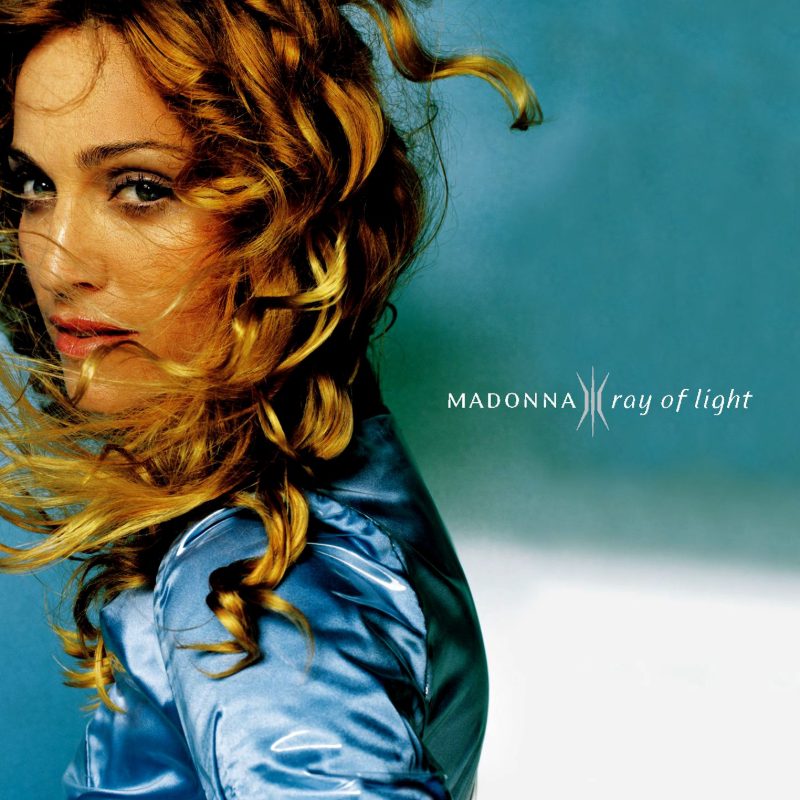
Thirteen tracks in 67 minutes. Recorded across eight months at Larrabee Studios in West Hollywood with William Orbit co-producing, after Madonna had spent a year studying Kabbalah, training her voice with Joan Lader for the Evita role, and giving birth to her first child Lourdes. The album that converted Madonna from late-1980s confessional pop figure into late-1990s electronic-pop visionary, and proved that maternal-spiritual subject matter and Detroit-techno-derived production could deliver four Grammy wins and a Diamond certification.
- Released
- February 22, 1998 (UK); March 3, 1998 (US)
- Label
- Maverick / Warner Bros. (US, 9 46847-1)
- Producer(s)
- Madonna · William Orbit · Patrick Leonard · Marius De Vries
- Runtime
- 66:54 (13 tracks)
- Chart peak (US)
- #2 (Billboard 200)
- Chart peak (UK)
- #1 (3 weeks)
- Certifications
- 4× Platinum (RIAA, 1999); 5× Platinum (BPI, 2018)
- Awards & honours
- 4 Grammy wins (Best Pop Album, Best Dance Recording for 'Ray of Light,' Best Recording Package, Best Music Video for 'Ray of Light'); 6 nominations; ranked #161 on Rolling Stone's 500 Greatest Albums (2020)
Thirteen tracks in 67 minutes. Recorded across eight months at Larrabee Studios in West Hollywood with William Orbit co-producing, after Madonna had spent a year studying Kabbalah, training her voice with Joan Lader for the Evita role, and giving birth to her first child Lourdes. The album that converted Madonna from late-1980s confessional pop figure into late-1990s electronic-pop visionary, and proved that maternal-spiritual subject matter and Detroit-techno-derived production could deliver four Grammy wins and a Diamond certification.
Madonna in autumn 1996 was thirty-eight years old, eight months into her pregnancy with her first child (Lourdes Maria Ciccone Leon, born October 14, 1996), recovering from the year-and-a-half preparation for the Evita film role that had required substantial vocal-training work with the Broadway vocal coach Joan Lader. The Evita training had given Madonna a substantially expanded vocal range and the ability to sustain held notes she had not been able to deliver on earlier recordings. The pregnancy and motherhood had given her a new lyrical subject. The Kabbalah studies she had begun in 1995 had given her a spiritual frame the previous Catholic-confessional Like a Prayer vocabulary had not had.
William Orbit was forty-one years old in autumn 1996, a London-born electronic-music producer who had spent the 1990s producing his own Strange Cargo LPs, scoring films, and producing the Sundance-circuit ambient compilations. He had no commercial-pop production credits at that scale. Madonna had heard Orbit's Pieces in a Modern Style (1995) ambient LP through a friend recommendation and decided to pursue him as a collaborator. The initial pitch was made in late 1996; Orbit accepted in early 1997 with the understanding that the album would be a co-production with substantial Orbit aesthetic input rather than a Madonna LP with Orbit guesting on a few tracks.
Sessions began at Larrabee Studios in West Hollywood in June 1997 and ran through January 1998. The recording was substantially more extended than any previous Madonna LP, eight months of intensive sessions, multiple stages of song development, extensive re-recording. Madonna's pre-recorded vocal demos were treated, layered, manipulated, and reconstructed by Orbit in subsequent overdub sessions. The album's signature production texture, washy ambient pads, Detroit-techno-derived rhythm tracks, treated Madonna vocals with substantial pitch-and-time manipulation, is Orbit's specific contribution.
The album's central artistic decision was Madonna's pivot from late-1980s confessional pop vocabulary toward late-1990s electronic-pop production. The vocal training from Evita had given her the range; the Kabbalah studies had given her the spiritual frame; Lourdes's birth had given her the maternal subject. Orbit gave her the production. The four-element combination is the album's specific commercial-and-cultural argument: Madonna at forty was a different artist than Madonna at thirty, and the album's commercial reception proved the market was ready for that argument.
Patrick Leonard returned as co-producer on three tracks ('Skin,' 'Nothing Really Matters,' 'Sky Fits Heaven'), Madonna's longtime collaborator providing continuity with the Like a Prayer / Erotica era. Rick Nowels co-produced two tracks. The split-producer arrangement gave the album substantial sonic heterogeneity within the overall Orbit electronic-pop frame. Marius De Vries handled additional production and mixing across the entire LP.
Maverick released the album on February 22, 1998 in the UK and March 3 in the US. The UK launch was the first time Madonna had released in the UK before the US, a deliberate decision recognizing the album's electronic-pop vocabulary's stronger immediate fit in the UK market. UK chart entry at #1 was Madonna's first UK #1 album debut. US chart entry at #2 (held off #1 by the Titanic soundtrack) was her US commercial peak for the album. The album sold roughly six million copies worldwide within twelve months; lifetime sales have exceeded sixteen million.
The Grammy reception in early 1999 was extraordinary: four wins from six nominations including Best Pop Album, Best Dance Recording for the title track, Best Recording Package, and Best Music Video for 'Ray of Light' (Jonas Åkerlund directing). Madonna's reception as an electronic-pop figure was institutionally ratified. The MTV VMA Video of the Year for 'Ray of Light' and the additional Best Female Video, Best Direction, and Best Editing wins consolidated the visual reception.
Ray of Light belongs at #89 because it is the album that converted Madonna from late-1980s confessional pop figure into late-1990s electronic-pop visionary, and proved that maternal-spiritual subject matter and Detroit-techno-derived production could deliver four Grammy wins, a Diamond certification, and the most expansive critical reception of any Madonna LP. Every subsequent commercial-electronic-pop reinvention by an established pop artist, Cher's Believe (1998, late-1998 follow-up), Beyoncé's Lemonade-era electronic moves, Kylie's Light Years (2000), Britney's Blackout (2007), Robyn's catalogue, descends from the proof Ray of Light delivered. The album's continuing presence in Madonna's live setlists across her 2023-24 Celebration Tour confirms the canonical-text status.
Pressing guide — the one to own
Original 1998 US 2xLP on Maverick/Warner Bros., catalog 9 44523-0 on the spine and 0-44523 on the labels (the often-cited "9 46847-1" is the European pressing; 46847 is the CD stem). Single matte sleeve, photographed by Mario Testino. Lacquers were cut at Sterling Sound — the runouts machine-stamp "STERLING" alongside an "SR" engineer mark — though Discogs does not personally credit Ted Jensen on this release. A high-print mainstream record, so clean originals trade in the $15–40 range.