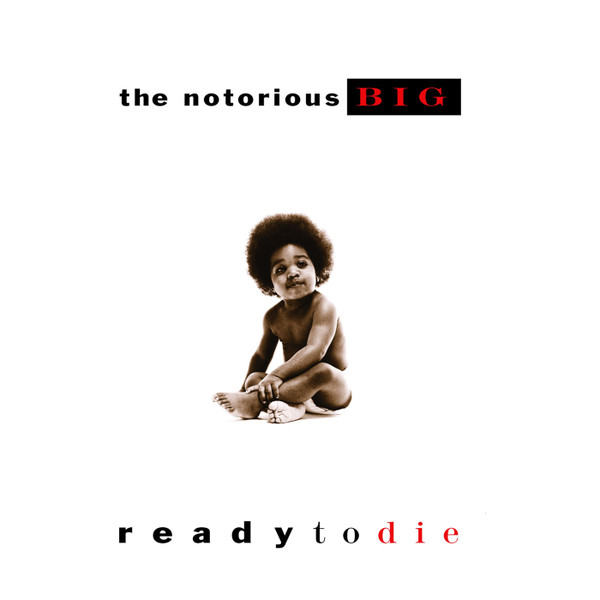
The Notorious B.I.G.'s debut. Released September 13, 1994. The album that established East Coast hip-hop's storytelling tradition for the 1990s.
- Released
- September 13, 1994
- Label
- Bad Boy Records · Arista
- Producer(s)
- Sean 'Puffy' Combs · Various
- Runtime
- 69:55 (17 tracks)
- Chart peak (US)
- #15 (Billboard 200) · #3 (Top R&B/Hip-Hop)
- Chart peak (UK)
- #48
- Certifications
- 6× Platinum (RIAA); 8M units globally
- Awards & honours
- Library of Congress National Recording Registry (2020); ranked #133 on Rolling Stone's 500 Greatest Albums (2020); routinely #1 on East Coast hip-hop polls
Approximately fifteen months across multiple New York studios (Hit Factory, D&D Recording, Quad Recording, the Bad Boy Studios in midtown) with Sean 'Puffy' Combs as principal producer. Seventeen tracks across 68 minutes including skits. The album that turned Christopher Wallace, twenty-two years old, a former Brooklyn drug dealer signed to Sean Combs's brand-new Bad Boy Records, into the commercially dominant rapper of the East Coast and established the Bad Boy production template that would define mainstream hip-hop for the rest of the decade.
Christopher Wallace had been freestyling on Brooklyn corners since age 14. By 1992 he was 19, had served nine months at a North Carolina prison on a 1991 drug charge, and had been returning to Brooklyn to work as a low-level Bedford-Stuyvesant drug dealer when Mister Cee (a Big Daddy Kane-affiliated DJ) heard a Wallace freestyle and put a tape into the hands of the Source magazine's editor at the time. The Source's 'Unsigned Hype' column featured Wallace under the name Biggie Smalls (later changed to the Notorious B.I.G. when an older rapper with the same name objected) in March 1992. Sean 'Puffy' Combs, twenty-three years old, a former intern at Uptown Records who had risen to A&R vice president before being fired in 1993, heard the Source feature and signed Wallace to Uptown's A&R roster in 1992. When Combs was fired from Uptown in May 1993, he took Wallace and several other artists to form Bad Boy Records under an Arista Records distribution deal. Combs was 24 when Bad Boy launched; Wallace was 21 when the Ready to Die sessions began.
Recording began at multiple New York studios in late 1993 and continued through 1994. The Hit Factory in midtown was the primary location; D&D Recording (a smaller facility used for hip-hop sessions by Pete Rock, DJ Premier, and others), Quad Recording (where Tupac Shakur would be shot in November 1994 during the sessions), and various other New York studios handled specific overdubs and additional sessions. Sean Combs was the album's executive producer and credited co-producer on multiple tracks; the production team also included DJ Premier (then in Gang Starr), Easy Mo Bee (Big Daddy Kane's producer), Lord Finesse (DITC member), Chucky Thompson (Bad Boy staff producer), and others. The deliberate approach was to use a rotating cast of established East Coast producers to give the album textural variety while maintaining Combs's overall structural direction. The album's specific production aesthetic, Mtume samples, Diana Ross samples, soul-music chord progressions, was Combs's commercial strategy for crossing Wallace into pop-radio territory.
The Crime Bill, Clinton's September 12, 1994 omnibus crime act that funded 100,000 new police officers and expanded mass incarceration, was signed 24 hours before the album's September 13 release. The Crime Bill's expansion of mandatory minimums and prison capacity is the political context the album was recorded against; the album's first-person criminal narrative (the title is not metaphorical; the album frames death as imminent) landed into the legal regime that would, over the next decade, lock up many of the album's actual demographic peers. The album's specific Brooklyn geography (the Bedford-Stuyvesant corner narratives, the Atlantic Avenue references, the Garvey Park settings) was drawn directly from Wallace's pre-rap life experience. The deliberate documentary approach to street-level narrative, Wallace's autobiographical detail and specific street geography, became one of the album's distinguishing features.
The seventeen tracks are deliberately varied in approach. The opening 'Intro' is the album's birth-to-criminality framing skit. 'Things Done Changed' is the documentary-portrait opening track. 'Gimme the Loot' is the deliberately violent drug-dealing autobiography. 'Machine Gun Funk' is the album's most-cited DJ Premier production (the Premier sample loop is from Tom Scott's 1974 'Sneakin' in the Back'). 'Warning' is the home-invasion narrative. 'Ready to Die' (the title track) is the album's central suicidal-ideation document. 'One More Chance' (the album cut) is the love-and-sex track. 'Fuck Me (Interlude)' is the deliberately provocative skit. 'The What' is the Method Man collaboration. 'Juicy' is the album's commercial centerpiece, Mtume's 'Juicy Fruit' sample, Combs's Bad Boy production, Wallace's autobiographical 'It was all a dream' opening, reached US #27 as a single. 'Everyday Struggle' is the dealer-life portrait. 'Me & My Bitch' is the relationship-drama track. 'Big Poppa' is the deliberately pop-crossing radio single (reached US #6 in February 1995). 'Respect' is the personal-history track. 'Friend of Mine' is the betrayal narrative. 'Unbelievable' is the Premier-produced freestyle showcase. 'Suicidal Thoughts' closes the album with the deliberate suicide-call-narrative ending.
'Juicy' became the album's commercial breakthrough. Released as the lead single in August 1994, the song's specific structure, Mtume's 'Juicy Fruit' bassline (a clear sample that Combs had specifically licensed; the song's opening Diana Ross-derived chorus uses a clean uncleared sample), Wallace's autobiographical narrative ('It was all a dream / I used to read Word Up magazine'), and Combs's deliberate pop-radio production approach, gave the album its primary commercial entrance. The song reached US #27 in autumn 1994. 'Big Poppa' (released as the second single in November 1994) reached US #6 in February 1995. The two singles together drove the album from initial release-week sales of approximately 57,000 units to over a million units by spring 1995. The album would reach US #15 and ultimately sell over 4 million units.
Tupac Shakur was shot five times at Quad Recording Studios on November 30, 1994, 11 weeks after Ready to Die's release. Tupac was robbed and shot at the studio where Biggie was recording with Combs upstairs; Tupac subsequently accused Biggie and Combs of orchestrating the attack. Both Combs and Wallace denied involvement; the actual shooters were never definitively identified. The accusation triggered the formal phase of the East Coast / West Coast conflict that would consume both rappers and produce both murders within thirty months. Tupac was shot and killed in Las Vegas on September 7, 1996; Wallace was shot and killed in Los Angeles on March 9, 1997. Both murders remain unsolved (though numerous investigations have identified suspected perpetrators without securing prosecutions). Ready to Die was therefore the last Biggie album released before the conflict became open and personal.
Ready to Die belongs at #49 because it is the album that established the Bad Boy commercial template and gave the East Coast its most commercially successful rapper of the 1990s. Wallace's specific narrative gift, the way he could move from comedy ('Juicy') to threat ('Machine Gun Funk') to suicidal first-person ('Suicidal Thoughts') across 9 minutes of album time, was without precedent in the genre at this commercial level. The album's pre-conflict release date (September 1994, before the November Tupac shooting) makes it the document of Biggie before he became a casualty; everything after is the document of an artist working under the conditions the album's title accidentally predicted. The murder closed the chapter; the album remains the artist's most complete pre-conflict statement and the foundational text every subsequent East Coast commercial-rap album has descended from. Life After Death (March 1997, released 2 weeks after Wallace's murder) extended the commercial scale but did not exceed Ready to Die's specific autobiographical weight. The album's reputation has compounded continuously for thirty years.
Pressing guide — the one to own
1994 US first pressing, Bad Boy / Arista 73000-2 (2xLP) with the original Butch Belair photograph cover (the baby photograph on cover; deliberately styled to evoke an album-of-soul-music type of cover). Look for the matrix etchings 73000-2-A / B / C / D, hand-etched at Frankford/Wayne mastering by Tom Coyne. The original US first pressings include the printed inner sleeve with the full lyric sheet, the production credits, and the Bad Boy / Arista label graphics.