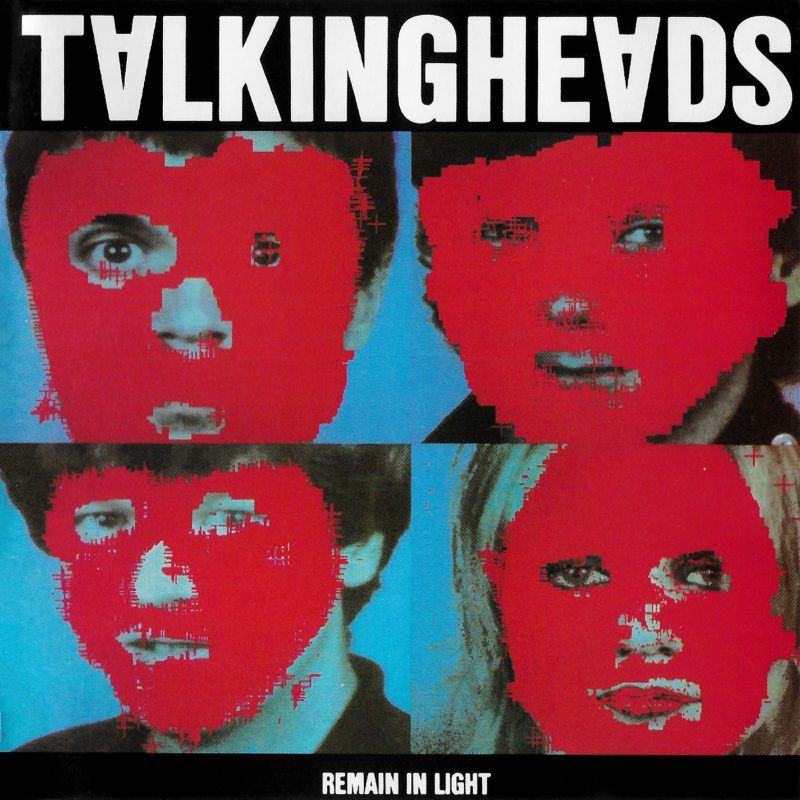
David Byrne and Brian Eno's Afrobeat-influenced fourth Talking Heads album. Recorded at Compass Point in the Bahamas, 1980. The album that ended new wave and started world music.
- Released
- October 8, 1980
- Label
- Sire Records (Warner Bros.)
- Producer(s)
- Brian Eno · Talking Heads
- Runtime
- 40:09 (8 tracks)
- Chart peak (US)
- #19 (Billboard 200)
- Chart peak (UK)
- #21 (Record Retailer)
- Certifications
- Platinum (RIAA); 1.5M units globally
- Awards & honours
- Library of Congress National Recording Registry (2017); ranked #39 on Rolling Stone's 500 Greatest Albums (2020)
Three months at Compass Point Studios in the Bahamas and at Sigma Sound in Philadelphia with Brian Eno producing. Eight tracks across 40 minutes. The album that turned Talking Heads from a New York post-punk quartet into a sustained art-rock proposition, the album that introduced Afrobeat polyrhythm to mainstream American rock, and the third and final Eno-produced Talking Heads LP.
Talking Heads had formed at the Rhode Island School of Design in 1974 and had been recording at CBGB since 1975. By 1979 the band, David Byrne, Tina Weymouth, Chris Frantz, and Jerry Harrison, had released three albums (Talking Heads: 77, More Songs About Buildings and Food, Fear of Music), each produced by Brian Eno, each demonstrating the band's increasing willingness to push beyond conventional New York post-punk vocabulary. Fear of Music (August 1979) had introduced explicit African-rhythm influence on tracks like 'I Zimbra' and had used percussion programmer Robert Fripp on extensive guitar treatment. The band toured Fear of Music as a ten-piece expanded lineup including Bernie Worrell (P-Funk keyboardist), Busta Jones (bass), Adrian Belew (guitar), and Steve Scales (percussion). The expanded touring band fundamentally altered what Talking Heads sounded like as a live unit and would shape the Remain in Light recording approach.
Recording began at Compass Point Studios in Nassau, Bahamas in July 1980. The studio, owned and operated by Chris Blackwell of Island Records, with an A&R history including Bob Marley, Robert Palmer, and AC/DC's Back in Black, had become a preferred late-1970s and early-1980s recording location for British and American art-rock artists. Brian Eno was hired again as producer despite escalating internal tensions in the band about Eno's increasing creative control. The deliberate decision to record at Compass Point, physically isolated from New York, tropical, with its own house engineers and rhythm section, was both an aesthetic choice and a band-management strategy. The full ten-piece expanded touring band was brought to Nassau for the sessions; the album would be recorded with the expanded lineup rather than the four-member core.
The recording approach was unprecedented for Talking Heads. Eno and Byrne had been working together on parallel sessions for the project that would become My Life in the Bush of Ghosts (released February 1981) and had developed a specific technique: extended single-chord trance grooves built up through layered Afrobeat-derived polyrhythms, recorded over hours of session time, then edited in post-production. The Remain in Light sessions used this approach. Tracks were built up in deliberate stages: a single-chord groove established by drums, bass, and percussion (Frantz, Weymouth, Scales, sometimes Worrell on syndrums); guitars layered on top (Belew, Harrison, Byrne); horns added (Wally Badarou on synths; later overdubs in Philadelphia); vocals overdubbed last. The deliberate refusal of conventional song structure (verse-chorus-verse) was the album's primary structural decision. The four-piece Talking Heads as a self-contained band didn't record this album; the expanded ten-piece ensemble did.
Fela Kuti's Afrobeat was the album's primary acknowledged influence. Eno had been collecting Fela Kuti records throughout the late 1970s and had introduced them to Byrne during the Fear of Music sessions in spring 1979. Kuti's records, particularly Zombie (1976), Sorrow Tears and Blood (1977), Coffin for Head of State (1981), used extended single-chord grooves, layered percussion, brass-section riffing, and call-and-response vocal arrangements. Remain in Light's single-chord trance structures, percussion approach, and call-and-response vocals are direct applications of Kuti's vocabulary. The debt has been acknowledged by Byrne and Eno in subsequent interviews; the album's specific contribution was the application of Kuti's methods to white American art-rock for a mainstream major-label audience.
The album's eight tracks divide into deliberately distinct halves. Side one ('Born Under Punches,' 'Crosseyed and Painless,' 'The Great Curve') is the Afrobeat-trance side, three extended single-chord workouts with deliberately disorienting lyric content addressing identity dissolution, paranoia, and cosmic scale. Side two ('Once in a Lifetime,' 'Houses in Motion,' 'Seen and Not Seen,' 'Listening Wind,' 'The Overload') is the slower, more meditative side, 'Once in a Lifetime' is the album's primary commercial moment and one of the most-cited recordings of the entire 1980s. The two sides represent two distinct approaches to the same compositional vocabulary: groove as endurance and groove as contemplation.
The album was released on October 8, 1980, 3 weeks before Reagan's election. Critical response was immediate and substantial; Rolling Stone, the Village Voice, and the New York Times reviewed the album as a major artistic statement. Commercial response was modest, Remain in Light peaked at US #19 and UK #21, lower than Fear of Music had charted. The album sold steadily through the 1980s; first-year sales were approximately 500,000 units. The 'Once in a Lifetime' video, directed by Toni Basil, became one of MTV's most-played clips in the channel's early years and substantially extended the album's commercial life through 1981 and 1982. The album's cultural impact has compounded continuously since 1980.
Remain in Light belongs at #41 because it is the album in which Talking Heads completed their move from CBGB post-punk into something genuinely new, a hybrid of Afrobeat polyrhythm, post-punk angularity, art-school conceptualism, and Eno's studio-as-instrument approach. The Compass Point sessions produced an album that has remained the band's most-cited work and the foundational text for the entire genre of art-rock that takes non-Western music seriously. Byrne's solo career, the Tom Tom Club's spinoff success (formed by Frantz and Weymouth in 1981 partly in response to Eno-Byrne dominance of Remain in Light), the Eno production approach that followed (U2's Joshua Tree included), all of these are downstream of the decisions made in the Bahamas in summer 1980. The album sits at the seam between the late 1970s' guitar-band default and the 1980s' studio-rhythm-section approach; the seam is audible on every track. Vampire Weekend, Yeasayer, the entire indie-rock-meets-world-music tradition of the 2000s and 2010s, the entire LCD Soundsystem catalog, all of these are downstream of decisions Talking Heads made in the Nassau control room in July 1980.
Pressing guide — the one to own
1980 US first pressing, Sire SRK 6095 with the famous Tibor Kalman / M&Co cover design featuring the four band members' faces masked by deliberately stylized red squares (each face partially obscured by a different proportion of red). Look for the matrix etchings SRK 6095-A1 / B1, hand-etched at Sterling Sound by George Marino. The original gatefold (inner-sleeve) contains the full ten-piece personnel credits; some later 1980 pressings dropped the gatefold for cost reasons.