
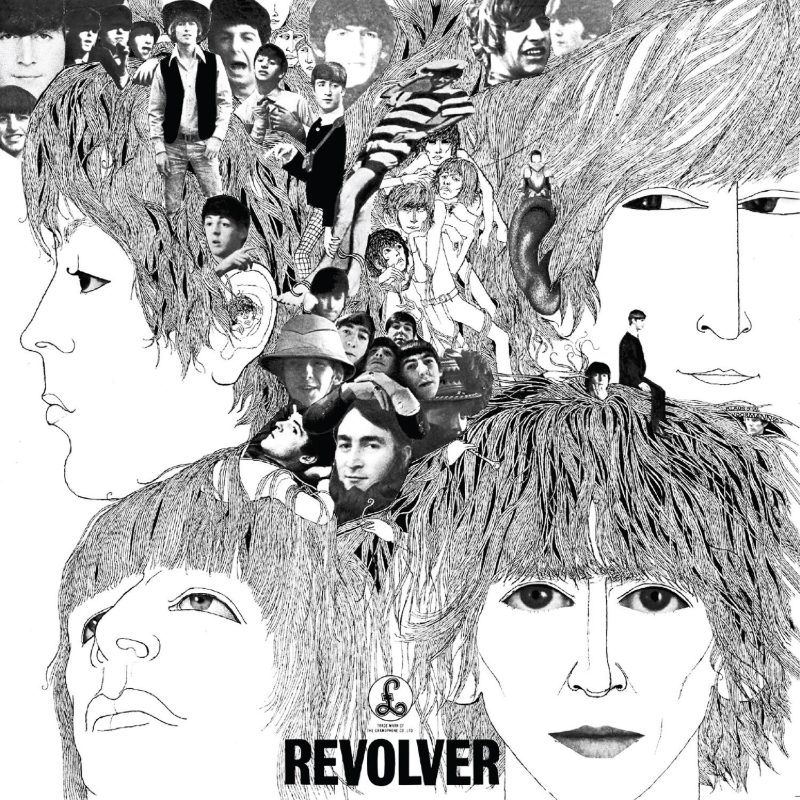
№ 3 of 100
Revolver
Revolver by The Beatles (1966), № 3 in The Lead-In’s 100 greatest albums. If you ever wonder why your favorite indie band sounds the way it does, the answer is usually somewhere on side two of this record.
Revolver by The Beatles (1966), № 3 in The Lead-In’s 100 greatest albums. If you ever wonder why your favorite indie band sounds the way it does, the answer is usually somewhere on side two of this record.
The album where the Beatles stopped being a band that toured and started being a studio. Five months after Rubber Soul. Two months before they performed live for the last time. Everything they would do for the next four years started here.
They had three months between sessions. They'd quit touring in everything but name. They were taking drugs they hadn't been taking three months earlier. They had stopped trying to sound like a band that could be reproduced on stage. The album they made is the most concentrated single-LP demonstration of the Beatles' rate of change.
The recording sessions for Revolver ran from April 6 to June 22, 1966, at EMI Studios on Abbey Road in St John's Wood. The Beatles had finished Rubber Soul in December of the previous year. In the intervening 16 weeks, John Lennon and George Harrison had both taken LSD for the first time (or in Lennon's case, for the first time intentionally); Paul McCartney had been immersing himself in Stockhausen, John Cage, and the Italian avant-garde via the apartment of his then-girlfriend Jane Asher's brother; and Brian Wilson had released Pet Sounds in mid-May, 3 weeks into the sessions. They were halfway through making Revolver when they heard the album most directly aimed at them. They were already ahead.
The first song they recorded was 'Tomorrow Never Knows.' Take one was April 6. The song would eventually appear as the final track on the UK album, but it was the first sound the band committed to tape after Rubber Soul. Lennon had written it from a copy of The Psychedelic Experience by Timothy Leary, Ralph Metzner, and Richard Alpert (later Ram Dass), which was itself a paraphrase of the Tibetan Book of the Dead. He wanted his vocal to sound like the Dalai Lama chanting from a Himalayan mountaintop. Geoff Emerick, the 19-year-old engineer assigned to the sessions, suggested running Lennon's voice through a rotating Leslie speaker, the kind built into a Hammond organ. It had never been done with a vocal in pop. Lennon agreed, then said it should be done in the second half of the song so the listener would notice the change. The first half he sang plainly. The Leslie made the second half sound, accurately, like a different person was singing.
Then Paul made the loops. Five tape loops, one per Beatle plus Emerick, McCartney brought them in from his home, where he'd been making them on a half-inch reel-to-reel for months as an Asher-and-friends parlor amusement. The loops included a sped-up sitar from the previous year's George Harrison sessions, a McCartney laugh slowed and reversed, an orchestral chord from a Sibelius LP, and at least one bass figure run backward. Five engineers held the loops in playback as faders, riding them up and down across the second half of the song. The drum track was Ringo Starr's, recorded with the snare strings taped flat to a piece of cardboard inside the drum (also Emerick's idea), then heavily compressed and limited until the kit sounded, Emerick later said, like it was being played in a tunnel. There was no song like this on Pet Sounds. There was no song like this anywhere.
By June, they had decided to do what they'd been threatening to do for a year: stop performing. Revolver was the first Beatles album whose sounds couldn't be reproduced on a stage. The last full concert the band would ever play was August 29, 1966, at Candlestick Park in San Francisco. Revolver had been out for 3 weeks. The single 'Eleanor Rigby' / 'Yellow Submarine' was at number one in both the UK and the US. They didn't play either song live. The string octet that frames 'Eleanor Rigby' (scored by George Martin, with no Beatles audible on the track at all except McCartney's vocal) cannot be carried by four men and a drum kit. Neither can the eight-track speed-up on 'I'm Only Sleeping,' the backwards lead guitar on 'I'm Only Sleeping,' the brass band on 'Got to Get You into My Life,' the Indian classical ensemble on 'Love You To,' or the rotating Leslie vocal on 'Tomorrow Never Knows.' Within the album, the Beatles ceased to be a four-piece. The studio became the fifth member, and they would never demote it again.
What pushes Revolver past the rest of the Beatles' run is that the four are still equal here. Lennon writes 'I'm Only Sleeping' and 'And Your Bird Can Sing' and 'She Said She Said' and the closing 'Tomorrow Never Knows.' McCartney writes 'Eleanor Rigby' and 'Here, There and Everywhere' and 'Good Day Sunshine' and 'For No One' and 'Got to Get You into My Life.' Harrison writes three songs, his largest single-LP share of the catalogue, and one of them, 'Taxman,' is the album's opener and the most aggressive piece of guitar pop the band ever recorded. Starr sings 'Yellow Submarine.' The vocal arrangement is collective: Lennon and McCartney harmonize on McCartney songs and McCartney harmonizes Lennon's. By Sgt. Pepper, ten months later, this democracy had begun to fracture. By the White Album it was gone. Revolver is the last album on which all four Beatles are reaching for the same record.
It is also the band's last great pop album. Sgt. Pepper is a concept and an event; Revolver is a collection of songs. Every track is two-and-a-half to 3 minutes long. Every track has hooks. 'Eleanor Rigby' opens with a string figure most listeners can hum from memory; 'For No One' has a French horn solo by Alan Civil, first chair of the BBC Symphony, that is the most-quoted classical instrumental break in pop. 'I'm Only Sleeping' has the first commercial use of reverse guitar (Harrison played the part forward, then asked Geoff Emerick to flip the tape, then memorized the reverse phrasing and re-played it, then they used the original reverse take anyway). 'Got to Get You into My Life' is McCartney's Motown song, three years before the Funk Brothers played on 'What's Going On.' Side two opens with Harrison's 'Love You To,' the first major-label pop song built around Indian classical instrumentation as primary instrumentation rather than ornament. Each of these decisions, taken in isolation, would have been the most adventurous thing on a typical 1966 album.
The American release excised three Lennon songs ('I'm Only Sleeping,' 'And Your Bird Can Sing,' 'Doctor Robert') because Capitol had already put them on Yesterday and Today, the US-only compilation released in June. American listeners in 1966 heard an eleven-track Revolver that erased a third of Lennon's contribution. It is one of the great editorial atrocities of the era. The album was restored to its UK sequence only in 1987, when EMI standardized the catalogue worldwide on CD. Anyone who came up on the eleven-track Revolver, and that is millions of Americans, heard a fundamentally different record. The album we are ranking is the UK fourteen-track. That distinction matters.
Revolver belongs at #3 because it is the album that changed how pop albums were made and what they could be. Pet Sounds opened the door; Revolver kicked it down. The Beatles would never sound like a band again, they would sound like a studio with four songwriters in it. Within twelve months they had retreated into Sgt. Pepper, which is a more famous record and a more theatrical one; within twenty-four they had begun to fracture; within four years they had broken up. Revolver is the last moment they sounded like the future was theirs and they were unhurried about claiming it. What's Going On and Pet Sounds rank above it on this list because they are heavier in subject; Revolver is lighter, but it is the most prophetic of the three. Every studio-built pop album made between August 1966 and last Tuesday is downstream.
Original UK mono pressing, Parlophone PMC 7009, on the yellow-and-black label. The true first state is identified by side two's matrix XEX 606-1, which carries the withdrawn 'Remix 11' of 'Tomorrow Never Knows'—an early mix quickly replaced, making the 'first-state' copies the prize rather than any generic 'loud cut'. The pairing to look for is XEX 605 / XEX 606 in the deadwax with low '-1' stamper numbers. There is no gatefold: the original is a single flipback sleeve with Klaus Voormann's pen-and-collage cover.
© The Lead-In · an independent, reader-supported music publication.