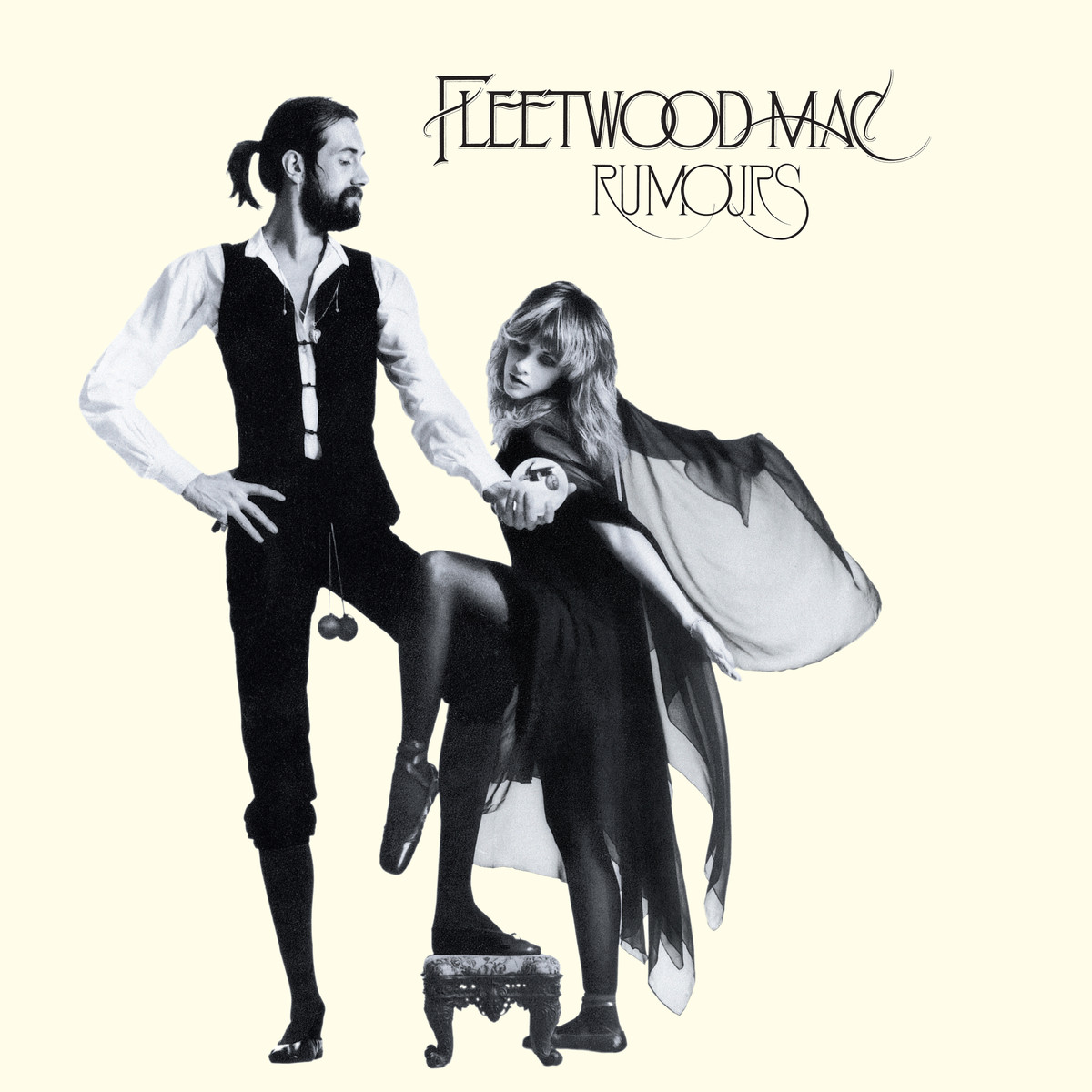
Fleetwood Mac in 1976, every band member sleeping with someone else's partner. The album that documented the relationship collapses in real time. Released February 4, 1977. Forty million sold.
- Released
- February 4, 1977
- Label
- Warner Bros.
- Producer(s)
- Fleetwood Mac · Ken Caillat · Richard Dashut
- Runtime
- 39:43 (11 tracks)
- Chart peak (US)
- #1 (Billboard 200, 31 weeks)
- Chart peak (UK)
- #1 (Record Retailer, 1 week)
- Certifications
- Diamond, 20× Platinum (RIAA); 40M units globally
- Awards & honours
- Grammy Album of the Year (1978); Library of Congress National Recording Registry (2018); ranked #7 on Rolling Stone's 500 Greatest Albums (2020)
Eleven months at the Record Plant in Sausalito and at five subsequent studios across California with five musicians whose marriages and relationships were collapsing in real time. Eleven tracks across 39 minutes. The album that turned Fleetwood Mac, a long-running British blues-rock band reconstituted in California with two new American members, into one of the bestselling rock acts of the postwar era, and the album that proved a touring rock band could record its own internal disintegration and sell forty million copies of the document.
Fleetwood Mac had been founded in London in 1967 by Peter Green, Mick Fleetwood, and John McVie. By 1974 the band had churned through multiple lineups, lost three guitarists to mental-health crises (Green in 1970, Jeremy Spencer to a religious cult in 1971, Bob Welch's departure in late 1974), and reconstituted in Los Angeles as a different proposition entirely. The reconstituted lineup added two American musicians, guitarist Lindsey Buckingham and singer Stevie Nicks, who had been recording together as Buckingham Nicks since 1973. The first record by the new five-piece, Fleetwood Mac (July 1975), was the band's commercial breakthrough: it eventually sold over 5 million copies and reached US #1. The Rumours sessions began as the follow-up, in February 1976, with no specific expectation that the album would do anything other than confirm what Fleetwood Mac had established.
By the time recording began at the Record Plant in Sausalito in February 1976, the band's internal personal relationships were in active collapse. John and Christine McVie's marriage had ended at the start of the year. Lindsey Buckingham and Stevie Nicks had been romantically involved since 1973 and broke up during the early sessions; both continued to share studio space and stage with each other for the next forty years. Mick Fleetwood's marriage to Jenny Boyd (sister of George Harrison's first wife, Pattie) had collapsed during the recording period; Fleetwood would later have an affair with Nicks. The album was therefore recorded by five musicians who were processing the ends of three of their major romantic relationships, with each musician writing songs partly addressed to other musicians in the same room. The deliberate structural decision to keep recording, rather than disbanding or rotating personnel, became the album's defining condition.
Recording extended from February 1976 to November 1976, an unusually long period for a 1976 rock album. The principal location was the Record Plant in Sausalito, north of San Francisco, chosen for its isolation, its 24-track facility, and Fleetwood's preference for the Sausalito Bay marina lifestyle. Engineer Ken Caillat and engineer-producer Richard Dashut were brought in to co-produce alongside the band itself; the formal credits read 'Produced by Fleetwood Mac with Richard Dashut and Ken Caillat.' Cocaine use was, by all subsequent band-member accounts, extensive throughout, Fleetwood and Stevie Nicks have both written autobiographically about this period in terms that have made the cocaine consumption part of the album's mythology. The session musicians on Rumours are exclusively the five band members; there are no outside players. Every instrument is played by one of Buckingham, Nicks, Christine McVie, John McVie, or Fleetwood.
The songwriting is structured as a direct conversation between band members. Buckingham's 'Go Your Own Way' is widely understood to be about Nicks; Nicks's 'Dreams' is about Buckingham; Christine McVie's 'Don't Stop' is the marital-optimism manifesto delivered by the marriage's surviving optimist; her 'You Make Loving Fun' is about the keyboardist she was newly involved with during the sessions, lyrics written so that they could plausibly be sung to John McVie (her ex-husband) in his presence. The band recorded these confessions together, in real time. Mick Fleetwood has described in his autobiography sitting at the drum kit listening to lyrics about himself or about other band members and continuing to play the appropriate parts. The album's specific emotional weight is the document of this process.
Mixing took place at Wally Heider Studios in Los Angeles in autumn 1976; final mastering was at the Mastering Lab in Hollywood by Ken Perry. The album was released on February 4, 1977. The lead single, 'Go Your Own Way' (Buckingham), had been released in December 1976 and was already on FM rotation by the album release date. 'Dreams' (Nicks) followed in April 1977 and became the band's only US #1 single, holding the top spot for one week in June. 'Don't Stop' (Christine McVie) was the third single. The album entered the Billboard 200 at #10, climbed to #1 by April 1977, and stayed at #1 for 31 consecutive weeks, at the time, the longest run by any rock album in chart history that wasn't a soundtrack. Rumours sold 10 million copies in its first year, 40 million across its lifetime, and remains one of the bestselling rock albums in history.
The 1978 Grammy Awards were the institutional ratification. Rumours won Album of the Year, the first album by a rock band with no individual member credited as 'artist of the year' to win the category. The band toured the album from April 1977 through August 1977; the tour was conducted under conditions where band members weren't on speaking terms outside performance contexts. Christine McVie and Stevie Nicks shared dressing rooms but separate hotels; Buckingham and Nicks performed 'Go Your Own Way' as a duet nightly. The deliberate decision to tour the album immediately, despite the personal conditions, produced the live-performance reputation the band has lived off for forty-seven years. Lindsey Buckingham didn't formally leave Fleetwood Mac until 1987; Stevie Nicks remained in the band continuously; Christine McVie left in 1998, returned in 2014, and remained until her death in 2022. The lineup that recorded Rumours toured together regularly through 2018.
Rumours belongs at #36 because it is the album that proved a working rock band could record its own internal collapse, sell forty million copies of the recording, and continue working together for decades after. The specific circumstances, two couples ending simultaneously while writing about each other in the same album for the same band, would never be replicated at the same commercial scale. The album's 31 weeks at US #1 made it the longest-running #1 album by a non-soundtrack of the entire 1970s. The band's decision to keep working despite the personal conditions produced the live-touring reputation that has sustained Fleetwood Mac for five decades. The Library of Congress added Rumours to the National Recording Registry in 2018. The album is a permanent argument that art can be made from, and within, conditions that should make art impossible, and that the document of those conditions, made carefully and at the highest production register, can outsell almost everything around it.
Pressing guide — the one to own
1977 US first pressing, Warner Bros. BSK 3010 with the original gatefold sleeve showing the famous Herbie Worthington photograph of Stevie Nicks (in shawl, pointing) and Mick Fleetwood (standing behind in waistcoat, with two wooden balls hanging from his belt). Look for the matrix etchings BSK 3010-A1 / B1, hand-etched at Warner's Burbank facility by Lee Hulko. The earliest US pressings have the inner sleeve with the full lyric sheet printed on textured paper; later pressings (mid-1977 onward) used smooth-finish inner sleeve stock.